 Add to Chrome
 Add to Firefox
 Add to Edge
Wireless Large AI Model: Shaping the AI-Native Future of 6G and Beyond
Apr 20, 2025
The emergence of sixth-generation and beyond communication systems is expected to fundamentally transform digital experiences through introducing unparalleled levels of intelligence, efficiency, and connectivity. A promising technology poised to enable this revolutionary vision is the wireless large AI model (WLAM), characterized by its exceptional capabilities in data processing, inference, and decision-making. In light of these remarkable capabilities, this paper provides a comprehensive survey of WLAM, elucidating its fundamental principles, diverse applications, critical challenges, and future research opportunities. We begin by introducing the background of WLAM and analyzing the key synergies with wireless networks, emphasizing the mutual benefits. Subsequently, we explore the foundational characteristics of WLAM, delving into their unique relevance in wireless environments. Then, the role of WLAM in optimizing wireless communication systems across various use cases and the reciprocal benefits are systematically investigated. Furthermore, we discuss the integration of WLAM with emerging technologies, highlighting their potential to enable transformative capabilities and breakthroughs in wireless communication. Finally, we thoroughly examine the high-level challenges hindering the practical implementation of WLAM and discuss pivotal future research directions.

Network Slicing for eMBB, URLLC, and mMTC: An Uplink Rate-Splitting Multiple Access Approach
Aug 23, 2022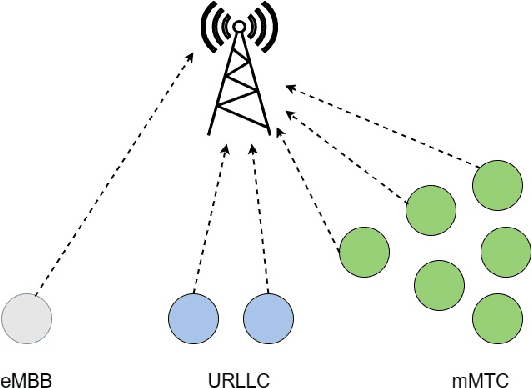
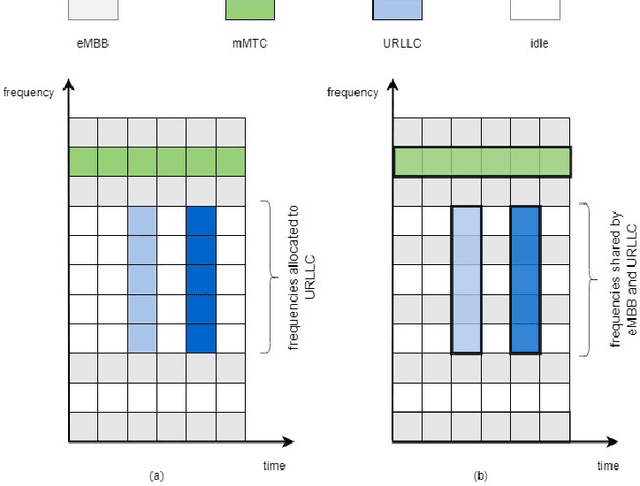
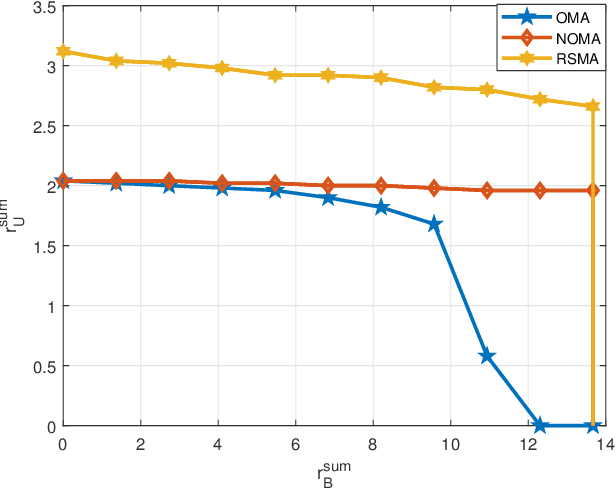
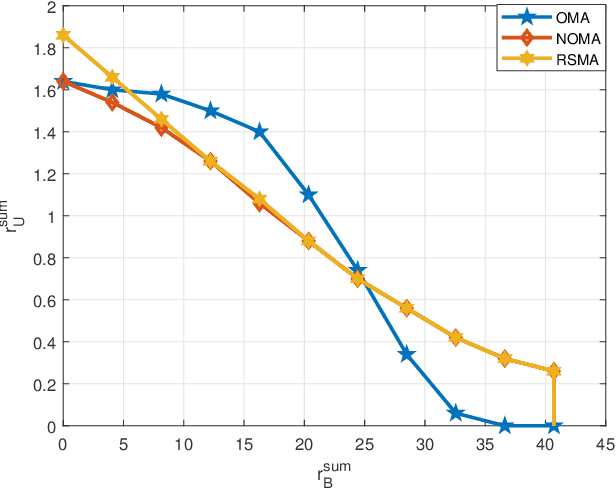
There are three generic services in 5G: enhanced mobile broadband (eMBB), ultra-reliable low-latency communications (URLLC), and massive machine-type communications (mMTC). To guarantee the performance of heterogeneous services, network slicing is proposed to allocate resources to different services. Network slicing is typically done in an orthogonal multiple access (OMA) fashion, which means different services are allocated non-interfering resources. However, as the number of users grows, OMA-based slicing is not always optimal, and a non-orthogonal scheme may achieve a better performance. This work aims to analyse the performances of different slicing schemes in uplink, and a promising scheme based on rate-splitting multiple access (RSMA) is studied. RSMA can provide a more flexible decoding order and theoretically has the largest achievable rate region than OMA and non-orthogonal multiple access (NOMA) without time-sharing. Hence, RSMA has the potential to increase the rate of users requiring different services. In addition, it is not necessary to decode the two split streams of one user successively, so RSMA lets suitable users split messages and designs an appropriate decoding order depending on the service requirements. This work shows that for network slicing RSMA can outperform NOMA counterpart, and obtain significant gains over OMA in some region.