 Add to Chrome
 Add to Firefox
 Add to Edge
ASI-Bench: At the Dawn of Artificial Superintelligence
Aug 18, 2026
Artificial superintelligence (ASI) requires AI to move beyond mastering existing knowledge toward exploring the unknown, creating new knowledge, and turning new ideas into verifiable results. However, the capabilities of today's AI systems are still largely built on learning, compressing, and applying existing human knowledge. Accordingly, existing benchmarks primarily test whether AI can produce correct answers based on learned knowledge, or whether it can complete tasks under extensive human guidance. We therefore introduce ASI-Bench, the first benchmark to jointly evaluate AI systems' capabilities of innovative exploration and autonomous scientific execution across general research domains, and the first to progressively withdraw human methodological guidance within the same research project to test how far AI can proceed on its own. Built by over 40 experts with the cost of 31,000+ human hours, ASI-Bench contains 60 project-level research tasks across 11 scientific domains and progressively reduces methodological guidance to test whether AI can independently select methods, conduct research, and produce verifiable results. All tasks undergo expert review, AI-assisted auditing, sandbox execution, and scorer validation. Across 18 state-of-the-art agent--model configurations, the average score drops from 50.91 with full methodological guidance to 29.10 with only the method specified and 26.62 when agents must determine the method themselves. This sharp decline shows that current systems remain heavily dependent on human guidance and are still far from autonomously conducting end-to-end, project-level scientific research. ASI-Bench is open to the world. We invite researchers and builders everywhere to contribute new tasks, challenge the limits of today's AI, and help accelerate humanity's collective path toward artificial superintelligence at https://asibench.apexin.ai/submit.

Are We on the Right Way to Assessing LLM-as-a-Judge?
Dec 17, 2025LLM-as-a-Judge has been widely adopted as an evaluation method and served as supervised rewards in model training. However, existing benchmarks for LLM-as-a-Judge are mainly relying on human-annotated ground truth, which introduces human bias that undermines the assessment of reliability and imposes scalability constraints. To overcome these limitations, we introduce Sage, a novel evaluation suite that assesses the quality of LLM judges without necessitating any human annotation. Inspired by axioms of rational choice theory, Sage introduces two new lenses for measuring LLM-as-a-Judge: local self-consistency (pair-wise preference stability) and global logical consistency (transitivity across a full set of preferences). We curate a dataset of 650 questions by combining structured benchmark problems with real-world user queries. Our experiments demonstrate both the stability of our metrics and their high correlation with supervised benchmarks like LLMBar and RewardBench2, confirming Sage's reliability as an evaluation suite for the robustness and accuracy of LLM-as-a-Judge. Based on Sage, we reveal that current state-of-the-art LLMs exhibit significant reliability problems when acting as judges in both scoring and pairwise settings; even the top-performing models, Gemini-2.5-Pro and GPT-5, fail to maintain consistent preferences in nearly a quarter of difficult cases. We attribute this to a new phenomenon called situational preference, which explains why explicit rubrics or criteria can help the model judge consistently across answer pairs. Our further analysis shows that finetuned LLM-as-a-Judge is a feasible method to boost performance, and the panel-based judge as well as deep reasoning can enhance the judging consistency. We also find substantial inconsistency in human judgments, which indicates that human annotation may not be a reliable gold standard.
Wait, We Don't Need to "Wait"! Removing Thinking Tokens Improves Reasoning Efficiency
Jun 10, 2025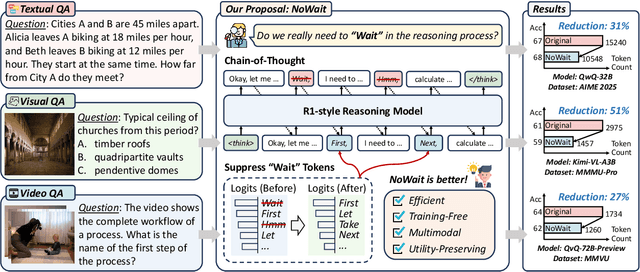

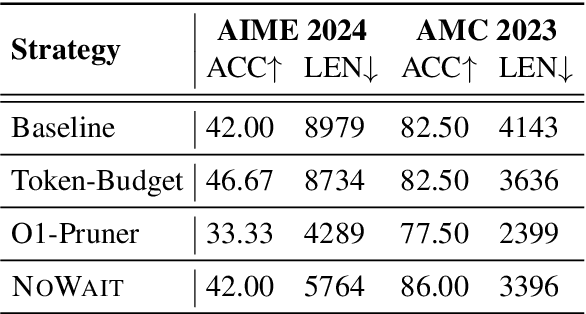
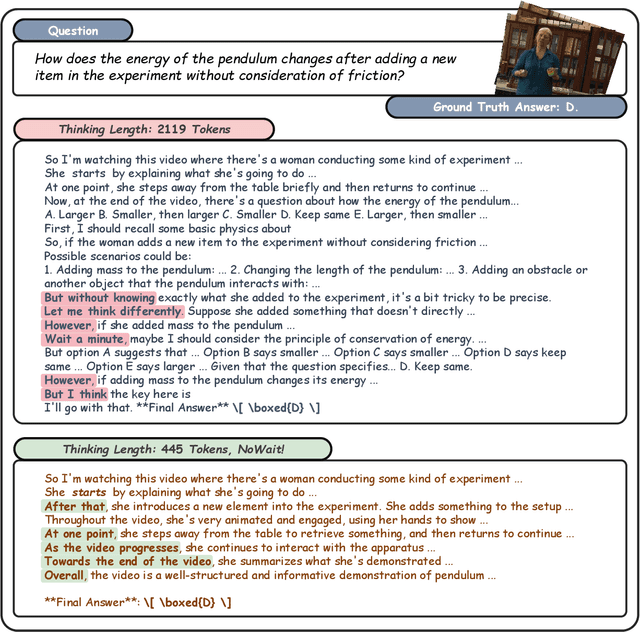
Recent advances in large reasoning models have enabled complex, step-by-step reasoning but often introduce significant overthinking, resulting in verbose and redundant outputs that hinder efficiency. In this study, we examine whether explicit self-reflection, signaled by tokens such as "Wait" and "Hmm", is necessary for advanced reasoning. We propose NoWait, a simple yet effective approach that disables explicit self-reflection by suppressing these tokens during inference. Extensive experiments on ten benchmarks across textual, visual, and video reasoning tasks show that NoWait reduces chain-of-thought trajectory length by up to 27%-51% in five R1-style model series, without compromising model utility. NoWait thus offers a plug-and-play solution for efficient and utility-preserving multimodal reasoning.