 Add to Chrome
 Add to Firefox
 Add to Edge
DAVOS: An Autonomous Vehicle Operating System in the Vehicle Computing Era
Jan 08, 2026
Vehicle computing represents a fundamental shift in how autonomous vehicles are designed and deployed, transforming them from isolated transportation systems into mobile computing platforms that support both safety-critical, real-time driving and data-centric services. In this setting, vehicles simultaneously support real-time driving pipelines and a growing set of data-driven applications, placing increased responsibility on the vehicle operating system to coordinate computation, data movement, storage, and access. These demands highlight recurring system considerations related to predictable execution, data and execution protection, efficient handling of high-rate sensor data, and long-term system evolvability, commonly summarized as Safety, Security, Efficiency, and Extensibility (SSEE). Existing vehicle operating systems and runtimes address these concerns in isolation, resulting in fragmented software stacks that limit coordination between autonomy workloads and vehicle data services. This paper presents DAVOS, the Delaware Autonomous Vehicle Operating System, a unified vehicle operating system architecture designed for the vehicle computing context. DAVOS provides a cohesive operating system foundation that supports both real-time autonomy and extensible vehicle computing within a single system framework.

CARScenes: Semantic VLM Dataset for Safe Autonomous Driving
Nov 18, 2025CAR-Scenes is a frame-level dataset for autonomous driving that enables training and evaluation of vision-language models (VLMs) for interpretable, scene-level understanding. We annotate 5,192 images drawn from Argoverse 1, Cityscapes, KITTI, and nuScenes using a 28-key category/sub-category knowledge base covering environment, road geometry, background-vehicle behavior, ego-vehicle behavior, vulnerable road users, sensor states, and a discrete severity scale (1-10), totaling 350+ leaf attributes. Labels are produced by a GPT-4o-assisted vision-language pipeline with human-in-the-loop verification; we release the exact prompts, post-processing rules, and per-field baseline model performance. CAR-Scenes also provides attribute co-occurrence graphs and JSONL records that support semantic retrieval, dataset triage, and risk-aware scenario mining across sources. To calibrate task difficulty, we include reproducible, non-benchmark baselines, notably a LoRA-tuned Qwen2-VL-2B with deterministic decoding, evaluated via scalar accuracy, micro-averaged F1 for list attributes, and severity MAE/RMSE on a fixed validation split. We publicly release the annotation and analysis scripts, including graph construction and evaluation scripts, to enable explainable, data-centric workflows for future intelligent vehicles. Dataset: https://github.com/Croquembouche/CAR-Scenes
An Advanced Framework for Ultra-Realistic Simulation and Digital Twinning for Autonomous Vehicles
May 02, 2024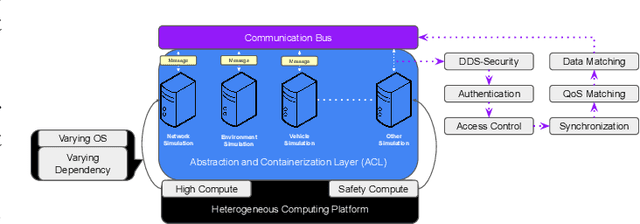
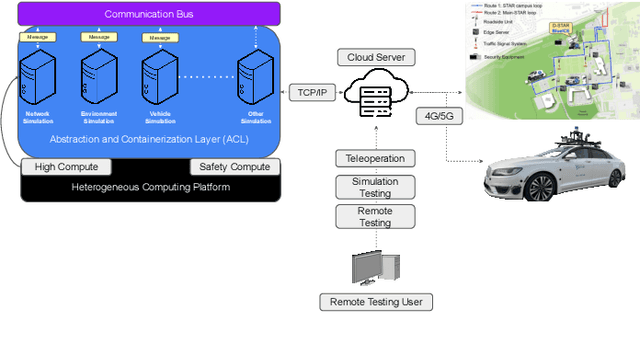
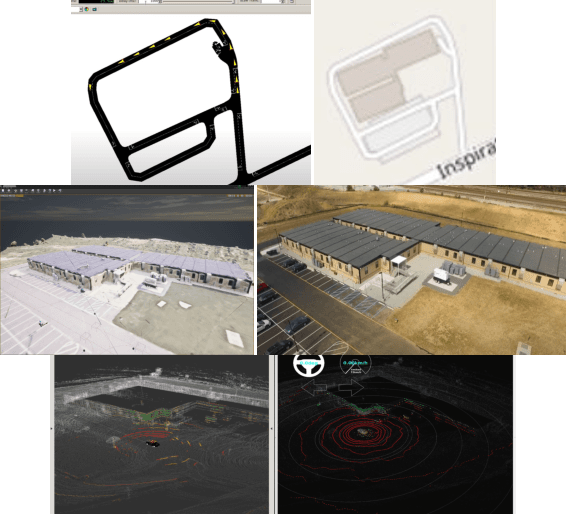
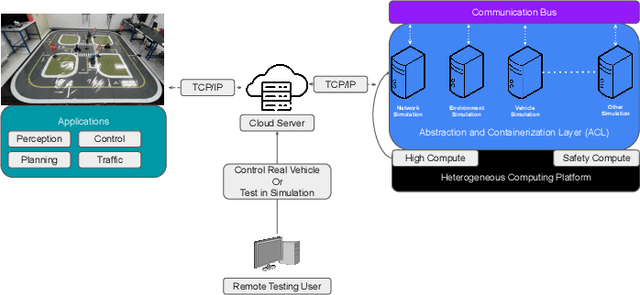
Simulation is a fundamental tool in developing autonomous vehicles, enabling rigorous testing without the logistical and safety challenges associated with real-world trials. As autonomous vehicle technologies evolve and public safety demands increase, advanced, realistic simulation frameworks are critical. Current testing paradigms employ a mix of general-purpose and specialized simulators, such as CARLA and IVRESS, to achieve high-fidelity results. However, these tools often struggle with compatibility due to differing platform, hardware, and software requirements, severely hampering their combined effectiveness. This paper introduces BlueICE, an advanced framework for ultra-realistic simulation and digital twinning, to address these challenges. BlueICE's innovative architecture allows for the decoupling of computing platforms, hardware, and software dependencies while offering researchers customizable testing environments to meet diverse fidelity needs. Key features include containerization to ensure compatibility across different systems, a unified communication bridge for seamless integration of various simulation tools, and synchronized orchestration of input and output across simulators. This framework facilitates the development of sophisticated digital twins for autonomous vehicle testing and sets a new standard in simulation accuracy and flexibility. The paper further explores the application of BlueICE in two distinct case studies: the ICAT indoor testbed and the STAR campus outdoor testbed at the University of Delaware. These case studies demonstrate BlueICE's capability to create sophisticated digital twins for autonomous vehicle testing and underline its potential as a standardized testbed for future autonomous driving technologies.