 Add to Chrome
 Add to Firefox
 Add to Edge
MR-IQA-2: Faithful Image Quality Reflection via Fine-Grained Credit Assignment
Aug 19, 2026
Multimodal large language models (MLLMs) have shown strong potential for image quality assessment (IQA) by improving consistency between quality ratings and their underlying reasoning. However, most approaches supervise reasoning through human-provided ratings and rarely examine whether it faithfully reflects image quality. Rating accuracy alone does not ensure faithful reasoning; a shared reward also obscures supervision sources and may reinforce unfaithful reasoning when a correct rating occurs by chance. To improve the faithfulness and reliability of blind IQA, we aim to (1) decouple credit assignment for reasoning and rating and (2) provide verifiable supervision for faithful reasoning. We introduce MR-IQA-2, an actor-editor-judge framework that operationalizes reasoning-editing-reflection. The actor generates quality reasoning for an input image, and the editor revises the image according to the identified quality factors. A frozen judge compares the original and edited images and provides reflective supervision for the actor's reasoning. MR-IQA-2 further uses fine-grained credit assignment to decouple reasoning and rating supervision. Judge feedback supervises reasoning, whereas human ratings supervise the predicted rating. Masked token-specific updates distinguish these signals while preserving the causal relation from reasoning to rating. Across IQA benchmarks, MR-IQA-2 achieves competitive rating alignment with humans. Visual reflection also enables richer and more faithful visual understanding beyond rating, which may inform image-quality optimization and related downstream tasks. Code is available at https://github.com/RobinY99/MR-IQA-2.

MR-IQA: A Unified Margin View of Regression and Ranking for Blind Image Quality Assessment
Jun 30, 2026Blind image quality assessment (BIQA) is commonly built on two basic learning paradigms: regression and ranking. Regression calibrates absolute scores, whereas ranking recovers quality structure from ordinal relations. Although joint regression-ranking supervision often improves BIQA, the relation between the two paradigms remains largely empirical and underexplored. In this work, we revisit what underlies regression and ranking and identify pairwise relational distance, termed quality margin, as their common bridge. Our derivation shows that, at the objective-optimization level, both paradigms fit quality margins: regression fits margins induced by score endpoints, while ranking fits transformed or sign-level margins through preference probabilities. Motivated by this insight, we propose MR-IQA, a direct quality-margin optimization framework for reinforcement learning (RL)-based BIQA. MR-IQA samples quality scores and optimizes pairwise margin errors as policy rewards, thereby modeling quality structure more explicitly. Experiments on six BIQA benchmarks show competitive general performance, and controlled comparisons demonstrate that MR-IQA achieves the strongest average PLCC/SRCC over regression- or ranking-based RL methods. Our findings provide a new insight into unifying regression and ranking, offering a theoretical basis for understanding quality-structure modeling in BIQA and beyond. Code is available at https://github.com/RobinY99/MR-IQA.
Guiding Perception-Reasoning Closer to Human in Blind Image Quality Assessment
Dec 18, 2025Humans assess image quality through a perception-reasoning cascade, integrating sensory cues with implicit reasoning to form self-consistent judgments. In this work, we investigate how a model can acquire both human-like and self-consistent reasoning capability for blind image quality assessment (BIQA). We first collect human evaluation data that capture several aspects of human perception-reasoning pipeline. Then, we adopt reinforcement learning, using human annotations as reward signals to guide the model toward human-like perception and reasoning. To enable the model to internalize self-consistent reasoning capability, we design a reward that drives the model to infer the image quality purely from self-generated descriptions. Empirically, our approach achieves score prediction performance comparable to state-of-the-art BIQA systems under general metrics, including Pearson and Spearman correlation coefficients. In addition to the rating score, we assess human-model alignment using ROUGE-1 to measure the similarity between model-generated and human perception-reasoning chains. On over 1,000 human-annotated samples, our model reaches a ROUGE-1 score of 0.512 (cf. 0.443 for baseline), indicating substantial coverage of human explanations and marking a step toward human-like interpretable reasoning in BIQA.
Language Model-Driven Unsupervised Neural Machine Translation
Nov 10, 2019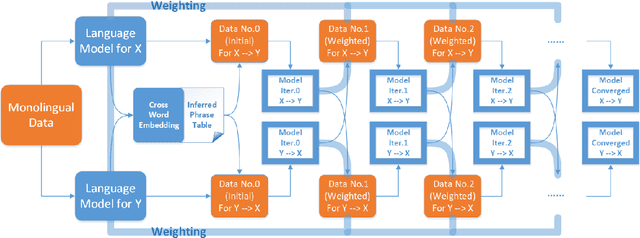
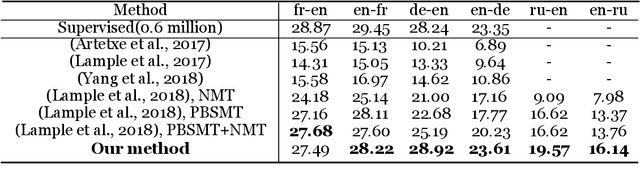
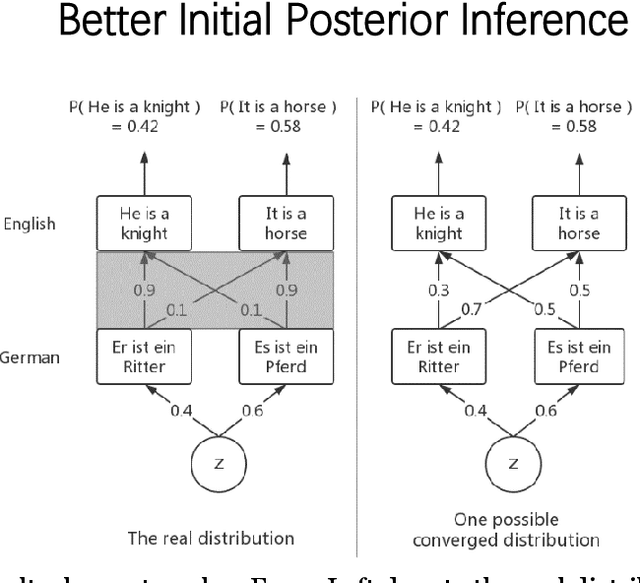
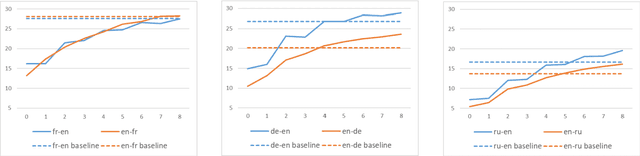
Unsupervised neural machine translation(NMT) is associated with noise and errors in synthetic data when executing vanilla back-translations. Here, we explicitly exploits language model(LM) to drive construction of an unsupervised NMT system. This features two steps. First, we initialize NMT models using synthetic data generated via temporary statistical machine translation(SMT). Second, unlike vanilla back-translation, we formulate a weight function, that scores synthetic data at each step of subsequent iterative training; this allows unsupervised training to an improved outcome. We present the detailed mathematical construction of our method. Experimental WMT2014 English-French, and WMT2016 English-German and English-Russian translation tasks revealed that our method outperforms the best prior systems by more than 3 BLEU points.