 Add to Chrome
 Add to Firefox
 Add to Edge
MMCAformer: Macro-Micro Cross-Attention Transformer for Traffic Speed Prediction with Microscopic Connected Vehicle Driving Behavior
Feb 17, 2026
Accurate speed prediction is crucial for proactive traffic management to enhance traffic efficiency and safety. Existing studies have primarily relied on aggregated, macroscopic traffic flow data to predict future traffic trends, whereas road traffic dynamics are also influenced by individual, microscopic human driving behaviors. Recent Connected Vehicle (CV) data provide rich driving behavior features, offering new opportunities to incorporate these behavioral insights into speed prediction. To this end, we propose the Macro-Micro Cross-Attention Transformer (MMCAformer) to integrate CV data-based micro driving behavior features with macro traffic features for speed prediction. Specifically, MMCAformer employs self-attention to learn intrinsic dependencies in macro traffic flow and cross-attention to capture spatiotemporal interplays between macro traffic status and micro driving behavior. MMCAformer is optimized with a Student-t negative log-likelihood loss to provide point-wise speed prediction and estimate uncertainty. Experiments on four Florida freeways demonstrate the superior performance of the proposed MMCAformer compared to baselines. Compared with only using macro features, introducing micro driving behavior features not only enhances prediction accuracy (e.g., overall RMSE, MAE, and MAPE reduced by 9.0%, 6.9%, and 10.2%, respectively) but also shrinks model prediction uncertainty (e.g., mean predictive intervals decreased by 10.1-24.0% across the four freeways). Results reveal that hard braking and acceleration frequencies emerge as the most influential features. Such improvements are more pronounced under congested, low-speed traffic conditions.

Multi-view Structural Convolution Network for Domain-Invariant Point Cloud Recognition of Autonomous Vehicles
Jan 27, 2025
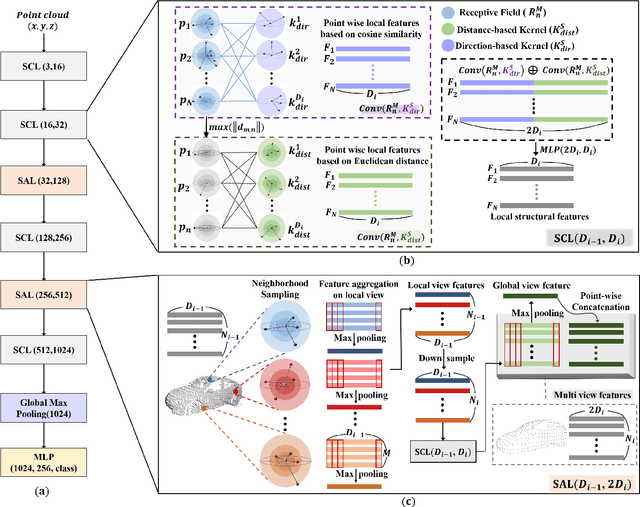
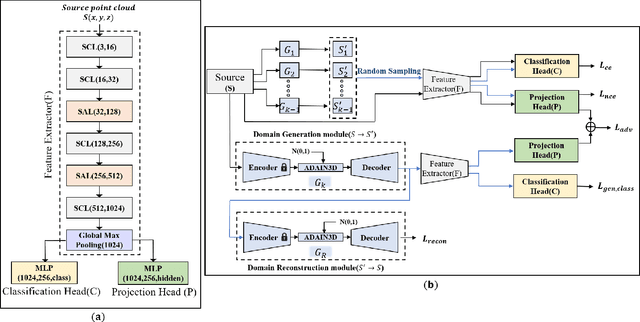
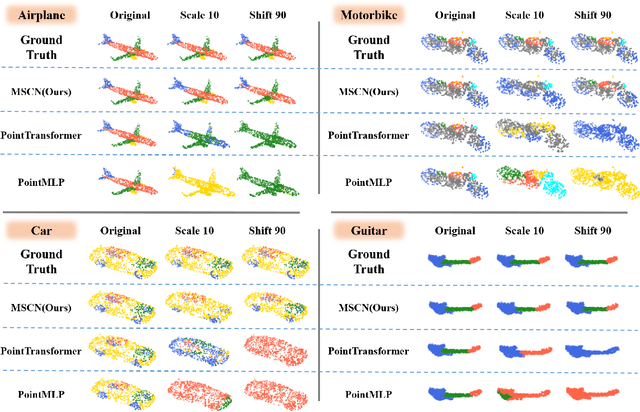
Point cloud representation has recently become a research hotspot in the field of computer vision and has been utilized for autonomous vehicles. However, adapting deep learning networks for point cloud data recognition is challenging due to the variability in datasets and sensor technologies. This variability underscores the necessity for adaptive techniques to maintain accuracy under different conditions. In this paper, we present the Multi-View Structural Convolution Network (MSCN) designed for domain-invariant point cloud recognition. MSCN comprises Structural Convolution Layers (SCL) that extract local context geometric features from point clouds and Structural Aggregation Layers (SAL) that extract and aggregate both local and overall context features from point clouds. Additionally, our MSCN enhances feature representation robustness by training with unseen domain point clouds derived from source domain point clouds. This method acquires domain-invariant features and exhibits robust, consistent performance across various point cloud datasets, ensuring compatibility with diverse sensor configurations without the need for parameter adjustments. This highlights MSCN's potential to significantly improve the reliability and domain invariant features in different environments. Our code is available at https://github.com/MLMLab/MSCN.
3D Adaptive Structural Convolution Network for Domain-Invariant Point Cloud Recognition
Jul 05, 2024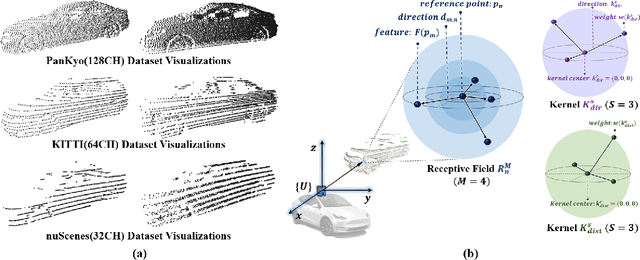

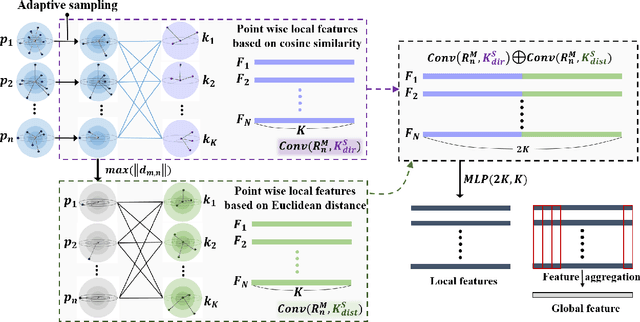
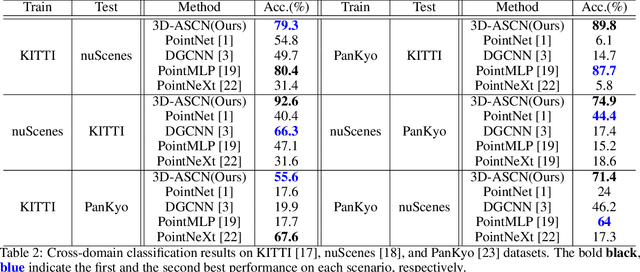
Adapting deep learning networks for point cloud data recognition in self-driving vehicles faces challenges due to the variability in datasets and sensor technologies, emphasizing the need for adaptive techniques to maintain accuracy across different conditions. In this paper, we introduce the 3D Adaptive Structural Convolution Network (3D-ASCN), a cutting-edge framework for 3D point cloud recognition. It combines 3D convolution kernels, a structural tree structure, and adaptive neighborhood sampling for effective geometric feature extraction. This method obtains domain-invariant features and demonstrates robust, adaptable performance on a variety of point cloud datasets, ensuring compatibility across diverse sensor configurations without the need for parameter adjustments. This highlights its potential to significantly enhance the reliability and efficiency of self-driving vehicle technology.