 Add to Chrome
 Add to Firefox
 Add to Edge
Order-Aware Test-Time Adaptation: Leveraging Temporal Dynamics for Robust Streaming Inference
Jan 28, 2026
Test-Time Adaptation (TTA) enables pre-trained models to adjust to distribution shift by learning from unlabeled test-time streams. However, existing methods typically treat these streams as independent samples, overlooking the supervisory signal inherent in temporal dynamics. To address this, we introduce Order-Aware Test-Time Adaptation (OATTA). We formulate test-time adaptation as a gradient-free recursive Bayesian estimation task, using a learned dynamic transition matrix as a temporal prior to refine the base model's predictions. To ensure safety in weakly structured streams, we introduce a likelihood-ratio gate (LLR) that reverts to the base predictor when temporal evidence is absent. OATTA is a lightweight, model-agnostic module that incurs negligible computational overhead. Extensive experiments across image classification, wearable and physiological signal analysis, and language sentiment analysis demonstrate its universality; OATTA consistently boosts established baselines, improving accuracy by up to 6.35%. Our findings establish that modeling temporal dynamics provides a critical, orthogonal signal beyond standard order-agnostic TTA approaches.

Chain-of-Image Generation: Toward Monitorable and Controllable Image Generation
Dec 09, 2025While state-of-the-art image generation models achieve remarkable visual quality, their internal generative processes remain a "black box." This opacity limits human observation and intervention, and poses a barrier to ensuring model reliability, safety, and control. Furthermore, their non-human-like workflows make them difficult for human observers to interpret. To address this, we introduce the Chain-of-Image Generation (CoIG) framework, which reframes image generation as a sequential, semantic process analogous to how humans create art. Similar to the advantages in monitorability and performance that Chain-of-Thought (CoT) brought to large language models (LLMs), CoIG can produce equivalent benefits in text-to-image generation. CoIG utilizes an LLM to decompose a complex prompt into a sequence of simple, step-by-step instructions. The image generation model then executes this plan by progressively generating and editing the image. Each step focuses on a single semantic entity, enabling direct monitoring. We formally assess this property using two novel metrics: CoIG Readability, which evaluates the clarity of each intermediate step via its corresponding output; and Causal Relevance, which quantifies the impact of each procedural step on the final generated image. We further show that our framework mitigates entity collapse by decomposing the complex generation task into simple subproblems, analogous to the procedural reasoning employed by CoT. Our experimental results indicate that CoIG substantially enhances quantitative monitorability while achieving competitive compositional robustness compared to established baseline models. The framework is model-agnostic and can be integrated with any image generation model.
Vision Transformers with Natural Language Semantics
Feb 27, 2024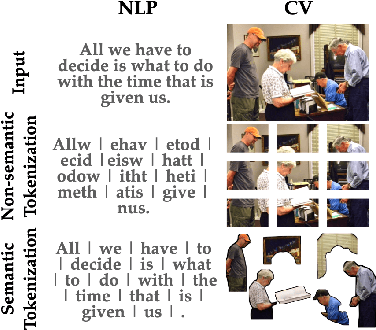


Tokens or patches within Vision Transformers (ViT) lack essential semantic information, unlike their counterparts in natural language processing (NLP). Typically, ViT tokens are associated with rectangular image patches that lack specific semantic context, making interpretation difficult and failing to effectively encapsulate information. We introduce a novel transformer model, Semantic Vision Transformers (sViT), which leverages recent progress on segmentation models to design novel tokenizer strategies. sViT effectively harnesses semantic information, creating an inductive bias reminiscent of convolutional neural networks while capturing global dependencies and contextual information within images that are characteristic of transformers. Through validation using real datasets, sViT demonstrates superiority over ViT, requiring less training data while maintaining similar or superior performance. Furthermore, sViT demonstrates significant superiority in out-of-distribution generalization and robustness to natural distribution shifts, attributed to its scale invariance semantic characteristic. Notably, the use of semantic tokens significantly enhances the model's interpretability. Lastly, the proposed paradigm facilitates the introduction of new and powerful augmentation techniques at the token (or segment) level, increasing training data diversity and generalization capabilities. Just as sentences are made of words, images are formed by semantic objects; our proposed methodology leverages recent progress in object segmentation and takes an important and natural step toward interpretable and robust vision transformers.