 Add to Chrome
 Add to Firefox
 Add to Edge
Stochastic Optimal Control Sampling for Diffusion Inverse Problems
Jun 27, 2026
Benefiting from the strong ability to capture data distributions, diffusion models have become powerful tools for solving image inverse problems. The key is to controllably steer the sampling trajectory toward the measurements while respecting the diffusion prior. In this work, we introduce Stochastic Optimal Control Sampling (SOCS), which models the denoising process as a dynamical system and injects control signals via SOC. Previous SOC-based approach addresses inverse problems by optimizing over the entire trajectory, which is computationally expensive. In contrast, we derive a closed-form control update and apply it at each sampling step, pulling the measurement-consistent clean prediction back onto the denoising flow. In SOCS, we can readily modulate the control strength to align with the diffusion model's native capabilities and thereby enhance perceptual quality. Our method is compatible with a variety of linear stochastic differential equation backbones. Extensive experiments across a broad spectrum of image inverse tasks demonstrate that SOCS achieves accurate measurement-aligned reconstructions with improved visual fidelity and stronger quantitative performance.

MUSO: Achieving Exact Machine Unlearning in Over-Parameterized Regimes
Oct 11, 2024
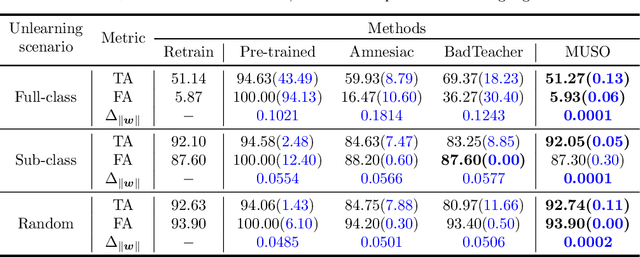
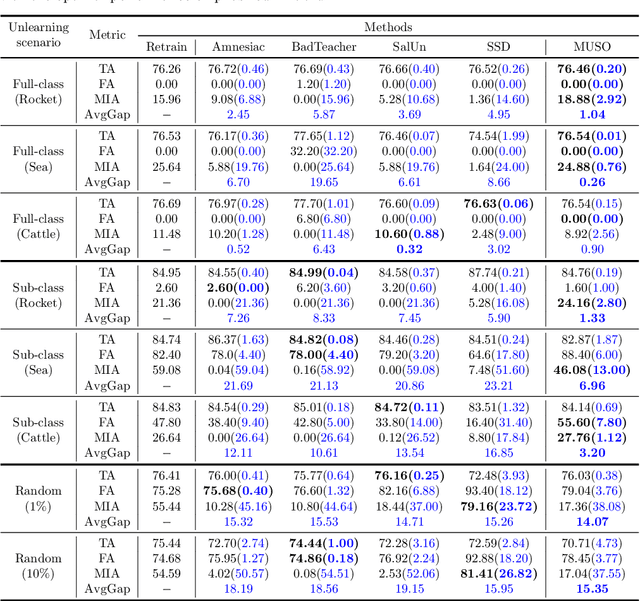
Machine unlearning (MU) is to make a well-trained model behave as if it had never been trained on specific data. In today's over-parameterized models, dominated by neural networks, a common approach is to manually relabel data and fine-tune the well-trained model. It can approximate the MU model in the output space, but the question remains whether it can achieve exact MU, i.e., in the parameter space. We answer this question by employing random feature techniques to construct an analytical framework. Under the premise of model optimization via stochastic gradient descent, we theoretically demonstrated that over-parameterized linear models can achieve exact MU through relabeling specific data. We also extend this work to real-world nonlinear networks and propose an alternating optimization algorithm that unifies the tasks of unlearning and relabeling. The algorithm's effectiveness, confirmed through numerical experiments, highlights its superior performance in unlearning across various scenarios compared to current state-of-the-art methods, particularly excelling over similar relabeling-based MU approaches.