 Add to Chrome
 Add to Firefox
 Add to Edge
BayesBench: Evaluating LLM Belief Trajectories Under Multi-Turn Evidence Accumulation
Jun 29, 2026
Large language models (LLMs) are typically deployed in multi-turn conversations, where each turn provides new evidence that should reduce epistemic uncertainty about their environment. Acting rationally then requires inferring the unobserved quantities that govern it and updating beliefs about them as evidence accumulates. Yet most evaluations only score the model's final-turn answer in a single-turn format, leaving this process unexamined. We ask how closely LLMs' belief updates match those of a rational Bayesian reasoner in multi-turn settings, and introduce BayesBench, a suite of simulation environments that probe this across three progressively complex tasks: (i) Bayesian estimation, where the model infers an unknown parameter from sequential evidence; (ii) Bayesian prediction, where the model turns inferred beliefs about a latent variable into outcome forecasts; and (iii) latent-framed Bayesian prediction, where observations are filtered through a user-persona framing, requiring joint inference over the latent state and the persona. Across seven LLMs (3B--70B), scaling improves latent inference and evidence accumulation, with updates occasionally matching the Bayesian posterior. However, these gains do not reliably carry over to downstream prediction, exposing a gap between inferring latent structure and using it to rationally update beliefs about the target outcome.

Credit Assignment with Resets in Language Model Reasoning
May 26, 2026Contemporary reinforcement learning with verifiable reward methods post-train language models on multi-step reasoning by assigning a single outcome reward uniformly across all tokens in a trajectory. Such uniform assignment ignores which steps contributed to success or failure. Improving credit assignment can address this limitation by enabling targeted refinement of faulty reasoning steps, rather than updating entire trajectories uniformly. Resets are one such simple mechanism, enabling more precise credit assignment by returning to an intermediate state and resampling counterfactual continuations, so that outcome differences can be attributed to decisions made at that point. We propose two such methods: Random-Reset Policy Optimization (RRPO), where reset states are drawn randomly from reasoning steps, and Self-Reset Policy Optimization (SRPO), where the model self-localizes the erroneous step in an incorrect trajectory and resets there. We analyze these methods within the Conservative Policy Iteration (CPI) framework. Extending CPI with a credit-assignment oracle that targets improvable states yields provable improvements over random resets. Across models and reasoning benchmarks, SRPO consistently outperforms standard GRPO and RRPO by sampling multiple suffix continuations at a self-localized reset and learning from their rewards, using only the model itself with no external supervision.
Structure Enables Effective Self-Localization of Errors in LLMs
Feb 02, 2026Self-correction in language models remains elusive. In this work, we explore whether language models can explicitly localize errors in incorrect reasoning, as a path toward building AI systems that can effectively correct themselves. We introduce a prompting method that structures reasoning as discrete, semantically coherent thought steps, and show that models are able to reliably localize errors within this structure, while failing to do so in conventional, unstructured chain-of-thought reasoning. Motivated by how the human brain monitors errors at discrete decision points and resamples alternatives, we introduce Iterative Correction Sampling of Thoughts (Thought-ICS), a self-correction framework. Thought-ICS iteratively prompts the model to generate reasoning one discrete and complete thought at a time--where each thought represents a deliberate decision by the model--creating natural boundaries for precise error localization. Upon verification, the model localizes the first erroneous step, and the system backtracks to generate alternative reasoning from the last correct point. When asked to correct reasoning verified as incorrect by an oracle, Thought-ICS achieves 20-40% self-correction lift. In a completely autonomous setting without external verification, it outperforms contemporary self-correction baselines.
Imbalanced Gradients in RL Post-Training of Multi-Task LLMs
Oct 22, 2025Multi-task post-training of large language models (LLMs) is typically performed by mixing datasets from different tasks and optimizing them jointly. This approach implicitly assumes that all tasks contribute gradients of similar magnitudes; when this assumption fails, optimization becomes biased toward large-gradient tasks. In this paper, however, we show that this assumption fails in RL post-training: certain tasks produce significantly larger gradients, thus biasing updates toward those tasks. Such gradient imbalance would be justified only if larger gradients implied larger learning gains on the tasks (i.e., larger performance improvements) -- but we find this is not true. Large-gradient tasks can achieve similar or even much lower learning gains than small-gradient ones. Further analyses reveal that these gradient imbalances cannot be explained by typical training statistics such as training rewards or advantages, suggesting that they arise from the inherent differences between tasks. This cautions against naive dataset mixing and calls for future work on principled gradient-level corrections for LLMs.
Internalizing Self-Consistency in Language Models: Multi-Agent Consensus Alignment
Sep 18, 2025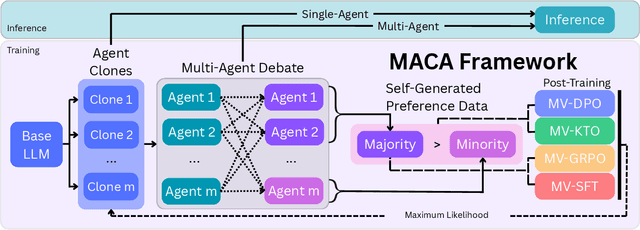
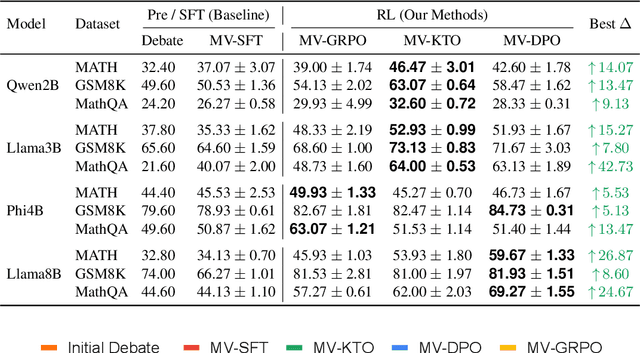
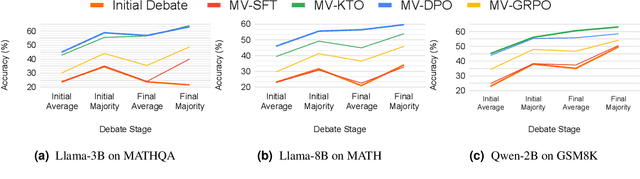
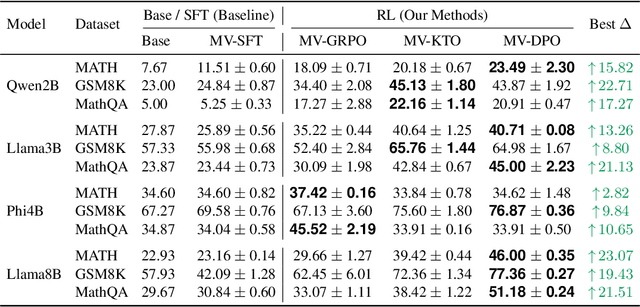
Language Models (LMs) are inconsistent reasoners, often generating contradictory responses to identical prompts. While inference-time methods can mitigate these inconsistencies, they fail to address the core problem: LMs struggle to reliably select reasoning pathways leading to consistent outcomes under exploratory sampling. To address this, we formalize self-consistency as an intrinsic property of well-aligned reasoning models and introduce Multi-Agent Consensus Alignment (MACA), a reinforcement learning framework that post-trains models to favor reasoning trajectories aligned with their internal consensus using majority/minority outcomes from multi-agent debate. These trajectories emerge from deliberative exchanges where agents ground reasoning in peer arguments, not just aggregation of independent attempts, creating richer consensus signals than single-round majority voting. MACA enables agents to teach themselves to be more decisive and concise, and better leverage peer insights in multi-agent settings without external supervision, driving substantial improvements across self-consistency (+27.6% on GSM8K), single-agent reasoning (+23.7% on MATH), sampling-based inference (+22.4% Pass@20 on MATH), and multi-agent ensemble decision-making (+42.7% on MathQA). These findings, coupled with strong generalization to unseen benchmarks (+16.3% on GPQA, +11.6% on CommonsenseQA), demonstrate robust self-alignment that more reliably unlocks latent reasoning potential of language models.