 Add to Chrome
 Add to Firefox
 Add to Edge
Evidence-Unit Fairness and the Limits of Query-Adaptive Sparse-Dense Fusion in Financial Document Retrieval
Jul 31, 2026
Retrieval over financial filings is difficult because queries are short and acronym-heavy while the answer-bearing evidence sits inside long, table-dense documents. We study sparse-dense hybrid retrieval on FinDER, a benchmark of expert-annotated questions over corporate 10-K filings. Our first finding is methodological: if the retrieval unit is larger than the dense encoder's input window, the dense model never sees a large share of the labeled evidence, confounding comparison against a full-text sparse baseline. We measure this directly and remove it by segmenting the corpus into encoder-sized windows. On the corrected corpus, fusing BM25 and a compact dense encoder improves reference-level Hit@10 by roughly 28 percent over either component, and training-free, untuned reciprocal rank fusion exceeds the equal-weight blend in an exploratory comparison. We then ask whether choosing the fusion weight per query helps: an oracle over the interpolation-weight grid shows headroom of 21.8 percent, yet none of the three lightweight adaptive routers (a score-confidence heuristic, a random forest over query features, and a ridge regressor over query embeddings) establishes a statistically reliable improvement over the fixed blend under company-grouped cross-validation with cluster-robust inference. Simple fusion is a strong baseline here, and we discuss why per-query weighting does not capture the available headroom.

A Multi-model Combination Approach for Probabilistic Wind Power Forecasting
Feb 13, 2017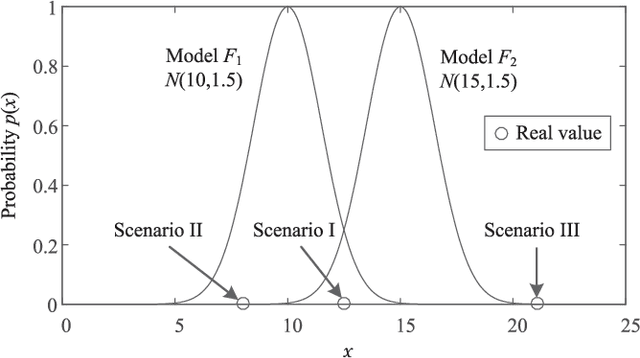
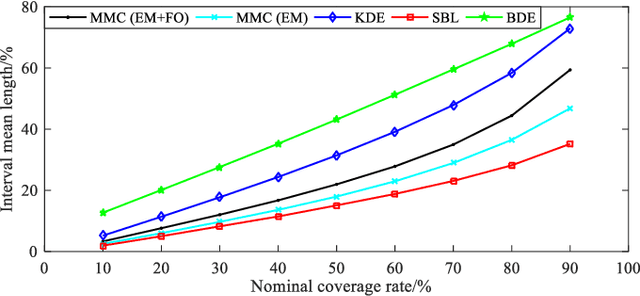
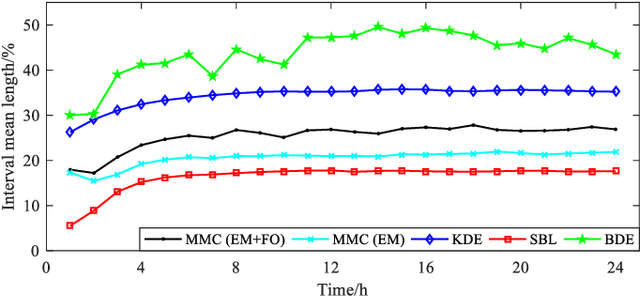
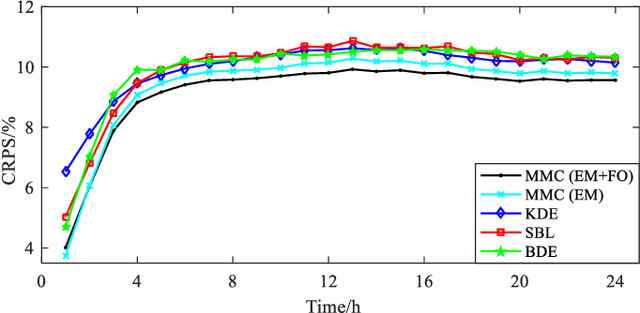
Short-term probabilistic wind power forecasting can provide critical quantified uncertainty information of wind generation for power system operation and control. As the complicated characteristics of wind power prediction error, it would be difficult to develop a universal forecasting model dominating over other alternative models. Therefore, a novel multi-model combination (MMC) approach for short-term probabilistic wind generation forecasting is proposed in this paper to exploit the advantages of different forecasting models. The proposed approach can combine different forecasting models those provide different kinds of probability density functions to improve the probabilistic forecast accuracy. Three probabilistic forecasting models based on the sparse Bayesian learning, kernel density estimation and beta distribution fitting are used to form the combined model. The parameters of the MMC model are solved based on Bayesian framework. Numerical tests illustrate the effectiveness of the proposed MMC approach.