 Add to Chrome
 Add to Firefox
 Add to Edge
Revisiting Non-Verbatim Memorization in Large Language Models: The Role of Entity Surface Forms
Apr 23, 2026
Understanding what kinds of factual knowledge large language models (LLMs) memorize is essential for evaluating their reliability and limitations. Entity-based QA is a common framework for analyzing non-verbatim memorization, but typical evaluations query each entity using a single canonical surface form, making it difficult to disentangle fact memorization from access through a particular name. We introduce RedirectQA, an entity-based QA dataset that uses Wikipedia redirect information to associate Wikidata factual triples with categorized surface forms for each entity, including alternative names, abbreviations, spelling variants, and common erroneous forms. Across 13 LLMs, we examine surface-conditioned factual memorization and find that prediction outcomes often change when only the entity surface form changes. This inconsistency is category-dependent: models are more robust to minor orthographic variations than to larger lexical variations such as aliases and abbreviations. Frequency analyses further suggest that both entity- and surface-level frequencies are associated with accuracy, and that entity frequency often contributes beyond surface frequency. Overall, factual memorization appears neither purely surface-specific nor fully surface-invariant, highlighting the importance of surface-form diversity in evaluating non-verbatim memorization.

Bipartite-play Dialogue Collection for Practical Automatic Evaluation of Dialogue Systems
Nov 19, 2022Automation of dialogue system evaluation is a driving force for the efficient development of dialogue systems. This paper introduces the bipartite-play method, a dialogue collection method for automating dialogue system evaluation. It addresses the limitations of existing dialogue collection methods: (i) inability to compare with systems that are not publicly available, and (ii) vulnerability to cheating by intentionally selecting systems to be compared. Experimental results show that the automatic evaluation using the bipartite-play method mitigates these two drawbacks and correlates as strongly with human subjectivity as existing methods.
Target-Guided Open-Domain Conversation Planning
Sep 20, 2022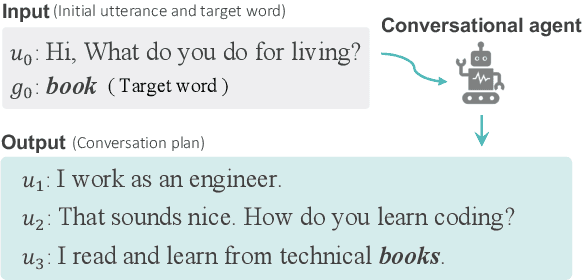
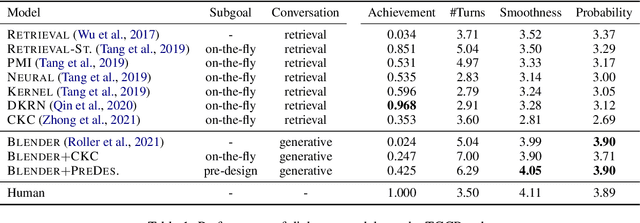

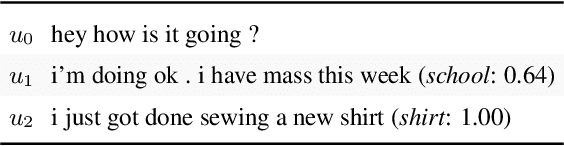
Prior studies addressing target-oriented conversational tasks lack a crucial notion that has been intensively studied in the context of goal-oriented artificial intelligence agents, namely, planning. In this study, we propose the task of Target-Guided Open-Domain Conversation Planning (TGCP) task to evaluate whether neural conversational agents have goal-oriented conversation planning abilities. Using the TGCP task, we investigate the conversation planning abilities of existing retrieval models and recent strong generative models. The experimental results reveal the challenges facing current technology.