 Add to Chrome
 Add to Firefox
 Add to Edge
QAROO: AI-Driven Online Task Offloading for Energy-Efficient and Sustainable MEC Networks
Apr 28, 2026
With the rapid advancement of artificial intelligence (AI) and intelligent science, intelligent edge computing has been widely adopted. However, the limitations of traditional methods, such as poor adaptability and the slow convergence of heuristic algorithms, are becoming increasingly evident. To enable sustainable and resource-efficient edge applications, this paper proposes an online task offloading framework for wireless powered mobile edge computing (MEC) networks, called Quantum Attention-based Reinforcement learning for Online Offloading (QAROO). The system employs a binary offloading strategy with the aim of co-optimizing computing and energy resources in dynamic channel environments. In response to the issues of poor adaptability in traditional approaches and the slow convergence of heuristic algorithms, the framework integrates quantum neural networks and attention mechanisms, introducing three key improvements: using recurrent neural networks to enhance temporal modeling capability, proposing an uncertainty-guided quantization method to improve exploration efficiency, and incorporating attention mechanisms into quantum networks to strengthen feature representation. Experiments demonstrate that the proposed method outperforms comparative schemes in terms of normalized computation speed and processing time, offering an efficient and stable solution for online task offloading in large-scale Internet of Things (IoT) dynamic environments.

Computing Systems for Autonomous Driving: State-of-the-Art and Challenges
Sep 30, 2020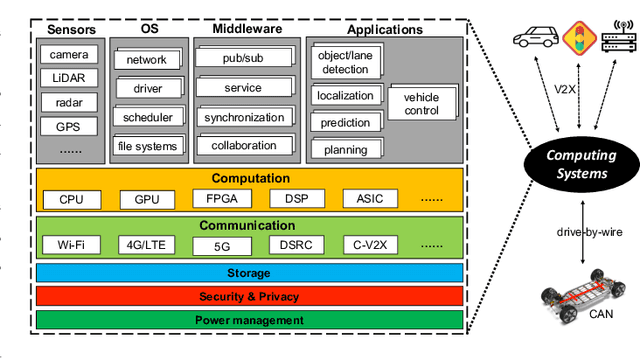
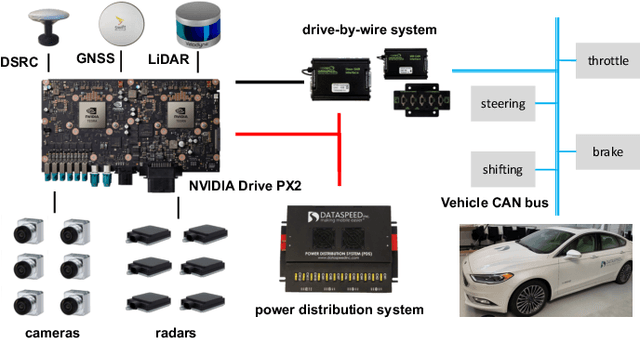
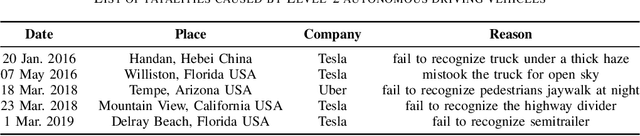
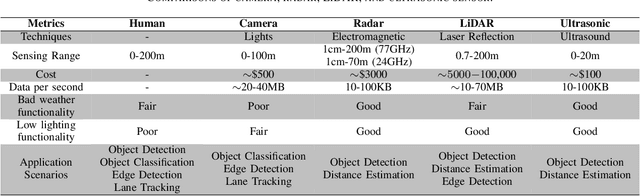
The recent proliferation of computing technologies, e.g., sensors, computer vision, machine learning, hardware acceleration, and the broad deployment of communication mechanisms, e.g., DSRC, C-V2X, 5G, have pushed the horizon of autonomous driving, which automates the decision and control of vehicles by leveraging the perception results based on multiple sensors. The key to the success of these autonomous systems is making a reliable decision in a real-time fashion. However, accidents and fatalities caused by early deployed autonomous vehicles arise from time to time. The real traffic environment is too complicated for the current autonomous driving computing systems to understand and handle. In this paper, we present the state-of-the-art computing systems for autonomous driving, including seven performance metrics and nine key technologies, followed by eleven challenges and opportunities to realize autonomous driving. We hope this paper will gain attention from both the computing and automotive communities and inspire more research in this direction.