 Add to Chrome
 Add to Firefox
 Add to Edge
HCRMap: Pressure-Aware Hot-Expert Residency Mapping for 3.5D MoE Chiplet Inference
Jul 13, 2026
Mixture-of-Experts (MoE) large language models (LLM) activate only a small number of experts during inference, but token routing introduces persistent expert hotness skew: a small set of hot experts continuously receives most tokens, while the remaining experts are lightly loaded. On 3.5D multi-chiplet systems, this skew not only causes compute imbalance but also amplifies pressure on communication, memory bandwidth, I/O, and execution queues. Therefore, the core problem is not simply to reduce token movement, but to dynamically place and reuse hot expert replicas across different memory tiers. This paper proposes HCRMap, a hot expert residency mapping framework for pressure-aware expert replica management in 3.5D MoE inference. Based on expert hotness, weight loading cost, migration overhead, and runtime resource pressure, HCRMap dynamically determines which experts should be promoted, retained, demoted, or evicted. It then maps routed token groups to suitable resident replicas, thereby jointly mitigating communication, memory, and queue bottlenecks. Experimental results show that HCRMap reduces end-to-end latency by 43.6% and 43.0% over Hydra in the prefill and decode stages, respectively; by 34.5% and 33.1% over MoEntwine; and by 46.7% and 46.0% over PIMoE.

A relic sketch extraction framework based on detail-aware hierarchical deep network
Jan 17, 2021
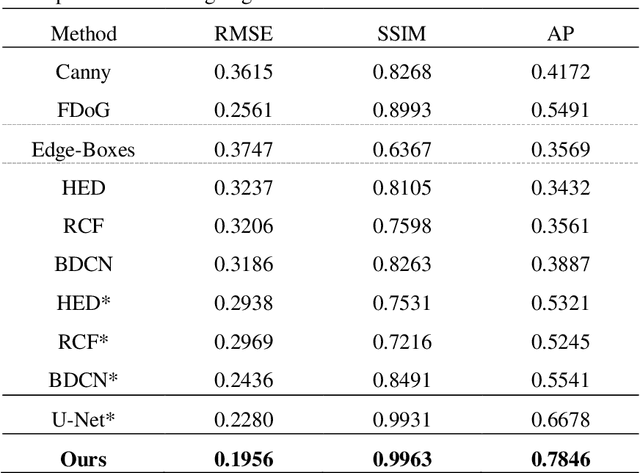
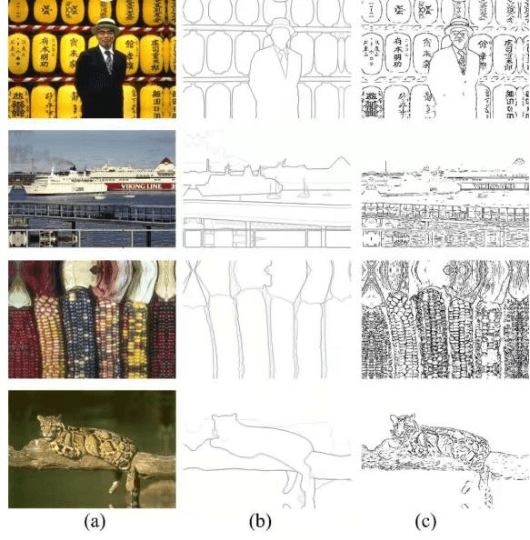
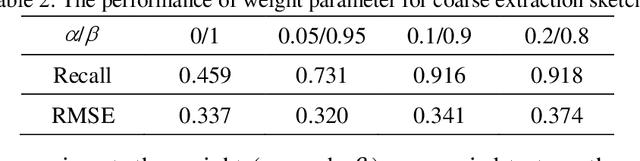
As the first step of the restoration process of painted relics, sketch extraction plays an important role in cultural research. However, sketch extraction suffers from serious disease corrosion, which results in broken lines and noise. To overcome these problems, we propose a deep learning-based hierarchical sketch extraction framework for painted cultural relics. We design the sketch extraction process into two stages: coarse extraction and fine extraction. In the coarse extraction stage, we develop a novel detail-aware bi-directional cascade network that integrates flow-based difference-of-Gaussians (FDoG) edge detection and a bi-directional cascade network (BDCN) under a transfer learning framework. It not only uses the pre-trained strategy to extenuate the requirements of large datasets for deep network training but also guides the network to learn the detail characteristics by the prior knowledge from FDoG. For the fine extraction stage, we design a new multiscale U-Net (MSU-Net) to effectively remove disease noise and refine the sketch. Specifically, all the features extracted from multiple intermediate layers in the decoder of MSU-Net are fused for sketch predication. Experimental results showed that the proposed method outperforms the other seven state-of-the-art methods in terms of visual and quantitative metrics and can also deal with complex backgrounds.
Weighted Motion Averaging for the Registration of Multi-View Range Scans
Apr 09, 2017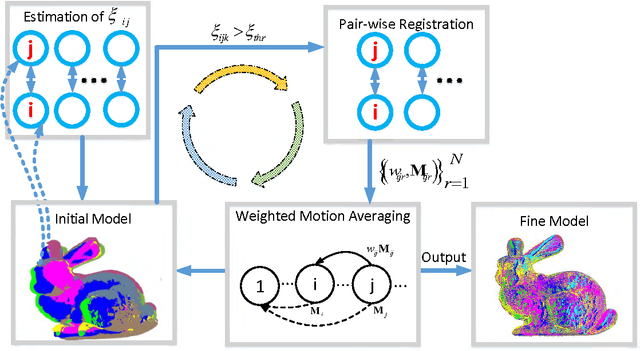
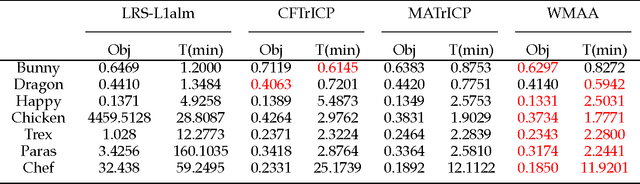
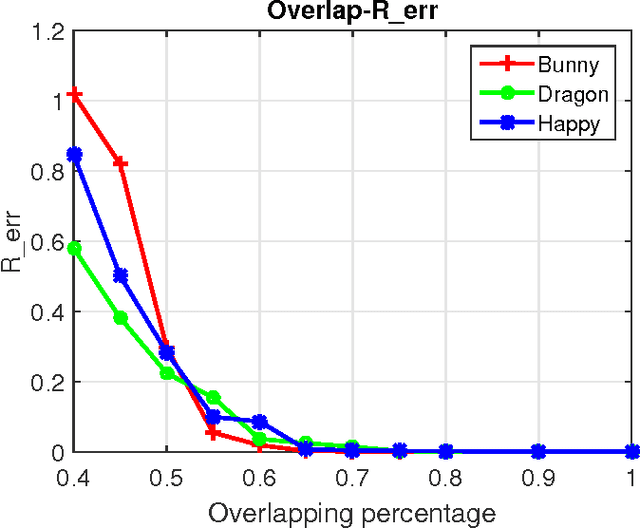
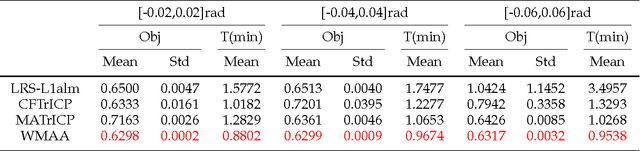
Multi-view registration is a fundamental but challenging problem in 3D reconstruction and robot vision. Although the original motion averaging algorithm has been introduced as an effective means to solve the multi-view registration problem, it does not consider the reliability and accuracy of each relative motion. Accordingly, this paper proposes a novel motion averaging algorithm for multi-view registration. Firstly, it utilizes the pair-wise registration algorithm to estimate the relative motion and overlapping percentage of each scan pair with a certain degree of overlap. With the overlapping percentage available, it views the overlapping percentage as the corresponding weight of each scan pair and proposes the weight motion averaging algorithm, which can pay more attention to reliable and accurate relative motions. By treating each relative motion distinctively, more accurate registration can be achieved by applying the weighted motion averaging to multi-view range scans. Experimental results demonstrate the superiority of our proposed approach compared with the state-of-the-art methods in terms of accuracy, robustness and efficiency.