 Add to Chrome
 Add to Firefox
 Add to Edge
Enabling Delayed-Full Charging Through Transformer-Based Real-Time-to-Departure Modeling for EV Battery Longevity
Dec 10, 2025
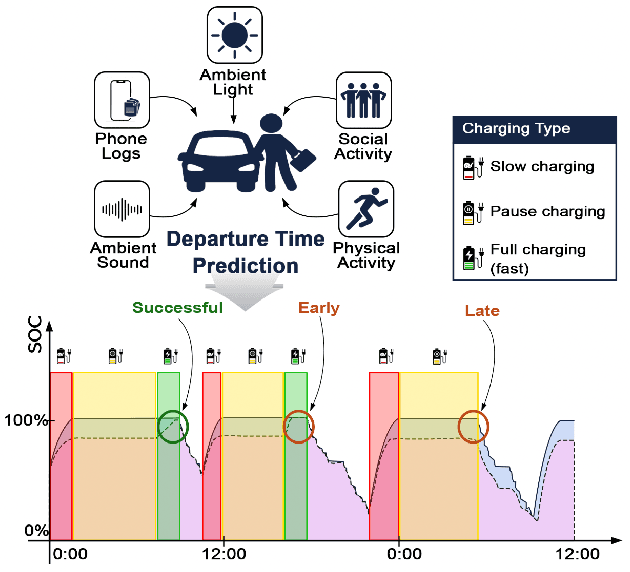
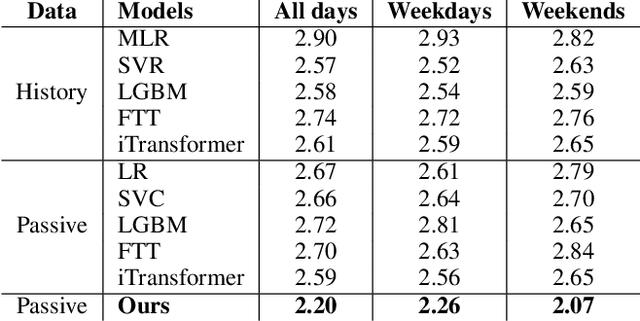
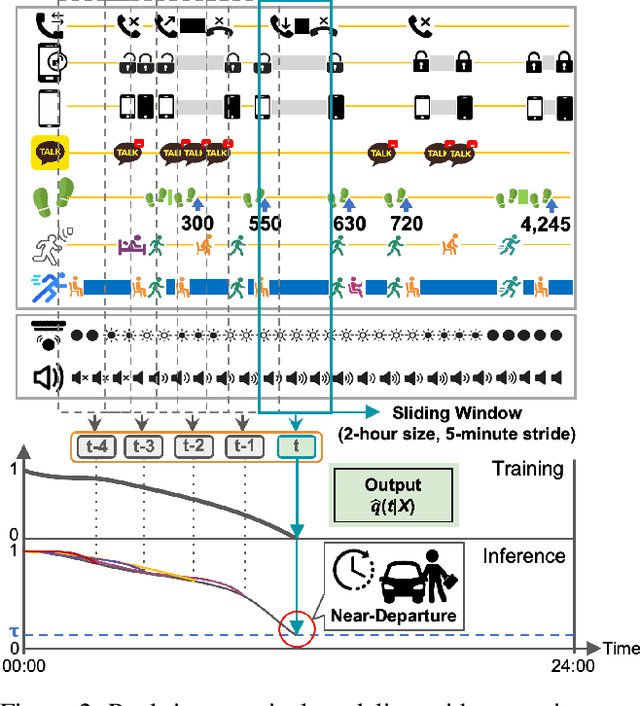
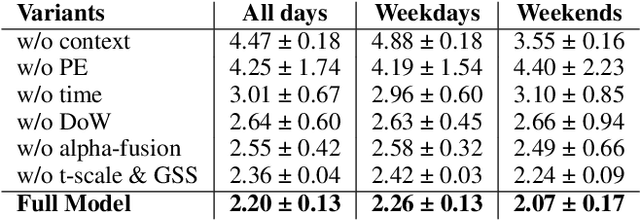
Electric vehicles (EVs) are key to sustainable mobility, yet their lithium-ion batteries (LIBs) degrade more rapidly under prolonged high states of charge (SOC). This can be mitigated by delaying full charging \ours until just before departure, which requires accurate prediction of user departure times. In this work, we propose Transformer-based real-time-to-event (TTE) model for accurate EV departure prediction. Our approach represents each day as a TTE sequence by discretizing time into grid-based tokens. Unlike previous methods primarily dependent on temporal dependency from historical patterns, our method leverages streaming contextual information to predict departures. Evaluation on a real-world study involving 93 users and passive smartphone data demonstrates that our method effectively captures irregular departure patterns within individual routines, outperforming baseline models. These results highlight the potential for practical deployment of the \ours algorithm and its contribution to sustainable transportation systems.

Beyond Feature Importance: Feature Interactions in Predicting Post-Stroke Rigidity with Graph Explainable AI
Apr 10, 2025This study addresses the challenge of predicting post-stroke rigidity by emphasizing feature interactions through graph-based explainable AI. Post-stroke rigidity, characterized by increased muscle tone and stiffness, significantly affects survivors' mobility and quality of life. Despite its prevalence, early prediction remains limited, delaying intervention. We analyze 519K stroke hospitalization records from the Healthcare Cost and Utilization Project dataset, where 43% of patients exhibited rigidity. We compare traditional approaches such as Logistic Regression, XGBoost, and Transformer with graph-based models like Graphormer and Graph Attention Network. These graph models inherently capture feature interactions and incorporate intrinsic or post-hoc explainability. Our results show that graph-based methods outperform others (AUROC 0.75), identifying key predictors such as NIH Stroke Scale and APR-DRG mortality risk scores. They also uncover interactions missed by conventional models. This research provides a novel application of graph-based XAI in stroke prognosis, with potential to guide early identification and personalized rehabilitation strategies.