 Add to Chrome
 Add to Firefox
 Add to Edge
COMET: Concept Space Dissection of the Modality Gap in Audio-Text Multimodal Contrastive Embeddings
May 28, 2026
Contrastive Language-Audio Pretraining (CLAP) models are widely used for audio understanding and support modality-agnostic condition swapping in many zero-shot applications. However, their performance is heavily affected by the modality gap between audio and text embeddings. Existing explanations mainly attribute this gap to the cone effect, treating it as a shift between mean embeddings, yet correcting the mean alone yields only limited improvements. Alternative hypotheses, such as information imbalance and dimensionality collapse, have also been proposed, but they remain insufficiently verified and have not been thoroughly studied in the audio domain. Meanwhile, several works attempt to decompose multimodal contrastive embeddings into interpretable concepts, but none explicitly analyze the modality gap from the perspective of concept decomposition. In this work, we introduce COMET (Concept space Organization and Modality gap Explanation with PLS-SVD Transformation), a novel partial least squares singular value decomposition (PLS-SVD) framework for CLAP that unveils a broader perspective of the modality gap. Our framework reveals that only a small, interpretable subset of axes, which captures shared concepts, contributes substantially to similarity computation, and that the mean component represents only partially the modality gap. Building on this insight, we propose a simple spectral truncation method that mitigates the modality gap in a training-free manner. The method enables zero-shot audio captioning with condition swapping to approach fully supervised performance, without requiring large auxiliary memory banks or expensive computation. At the same time, it achieves substantial embedding dimensionality reduction while preserving strong performance on retrieval and audio captioning tasks.

On RIS-Aided SIMO Gaussian Channels: Towards A Single-RF MIMO Transceiver Architecture
Nov 24, 2023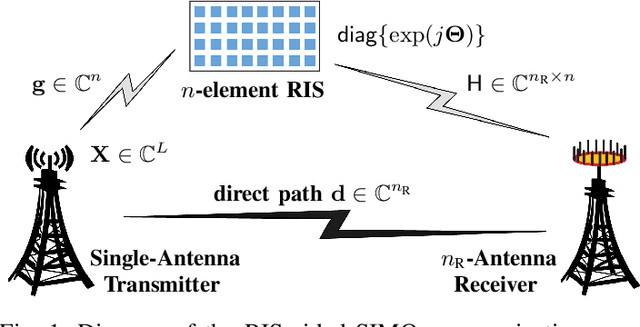
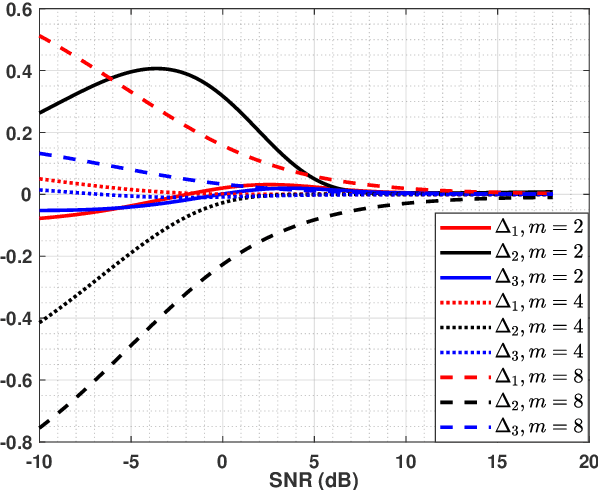
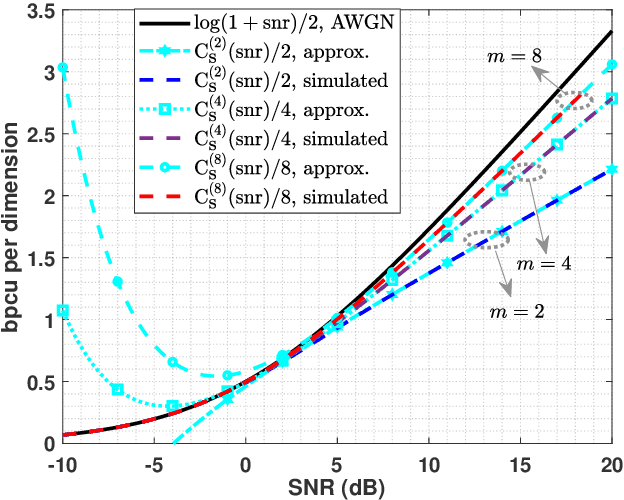
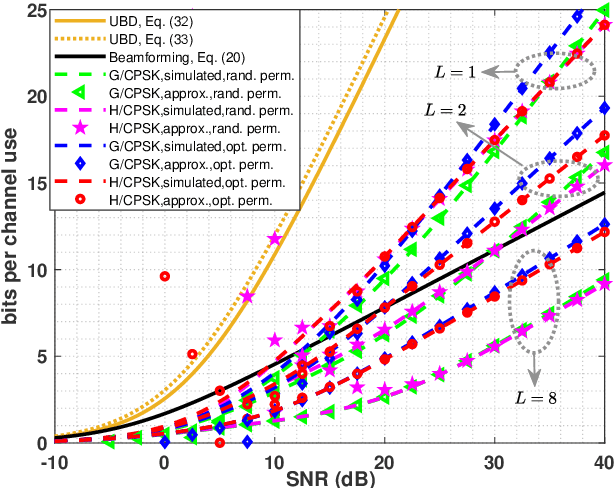
In this paper, for a single-input multiple-output (SIMO) system aided by a passive reconfigurable intelligent surface (RIS), the joint transmission accomplished by the single transmit antenna and the RIS with multiple controllable reflective elements is considered. Relying on a general capacity upper bound derived by a maximum-trace argument, we respectively characterize the capacity of such \rev{a} channel in the low-SNR or the rank-one regimes, in which the optimal configuration of the RIS is proved to be beamforming with carefully-chosen phase shifts. To exploit the potential of modulating extra information on the RIS, based on the QR decomposition, successive interference cancellation, and a strategy named \textit{partially beamforming and partially information-carrying}, we propose a novel transceiver architecture with only a single RF front end at the transmitter, by which the considered channel can be regarded as a concatenation of a vector Gaussian channel and several phase-modulated channels. Especially, we investigate a class of vector Gaussian channels with a hypersphere input support constraint, and not only generalize the existing result to arbitrary-dimensional real spaces but also present its high-order capacity asymptotics, by which both capacities of hypersphere-constrained channels and achievable rates of the proposed transceiver with two different signaling schemes can be well-approximated. Information-theoretic analyses show that the transceiver architecture designed for the SIMO channel has a boosted multiplexing gain, rather than one for the conventionally-used optimized beamforming scheme.Numerical results verify our derived asymptotics and show notable superiority of the proposed transceiver.