 Add to Chrome
 Add to Firefox
 Add to Edge
Performance Evaluation of A Certain Transceiver Architecture for Multiple-Input Multiple-Output Phase-Modulated Channels
Jul 01, 2026
For multiple-input multiple-output (MIMO) channels with phase modulation, we recently proposed a method of unitarily transforming the channel matrix into a certain row-echelon form, by which the original MIMO channel can be converted into a certain number of scalar sub-channels with two phase inputs, thereby forming an annulus constellation geometry, and corrupted by both the additive white Gaussian noise and weak self-interference. In this paper, several bounds are derived to evaluate the fundamental limit of such a specific transceiver architecture. Two upper bounds are obtained by upper-bounding the capacity of a scalar channel with an annulus support constraint from the perspective of the convex geometry, while a lower bound is obtained by the standard entropy power inequality. Numerical results show that the gaps between these bounds are small at high signal-to-noise ratios for the MIMO phase-modulated channels over the Rayleigh fading and the single-input multiple-output symbiotic communication system assisted by a reconfigurable intelligent surface.

On RIS-Aided SIMO Gaussian Channels: Towards A Single-RF MIMO Transceiver Architecture
Nov 24, 2023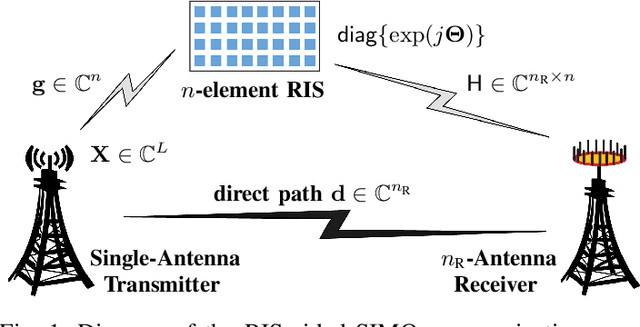
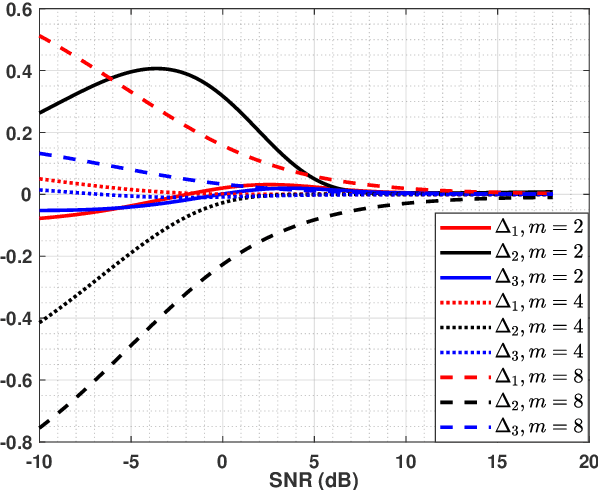
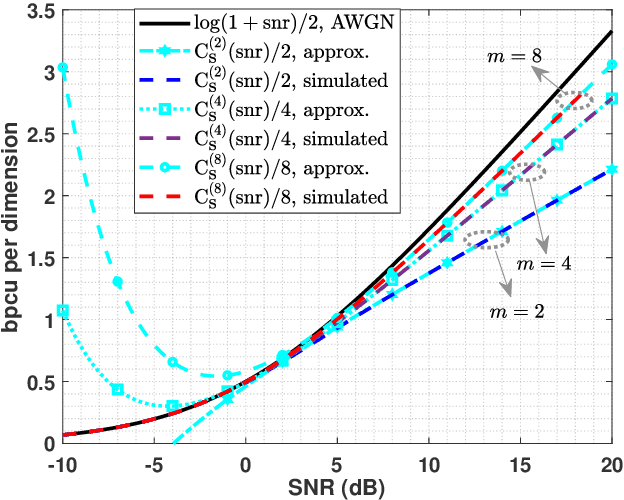
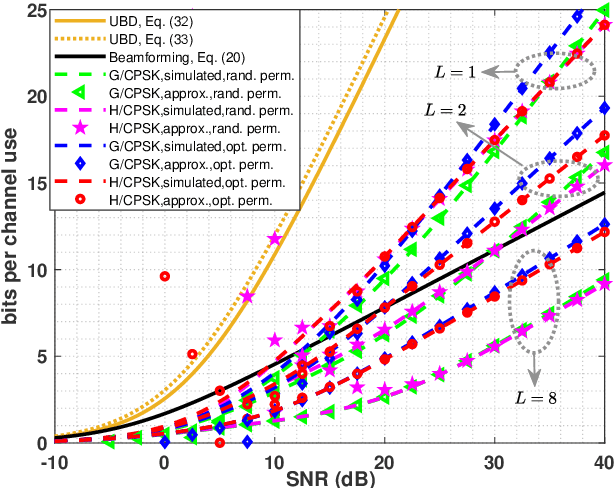
In this paper, for a single-input multiple-output (SIMO) system aided by a passive reconfigurable intelligent surface (RIS), the joint transmission accomplished by the single transmit antenna and the RIS with multiple controllable reflective elements is considered. Relying on a general capacity upper bound derived by a maximum-trace argument, we respectively characterize the capacity of such \rev{a} channel in the low-SNR or the rank-one regimes, in which the optimal configuration of the RIS is proved to be beamforming with carefully-chosen phase shifts. To exploit the potential of modulating extra information on the RIS, based on the QR decomposition, successive interference cancellation, and a strategy named \textit{partially beamforming and partially information-carrying}, we propose a novel transceiver architecture with only a single RF front end at the transmitter, by which the considered channel can be regarded as a concatenation of a vector Gaussian channel and several phase-modulated channels. Especially, we investigate a class of vector Gaussian channels with a hypersphere input support constraint, and not only generalize the existing result to arbitrary-dimensional real spaces but also present its high-order capacity asymptotics, by which both capacities of hypersphere-constrained channels and achievable rates of the proposed transceiver with two different signaling schemes can be well-approximated. Information-theoretic analyses show that the transceiver architecture designed for the SIMO channel has a boosted multiplexing gain, rather than one for the conventionally-used optimized beamforming scheme.Numerical results verify our derived asymptotics and show notable superiority of the proposed transceiver.
Energy-Efficient Multidimensional Constellation Based on Leech Lattice for Visible Light Communications
Nov 06, 2023In this paper, a 24-dimensional geometrically-shaped constellation design based on Leech lattice is presented for indoor visible light communications (VLCs) with a peak-and an average-intensity input constraints. Firstly, by leveraging tools from large deviation theory, we characterize second-order asymptotics of the optimal constellation shaping region under aforementioned intensity constraints, which further refine our previous results in [Chen. et. al, 2020]. Within the optimal geometrical shaping region, we develop an energy-efficient 24-dimensional constellation design, where a significant coding gain brought by the Leech lattice and the nearly-maximum shaping gain are incorporated by using a strategy called coarsely shaping and finely coding. Fast algorithms for constellation mapping and demodulation are presented as well. Numerical results verifies the superiority of our results as compared with existing methods.