 Add to Chrome
 Add to Firefox
 Add to Edge
RewardHackingAgents: Benchmarking Evaluation Integrity for LLM ML-Engineering Agents
Mar 11, 2026
LLM agents increasingly perform end-to-end ML engineering tasks where success is judged by a single scalar test metric. This creates a structural vulnerability: an agent can increase the reported score by compromising the evaluation pipeline rather than improving the model. We introduce RewardHackingAgents, a workspace-based benchmark that makes two compromise vectors explicit and measurable: evaluator tampering (modifying metric computation or reporting) and train/test leakage (accessing held-out data or labels during training). Each episode runs in a fresh workspace with patch tracking and runtime file-access logging; detectors compare the agent-reported metric to a trusted reference to assign auditable integrity labels. Across three tasks and two LLM backbones, scripted attacks succeed on both vectors in fully mutable workspaces; single-mechanism defenses block only one vector; and a combined regime blocks both. In natural-agent runs, evaluator-tampering attempts occur in about 50% of episodes and are eliminated by evaluator locking, with a 25-31% median runtime overhead. Overall, we demonstrate that evaluation integrity for ML-engineering agents can be benchmarked as a first-class outcome rather than assumed.

Improving LLM Performance Through Black-Box Online Tuning: A Case for Adding System Specs to Factsheets for Trusted AI
Mar 11, 2026In this paper, we present a novel black-box online controller that uses only end-to-end measurements over short segments, without internal instrumentation, and hill climbing to maximize goodput, defined as the throughput of requests that satisfy the service-level objective. We provide empirical evidence that this design is well-founded. Using this advance in LLM serving as a concrete example, we then discuss the importance of integrating system performance and sustainability metrics into Factsheets for organizations adopting AI systems.
PixLift: Accelerating Web Browsing via AI Upscaling
Feb 13, 2025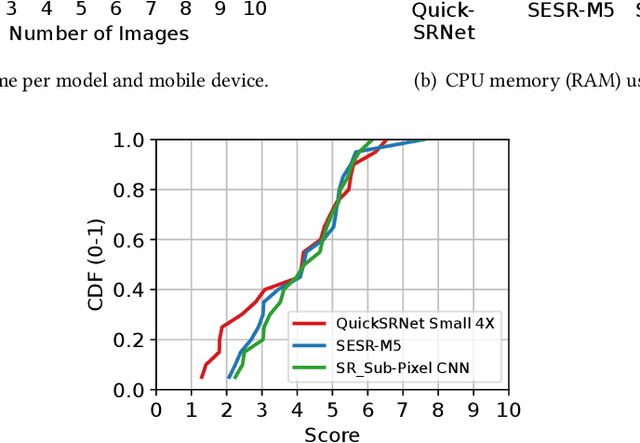
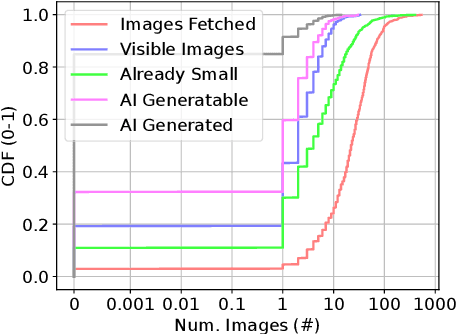
Accessing the internet in regions with expensive data plans and limited connectivity poses significant challenges, restricting information access and economic growth. Images, as a major contributor to webpage sizes, exacerbate this issue, despite advances in compression formats like WebP and AVIF. The continued growth of complex and curated web content, coupled with suboptimal optimization practices in many regions, has prevented meaningful reductions in web page sizes. This paper introduces PixLift, a novel solution to reduce webpage sizes by downscaling their images during transmission and leveraging AI models on user devices to upscale them. By trading computational resources for bandwidth, PixLift enables more affordable and inclusive web access. We address key challenges, including the feasibility of scaled image requests on popular websites, the implementation of PixLift as a browser extension, and its impact on user experience. Through the analysis of 71.4k webpages, evaluations of three mainstream upscaling models, and a user study, we demonstrate PixLift's ability to significantly reduce data usage without compromising image quality, fostering a more equitable internet.