 Add to Chrome
 Add to Firefox
 Add to Edge
Step-GUI Technical Report
Dec 19, 2025
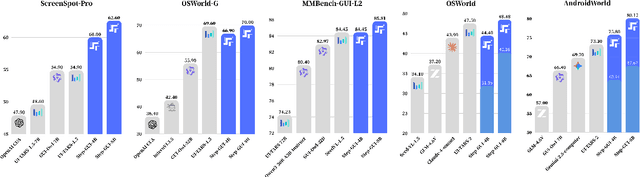
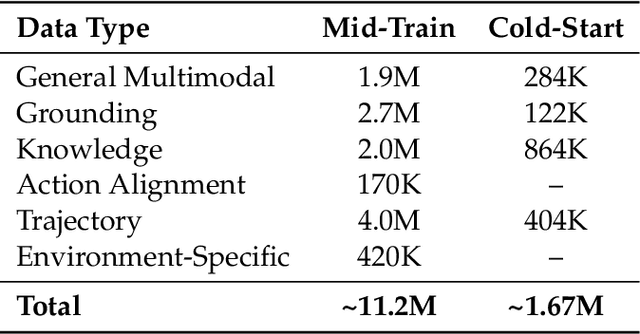
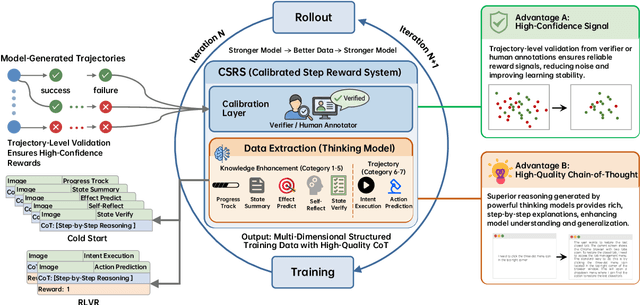
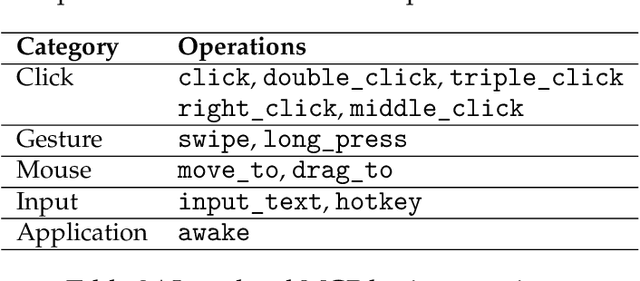
Recent advances in multimodal large language models unlock unprecedented opportunities for GUI automation. However, a fundamental challenge remains: how to efficiently acquire high-quality training data while maintaining annotation reliability? We introduce a self-evolving training pipeline powered by the Calibrated Step Reward System, which converts model-generated trajectories into reliable training signals through trajectory-level calibration, achieving >90% annotation accuracy with 10-100x lower cost. Leveraging this pipeline, we introduce Step-GUI, a family of models (4B/8B) that achieves state-of-the-art GUI performance (8B: 80.2% AndroidWorld, 48.5% OSWorld, 62.6% ScreenShot-Pro) while maintaining robust general capabilities. As GUI agent capabilities improve, practical deployment demands standardized interfaces across heterogeneous devices while protecting user privacy. To this end, we propose GUI-MCP, the first Model Context Protocol for GUI automation with hierarchical architecture that combines low-level atomic operations and high-level task delegation to local specialist models, enabling high-privacy execution where sensitive data stays on-device. Finally, to assess whether agents can handle authentic everyday usage, we introduce AndroidDaily, a benchmark grounded in real-world mobile usage patterns with 3146 static actions and 235 end-to-end tasks across high-frequency daily scenarios (8B: static 89.91%, end-to-end 52.50%). Our work advances the development of practical GUI agents and demonstrates strong potential for real-world deployment in everyday digital interactions.

ESGBERT: Language Model to Help with Classification Tasks Related to Companies Environmental, Social, and Governance Practices
Mar 31, 2022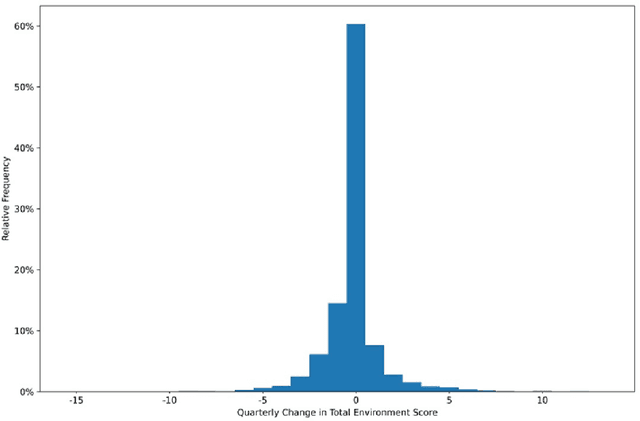
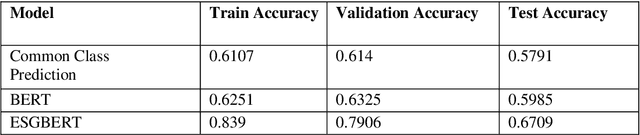
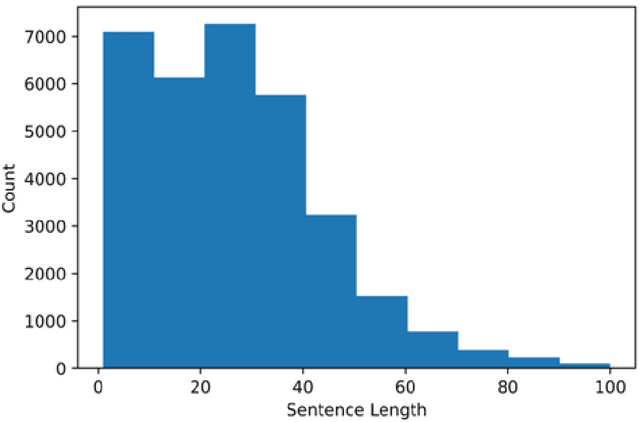
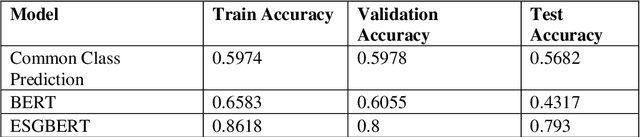
Environmental, Social, and Governance (ESG) are non-financial factors that are garnering attention from investors as they increasingly look to apply these as part of their analysis to identify material risks and growth opportunities. Some of this attention is also driven by clients who, now more aware than ever, are demanding for their money to be managed and invested responsibly. As the interest in ESG grows, so does the need for investors to have access to consumable ESG information. Since most of it is in text form in reports, disclosures, press releases, and 10-Q filings, we see a need for sophisticated NLP techniques for classification tasks for ESG text. We hypothesize that an ESG domain-specific pre-trained model will help with such and study building of the same in this paper. We explored doing this by fine-tuning BERTs pre-trained weights using ESG specific text and then further fine-tuning the model for a classification task. We were able to achieve accuracy better than the original BERT and baseline models in environment-specific classification tasks.