 Add to Chrome
 Add to Firefox
 Add to Edge
Improving through Interaction: Searching Behavioral Representation Spaces with CMA-ES-IG
Mar 09, 2026
Robots that interact with humans must adapt to individual users' preferences to operate effectively in human-centered environments. An intuitive and effective technique to learn non-expert users' preferences is through rankings of robot behaviors, e.g., trajectories, gestures, or voices. Existing techniques primarily focus on generating queries that optimize preference learning outcomes, such as sample efficiency or final preference estimation accuracy. However, the focus on outcome overlooks key user expectations in the process of providing these rankings, which can negatively impact users' adoption of robotic systems. This work proposes the Covariance Matrix Adaptation Evolution Strategies with Information Gain (CMA-ES-IG) algorithm. CMA-ES-IG explicitly incorporates user experience considerations into the preference learning process by suggesting perceptually distinct and informative trajectories for users to rank. We demonstrate these benefits through both simulated studies and real-robot experiments. CMA-ES-IG, compared to state-of-the-art alternatives, (1) scales more effectively to higher-dimensional preference spaces, (2) maintains computational tractability for high-dimensional problems, (3) is robust to noisy or inconsistent user feedback, and (4) is preferred by non-expert users in identifying their preferred robot behaviors. This project's code is available at github.com/interaction-lab/CMA-ES-IG

LAMS: LLM-Driven Automatic Mode Switching for Assistive Teleoperation
Jan 15, 2025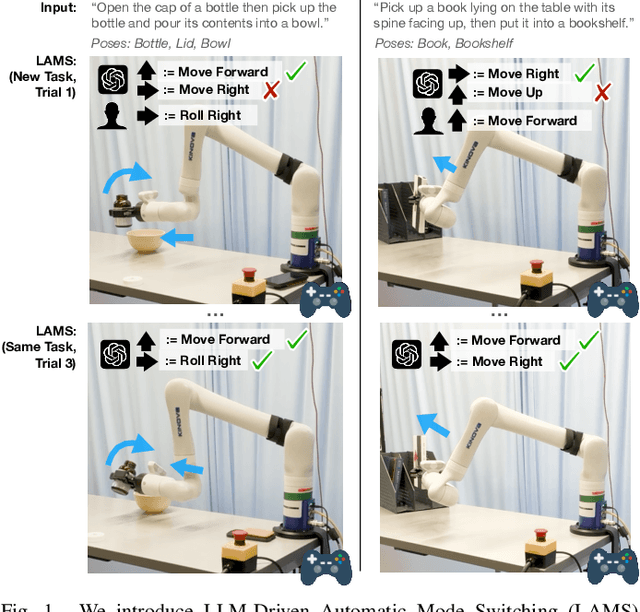
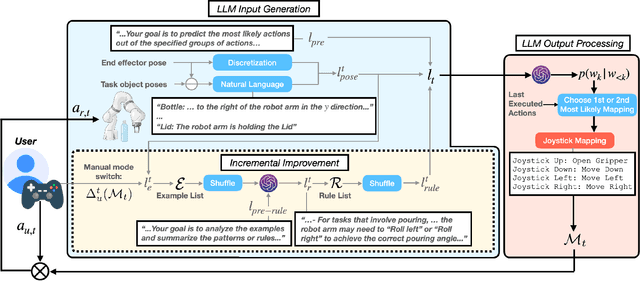
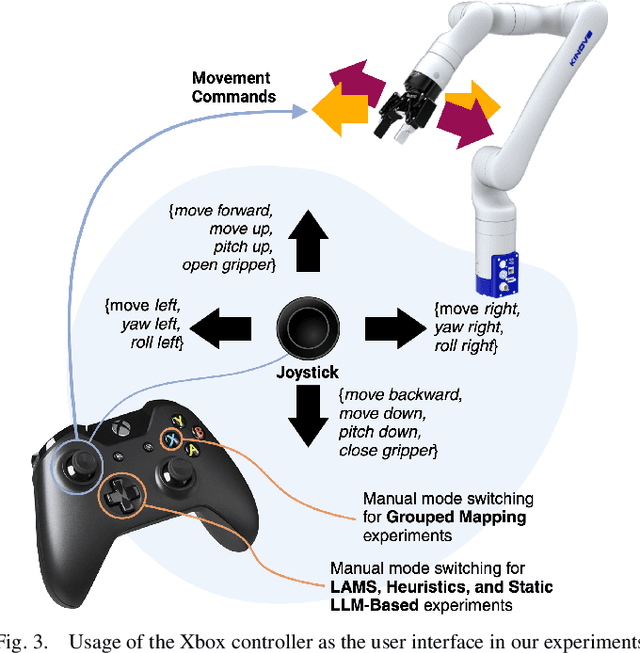
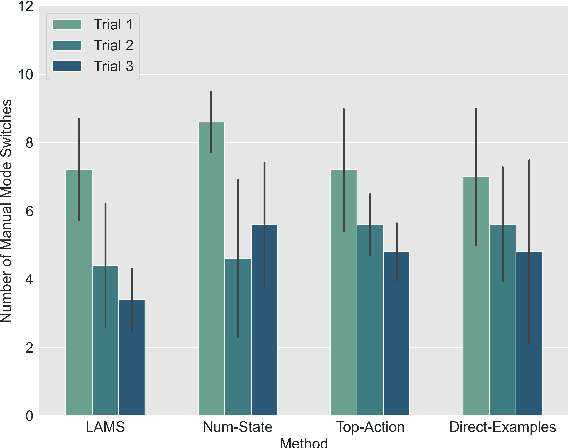
Teleoperating high degrees-of-freedom (DoF) robotic manipulators via low-DoF controllers like joysticks often requires frequent switching between control modes, where each mode maps controller movements to specific robot actions. Manually performing this frequent switching can make teleoperation cumbersome and inefficient. On the other hand, existing automatic mode-switching solutions, such as heuristic-based or learning-based methods, are often task-specific and lack generalizability. In this paper, we introduce LLM-Driven Automatic Mode Switching (LAMS), a novel approach that leverages Large Language Models (LLMs) to automatically switch control modes based on task context. Unlike existing methods, LAMS requires no prior task demonstrations and incrementally improves by integrating user-generated mode-switching examples. We validate LAMS through an ablation study and a user study with 10 participants on complex, long-horizon tasks, demonstrating that LAMS effectively reduces manual mode switches, is preferred over alternative methods, and improves performance over time. The project website with supplementary materials is at https://lams-assistance.github.io/.
Incremental Learning for Robot Shared Autonomy
Oct 08, 2024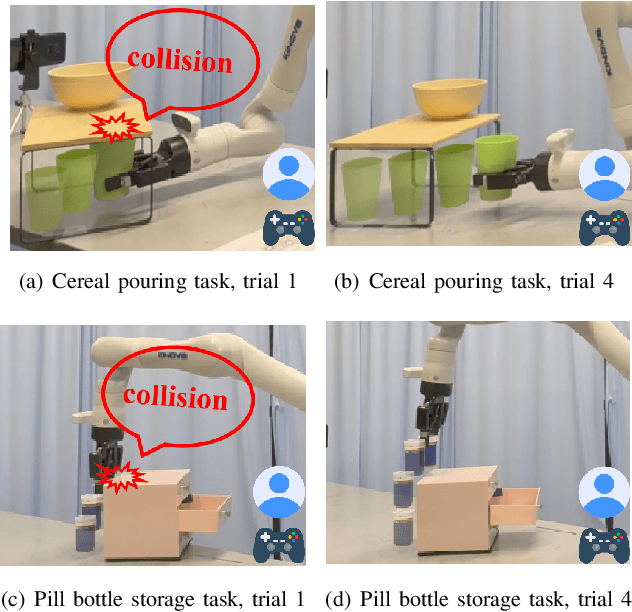
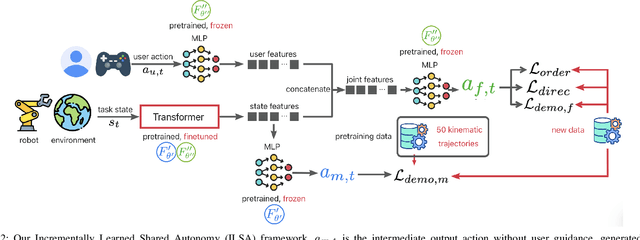
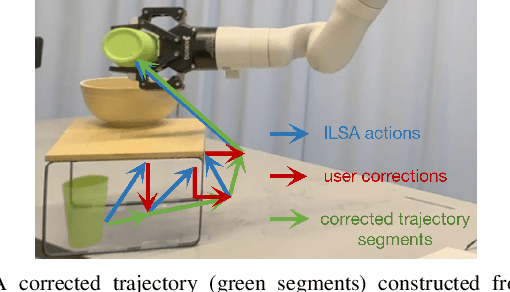
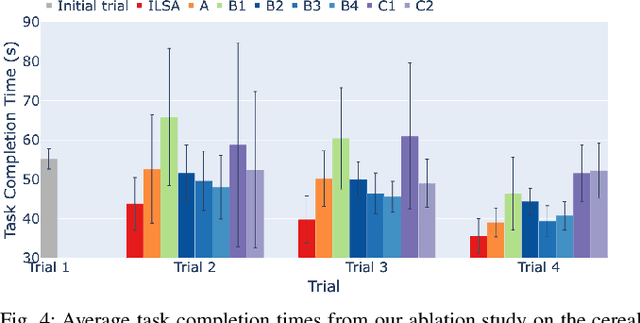
Shared autonomy holds promise for improving the usability and accessibility of assistive robotic arms, but current methods often rely on costly expert demonstrations and lack the ability to adapt post-deployment. This paper introduces ILSA, an Incrementally Learned Shared Autonomy framework that continually improves its assistive control policy through repeated user interactions. ILSA leverages synthetic kinematic trajectories for initial pretraining, reducing the need for expert demonstrations, and then incrementally finetunes its policy after each manipulation interaction, with mechanisms to balance new knowledge acquisition with existing knowledge retention during incremental learning. We validate ILSA for complex long-horizon tasks through a comprehensive ablation study and a user study with 20 participants, demonstrating its effectiveness and robustness in both quantitative performance and user-reported qualitative metrics. Code and videos are available at https://ilsa-robo.github.io/.