 Add to Chrome
 Add to Firefox
 Add to Edge
Enhancing Local Life Service Recommendation with Agentic Reasoning in Large Language Model
Apr 15, 2026
Local life service recommendation is distinct from general recommendation scenarios due to its strong living need-driven nature. Fundamentally, accurately identifying a user's immediate living need and recommending the corresponding service are inextricably linked tasks. However, prior works typically treat them in isolation, failing to achieve a unified modeling of need prediction and service recommendation. In this paper, we propose a novel large language model based framework that jointly performs living need prediction and service recommendation. To address the challenge of noise in raw consumption data, we introduce a behavioral clustering approach that filters out accidental factors and selectively preserves typical patterns. This enables the model to learn a robust logical basis for need generation and spontaneously generalize to long-tail scenarios. To navigate the vast search space stemming from diverse needs, merchants, and complex mapping paths, we employ a curriculum learning strategy combined with reinforcement learning with verifiable rewards. This approach guides the model to sequentially learn the logic from need generation to category mapping and specific service selection. Extensive experiments demonstrate that our unified framework significantly enhances both living need prediction performance and recommendation accuracy, validating the effectiveness of jointly modeling living needs and user behaviors.

AutoQual: An LLM Agent for Automated Discovery of Interpretable Features for Review Quality Assessment
Oct 09, 2025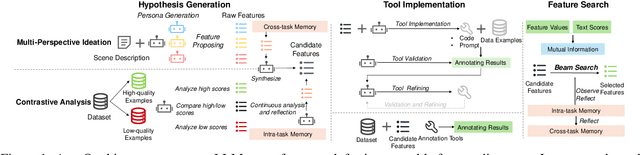
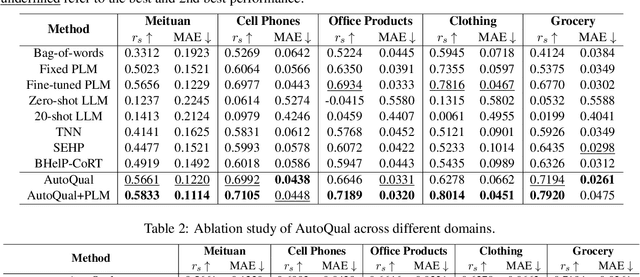
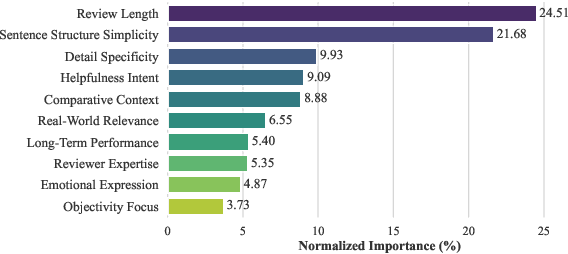
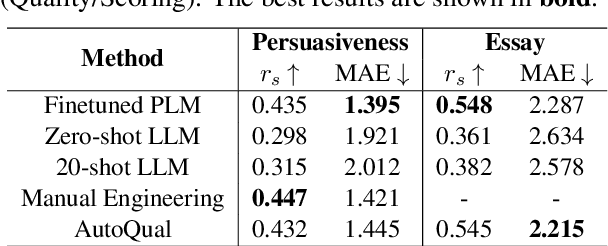
Ranking online reviews by their intrinsic quality is a critical task for e-commerce platforms and information services, impacting user experience and business outcomes. However, quality is a domain-dependent and dynamic concept, making its assessment a formidable challenge. Traditional methods relying on hand-crafted features are unscalable across domains and fail to adapt to evolving content patterns, while modern deep learning approaches often produce black-box models that lack interpretability and may prioritize semantics over quality. To address these challenges, we propose AutoQual, an LLM-based agent framework that automates the discovery of interpretable features. While demonstrated on review quality assessment, AutoQual is designed as a general framework for transforming tacit knowledge embedded in data into explicit, computable features. It mimics a human research process, iteratively generating feature hypotheses through reflection, operationalizing them via autonomous tool implementation, and accumulating experience in a persistent memory. We deploy our method on a large-scale online platform with a billion-level user base. Large-scale A/B testing confirms its effectiveness, increasing average reviews viewed per user by 0.79% and the conversion rate of review readers by 0.27%.