 Add to Chrome
 Add to Firefox
 Add to Edge
AnimationBench: Are Video Models Good at Character-Centric Animation?
Apr 16, 2026
Video generation has advanced rapidly, with recent methods producing increasingly convincing animated results. However, existing benchmarks-largely designed for realistic videos-struggle to evaluate animation-style generation with its stylized appearance, exaggerated motion, and character-centric consistency. Moreover, they also rely on fixed prompt sets and rigid pipelines, offering limited flexibility for open-domain content and custom evaluation needs. To address this gap, we introduce AnimationBench, the first systematic benchmark for evaluating animation image-to-video generation. AnimationBench operationalizes the Twelve Basic Principles of Animation and IP Preservation into measurable evaluation dimensions, together with Broader Quality Dimensions including semantic consistency, motion rationality, and camera motion consistency. The benchmark supports both a standardized close-set evaluation for reproducible comparison and a flexible open-set evaluation for diagnostic analysis, and leverages visual-language models for scalable assessment. Extensive experiments show that AnimationBench aligns well with human judgment and exposes animation-specific quality differences overlooked by realism-oriented benchmarks, leading to more informative and discriminative evaluation of state-of-the-art I2V models.

IFAdapter: Instance Feature Control for Grounded Text-to-Image Generation
Sep 12, 2024

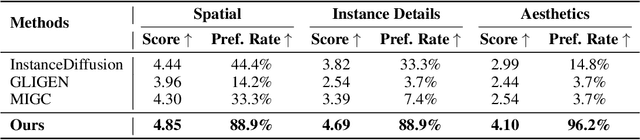

While Text-to-Image (T2I) diffusion models excel at generating visually appealing images of individual instances, they struggle to accurately position and control the features generation of multiple instances. The Layout-to-Image (L2I) task was introduced to address the positioning challenges by incorporating bounding boxes as spatial control signals, but it still falls short in generating precise instance features. In response, we propose the Instance Feature Generation (IFG) task, which aims to ensure both positional accuracy and feature fidelity in generated instances. To address the IFG task, we introduce the Instance Feature Adapter (IFAdapter). The IFAdapter enhances feature depiction by incorporating additional appearance tokens and utilizing an Instance Semantic Map to align instance-level features with spatial locations. The IFAdapter guides the diffusion process as a plug-and-play module, making it adaptable to various community models. For evaluation, we contribute an IFG benchmark and develop a verification pipeline to objectively compare models' abilities to generate instances with accurate positioning and features. Experimental results demonstrate that IFAdapter outperforms other models in both quantitative and qualitative evaluations.
Relation Rectification in Diffusion Model
Mar 29, 2024Despite their exceptional generative abilities, large text-to-image diffusion models, much like skilled but careless artists, often struggle with accurately depicting visual relationships between objects. This issue, as we uncover through careful analysis, arises from a misaligned text encoder that struggles to interpret specific relationships and differentiate the logical order of associated objects. To resolve this, we introduce a novel task termed Relation Rectification, aiming to refine the model to accurately represent a given relationship it initially fails to generate. To address this, we propose an innovative solution utilizing a Heterogeneous Graph Convolutional Network (HGCN). It models the directional relationships between relation terms and corresponding objects within the input prompts. Specifically, we optimize the HGCN on a pair of prompts with identical relational words but reversed object orders, supplemented by a few reference images. The lightweight HGCN adjusts the text embeddings generated by the text encoder, ensuring the accurate reflection of the textual relation in the embedding space. Crucially, our method retains the parameters of the text encoder and diffusion model, preserving the model's robust performance on unrelated descriptions. We validated our approach on a newly curated dataset of diverse relational data, demonstrating both quantitative and qualitative enhancements in generating images with precise visual relations. Project page: https://wuyinwei-hah.github.io/rrnet.github.io/.