 Add to Chrome
 Add to Firefox
 Add to Edge
AnimationBench: Are Video Models Good at Character-Centric Animation?
Apr 16, 2026
Video generation has advanced rapidly, with recent methods producing increasingly convincing animated results. However, existing benchmarks-largely designed for realistic videos-struggle to evaluate animation-style generation with its stylized appearance, exaggerated motion, and character-centric consistency. Moreover, they also rely on fixed prompt sets and rigid pipelines, offering limited flexibility for open-domain content and custom evaluation needs. To address this gap, we introduce AnimationBench, the first systematic benchmark for evaluating animation image-to-video generation. AnimationBench operationalizes the Twelve Basic Principles of Animation and IP Preservation into measurable evaluation dimensions, together with Broader Quality Dimensions including semantic consistency, motion rationality, and camera motion consistency. The benchmark supports both a standardized close-set evaluation for reproducible comparison and a flexible open-set evaluation for diagnostic analysis, and leverages visual-language models for scalable assessment. Extensive experiments show that AnimationBench aligns well with human judgment and exposes animation-specific quality differences overlooked by realism-oriented benchmarks, leading to more informative and discriminative evaluation of state-of-the-art I2V models.

From Code to Correctness: Closing the Last Mile of Code Generation with Hierarchical Debugging
Oct 02, 2024

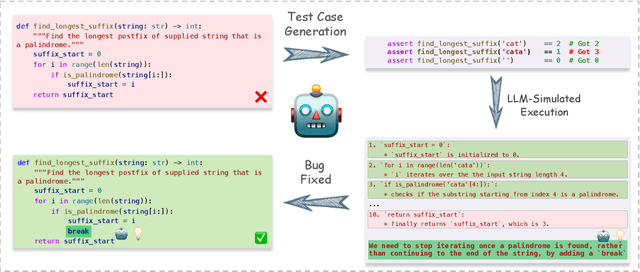

While large language models have made significant strides in code generation, the pass rate of the generated code is bottlenecked on subtle errors, often requiring human intervention to pass tests, especially for complex problems. Existing LLM-based debugging systems treat generated programs as monolithic units, failing to address bugs at multiple levels of granularity, from low-level syntax errors to high-level algorithmic flaws. In this paper, we introduce Multi-Granularity Debugger (MGDebugger), a hierarchical code debugger by isolating, identifying, and resolving bugs at various levels of granularity. MGDebugger decomposes problematic code into a hierarchical tree structure of subfunctions, with each level representing a particular granularity of error. During debugging, it analyzes each subfunction and iteratively resolves bugs in a bottom-up manner. To effectively test each subfunction, we propose an LLM-simulated Python executor, which traces code execution and tracks important variable states to pinpoint errors accurately. Extensive experiments demonstrate that MGDebugger outperforms existing debugging systems, achieving an 18.9% improvement in accuracy over seed generations in HumanEval and a 97.6% repair success rate in HumanEvalFix. Furthermore, MGDebugger effectively fixes bugs across different categories and difficulty levels, demonstrating its robustness and effectiveness.