 Add to Chrome
 Add to Firefox
 Add to Edge
MIXAR: Scaling Autoregressive Pixel-based Language Models to Multiple Languages and Scripts
Apr 13, 2026
Pixel-based language models are gaining momentum as alternatives to traditional token-based approaches, promising to circumvent tokenization challenges. However, the inherent perceptual diversity across languages poses a significant hurdle for multilingual generalization in pixel space. This paper introduces MIXAR, the first generative pixel-based language model trained on eight different languages utilizing a range of different scripts. We empirically evaluate MIXAR against previous pixel-based models as well as comparable tokenizer-based models, demonstrating substantial performance improvement on discriminative and generative multilingual tasks. Additionally, we show how MIXAR is robust to languages never seen during the training. These results are further strengthened when scaling the model to 0.5B parameters which not only improves its capabilities in generative tasks like LAMBADA but also its robustness when challenged with input perturbations such as orthographic attacks.

PIXAR: Auto-Regressive Language Modeling in Pixel Space
Jan 06, 2024Recent works showed the possibility of building open-vocabulary large language models (LLMs) that directly operate on pixel representations and are implemented as encoder-decoder models that reconstruct masked image patches of rendered text. However, these pixel-based LLMs are limited to autoencoding tasks and cannot generate new text as images. As such, they cannot be used for open-answer or generative language tasks. In this work, we overcome this limitation and introduce PIXAR, the first pixel-based autoregressive LLM that does not rely on a pre-defined vocabulary for both input and output text. Consisting of only a decoder, PIXAR can answer free-form generative tasks while keeping the text representation learning performance on par with previous encoder-decoder models. Furthermore, we highlight the challenges to autoregressively generate non-blurred text as images and link this to the usual maximum likelihood objective. We propose a simple adversarial pretraining that significantly improves the readability and performance of PIXAR making it comparable to GPT2 on short text generation tasks. This paves the way to building open-vocabulary LLMs that are usable for free-form generative tasks and questions the necessity of the usual symbolic input representation -- text as tokens -- for these challenging tasks.
Learning to Simulate Natural Language Feedback for Interactive Semantic Parsing
May 14, 2023

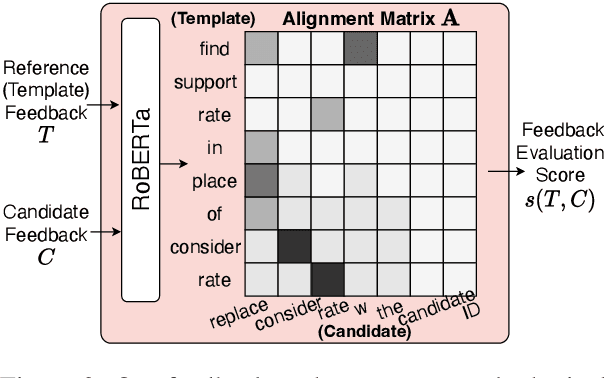

Interactive semantic parsing based on natural language (NL) feedback, where users provide feedback to correct the parser mistakes, has emerged as a more practical scenario than the traditional one-shot semantic parsing. However, prior work has heavily relied on human-annotated feedback data to train the interactive semantic parser, which is prohibitively expensive and not scalable. In this work, we propose a new task of simulating NL feedback for interactive semantic parsing. We accompany the task with a novel feedback evaluator. The evaluator is specifically designed to assess the quality of the simulated feedback, based on which we decide the best feedback simulator from our proposed variants. On a text-to-SQL dataset, we show that our feedback simulator can generate high-quality NL feedback to boost the error correction ability of a specific parser. In low-data settings, our feedback simulator can help achieve comparable error correction performance as trained using the costly, full set of human annotations.