 Add to Chrome
 Add to Firefox
 Add to Edge
HyperImageNet: A Large-Scale High-Spatial Resolution Hyperspectral Imagery Classification Benchmark
Jul 27, 2026
We present HyperImageNet, a large-scale benchmark for fine-grained hyperspectral land-cover understanding. The dataset contains 26,084 airborne hyperspectral image patches with 224 spectral bands and 138 fine-grained land-cover categories. Unlike existing datasets, HyperImageNet provides raw imagery, pixel-level semantic labels, and object-level instance masks, supporting both semantic and instance segmentation. Furthermore, we establish an open-environment benchmark with strict spatial separation to evaluate representative methods and the HyperFree foundation model. Experimental results demonstrate the effectiveness of HyperImageNet for fine-grained hyperspectral understanding and open-environment remote sensing research.

OpenDPR: Open-Vocabulary Change Detection via Vision-Centric Diffusion-Guided Prototype Retrieval for Remote Sensing Imagery
Mar 29, 2026Open-vocabulary change detection (OVCD) seeks to recognize arbitrary changes of interest by enabling generalization beyond a fixed set of predefined classes. We reformulate OVCD as a two-stage pipeline: first generate class-agnostic change proposals using visual foundation models (VFMs) such as SAM and DINOv2, and then perform category identification with vision-language models (VLMs) such as CLIP. We reveal that category identification errors are the primary bottleneck of OVCD, mainly due to the limited ability of VLMs based on image-text matching to represent fine-grained land-cover categories. To address this, we propose OpenDPR, a training-free vision-centric diffusion-guided prototype retrieval framework. OpenDPR leverages diffusion models to construct diverse prototypes for target categories offline, and to perform similarity retrieval with change proposals in the visual space during inference. The secondary bottleneck lies in change localization, due to the inherent lack of change priors in VFMs. To bridge this gap, we design a spatial-to-change weakly supervised change detection module named S2C to adapt their strong spatial modeling capabilities for change localization. Integrating the pretrained S2C into OpenDPR leads to an optional weakly supervised variant named OpenDPR-W, which further improves OVCD with minimal supervision. Experimental results on four benchmark datasets demonstrate that the proposed methods achieve state-of-the-art performance under both supervision modes. Code is available at https://github.com/guoqi2002/OpenDPR.
MapChange: Enhancing Semantic Change Detection with Temporal-Invariant Historical Maps Based on Deep Triplet Network
Jan 21, 2024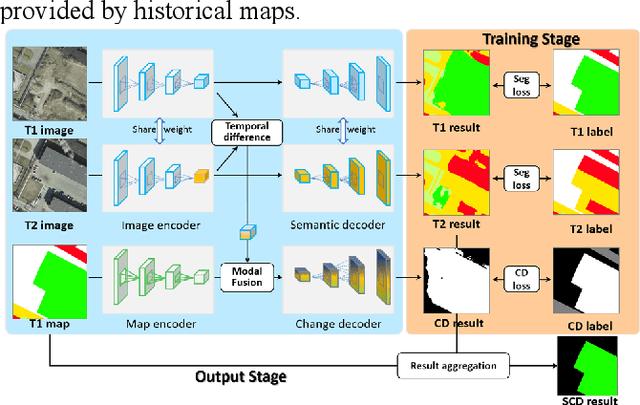
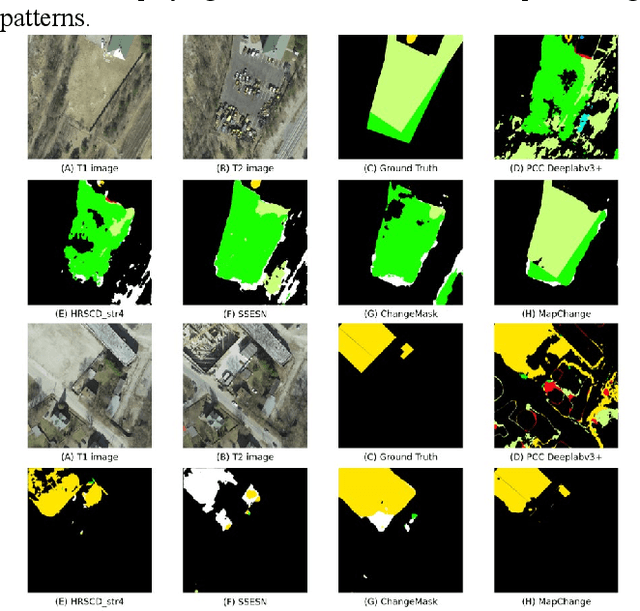


Semantic Change Detection (SCD) is recognized as both a crucial and challenging task in the field of image analysis. Traditional methods for SCD have predominantly relied on the comparison of image pairs. However, this approach is significantly hindered by substantial imaging differences, which arise due to variations in shooting times, atmospheric conditions, and angles. Such discrepancies lead to two primary issues: the under-detection of minor yet significant changes, and the generation of false alarms due to temporal variances. These factors often result in unchanged objects appearing markedly different in multi-temporal images. In response to these challenges, the MapChange framework has been developed. This framework introduces a novel paradigm that synergizes temporal-invariant historical map data with contemporary high-resolution images. By employing this combination, the temporal variance inherent in conventional image pair comparisons is effectively mitigated. The efficacy of the MapChange framework has been empirically validated through comprehensive testing on two public datasets. These tests have demonstrated the framework's marked superiority over existing state-of-the-art SCD methods.
Seeing Beyond the Patch: Scale-Adaptive Semantic Segmentation of High-resolution Remote Sensing Imagery based on Reinforcement Learning
Sep 27, 2023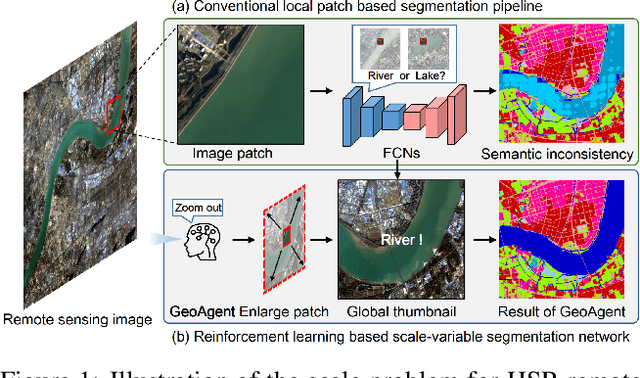
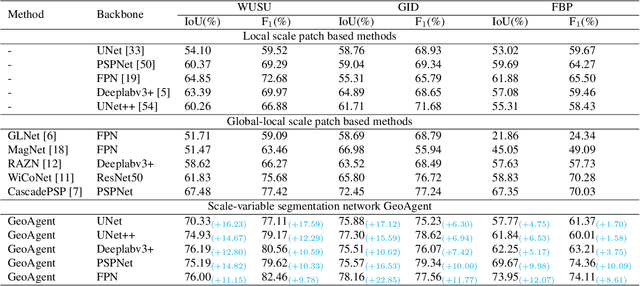
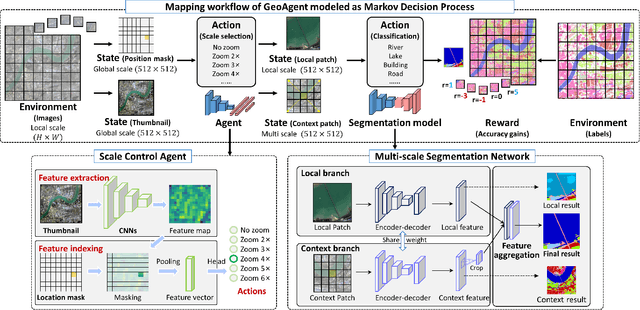
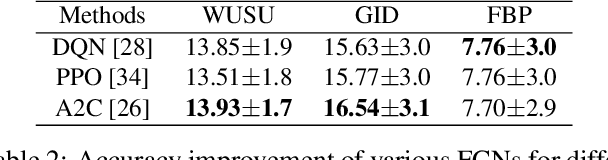
In remote sensing imagery analysis, patch-based methods have limitations in capturing information beyond the sliding window. This shortcoming poses a significant challenge in processing complex and variable geo-objects, which results in semantic inconsistency in segmentation results. To address this challenge, we propose a dynamic scale perception framework, named GeoAgent, which adaptively captures appropriate scale context information outside the image patch based on the different geo-objects. In GeoAgent, each image patch's states are represented by a global thumbnail and a location mask. The global thumbnail provides context beyond the patch, and the location mask guides the perceived spatial relationships. The scale-selection actions are performed through a Scale Control Agent (SCA). A feature indexing module is proposed to enhance the ability of the agent to distinguish the current image patch's location. The action switches the patch scale and context branch of a dual-branch segmentation network that extracts and fuses the features of multi-scale patches. The GeoAgent adjusts the network parameters to perform the appropriate scale-selection action based on the reward received for the selected scale. The experimental results, using two publicly available datasets and our newly constructed dataset WUSU, demonstrate that GeoAgent outperforms previous segmentation methods, particularly for large-scale mapping applications.