 Add to Chrome
 Add to Firefox
 Add to Edge
GeoLink: A 3D-Aware Framework Towards Better Generalization in Cross-View Geo-Localization
Apr 16, 2026
Generalizable cross-view geo-localization aims to match the same location across views in unseen regions and conditions without GPS supervision. Its core difficulty lies in severe semantic inconsistency caused by viewpoint variation and poor generalization under domain shift. Existing methods mainly rely on 2D correspondence, but they are easily distracted by redundant shared information across views, leading to less transferable representations. To address this, we propose GeoLink, a 3D-aware semantic-consistent framework for Generalizable cross-view geo-localization. Specifically, we offline reconstruct scene point clouds from multi-view drone images using VGGT, providing stable structural priors. Based on these 3D anchors, we improve 2D representation learning in two complementary ways. A Geometric-aware Semantic Refinement module mitigates potentially redundant and view-biased dependencies in 2D features under 3D guidance. In addition, a Unified View Relation Distillation module transfers 3D structural relations to 2D features, improving cross-view alignment while preserving a 2D-only inference pipeline. Extensive experiments on multiple benchmarks show that GeoLink consistently outperforms state-of-the-art methods and achieves superior generalization across unseen domains and diverse weather environments.

Unity in Diversity: Multi-expert Knowledge Confrontation and Collaboration for Generalizable Vehicle Re-identification
Jul 10, 2024
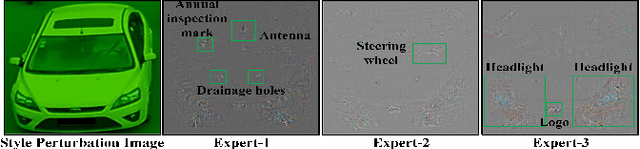


Generalizable vehicle re-identification (ReID) aims to enable the well-trained model in diverse source domains to broadly adapt to unknown target domains without additional fine-tuning or retraining. However, it still faces the challenges of domain shift problem and has difficulty accurately generalizing to unknown target domains. This limitation occurs because the model relies heavily on primary domain-invariant features in the training data and pays less attention to potentially valuable secondary features. To solve this complex and common problem, this paper proposes the two-stage Multi-expert Knowledge Confrontation and Collaboration (MiKeCoCo) method, which incorporates multiple experts with unique perspectives into Contrastive Language-Image Pretraining (CLIP) and fully leverages high-level semantic knowledge for comprehensive feature representation. Specifically, we propose to construct the learnable prompt set of all specific-perspective experts by adversarial learning in the latent space of visual features during the first stage of training. The learned prompt set with high-level semantics is then utilized to guide representation learning of the multi-level features for final knowledge fusion in the next stage. In this process of knowledge fusion, although multiple experts employ different assessment ways to examine the same vehicle, their common goal is to confirm the vehicle's true identity. Their collective decision can ensure the accuracy and consistency of the evaluation results. Furthermore, we design different image inputs for two-stage training, which include image component separation and diversity enhancement in order to extract the ID-related prompt representation and to obtain feature representation highlighted by all experts, respectively. Extensive experimental results demonstrate that our method achieves state-of-the-art recognition performance.