 Add to Chrome
 Add to Firefox
 Add to Edge
AutoCedar: An Agentic Framework for Verifier-Guided Access Control Policy Synthesis
Jul 04, 2026
Large Language Models are increasingly used to turn natural-language requirements into code. In access control, that shortcut is dangerous: a generated policy can compile and read correctly while granting access that no one approved. The difficulty is not only writing policy code. It is fixing what the requirements mean before code is written, and then checking that the final policy actually satisfies that intent. We present AutoCedar, a verifier-guided system that first turns natural-language access-control requirements into a reviewed, checkable target, and then synthesizes Cedar policies against that target. AutoCedar decomposes schema and policy authoring into small intent atoms: reviewable claims about vocabulary and behavior. Once those atoms pass mechanical validation and human intent review, the model proposes a candidate policy, the verifier checks it against the approved target, and each failure is turned into a repair signal that tells the model whether to broaden, narrow, or restructure the policy without changing the target. Because the model's work is split into small problems, each grounded in reviewed intent and backed by verifier feedback, end-to-end policy authoring becomes tractable. AutoCedar converges on all 221 tasks of CedarBench, our benchmark of authorization tasks paired with executable semantic boundaries. Across three requirements-corpus case studies covering healthcare, education, and conference management, AutoCedar converts noisy prose and extracted access-control fragments into reviewed schemas, formal checks, and a globally verified Cedar policy store for each scenario.

MAO: A Framework for Process Model Generation with Multi-Agent Orchestration
Aug 07, 2024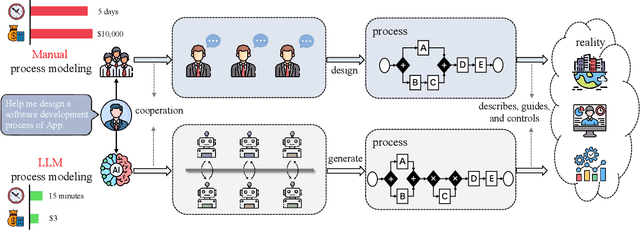
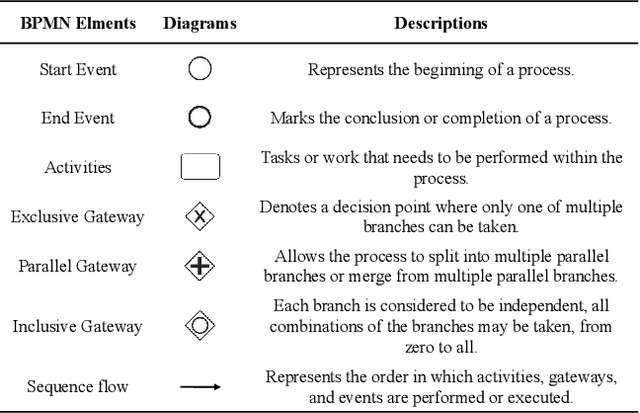
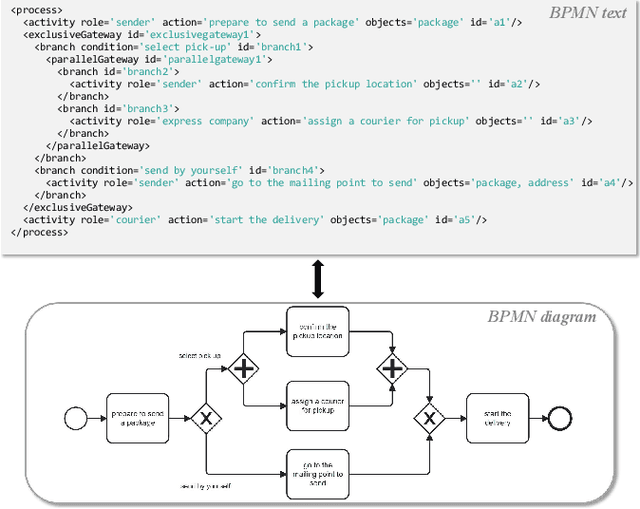
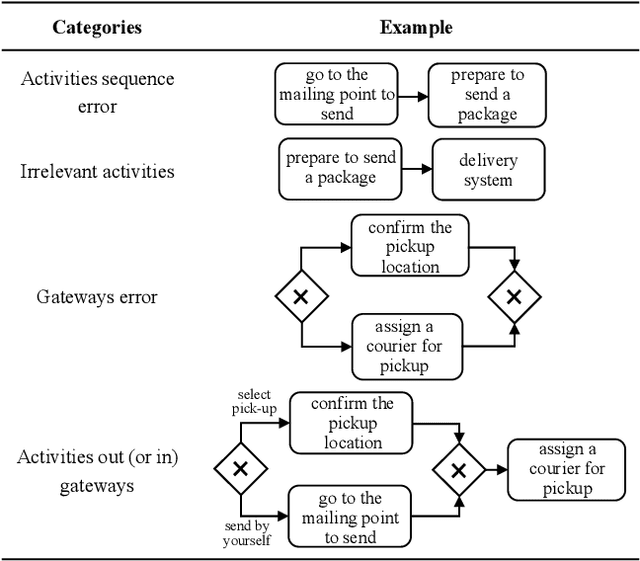
Process models are frequently used in software engineering to describe business requirements, guide software testing and control system improvement. However, traditional process modeling methods often require the participation of numerous experts, which is expensive and time-consuming. Therefore, the exploration of a more efficient and cost-effective automated modeling method has emerged as a focal point in current research. This article explores a framework for automatically generating process models with multi-agent orchestration (MAO), aiming to enhance the efficiency of process modeling and offer valuable insights for domain experts. Our framework MAO leverages large language models as the cornerstone for multi-agent, employing an innovative prompt strategy to ensure efficient collaboration among multi-agent. Specifically, 1) generation. The first phase of MAO is to generate a slightly rough process model from the text description; 2) refinement. The agents would continuously refine the initial process model through multiple rounds of dialogue; 3) reviewing. Large language models are prone to hallucination phenomena among multi-turn dialogues, so the agents need to review and repair semantic hallucinations in process models; 4) testing. The representation of process models is diverse. Consequently, the agents utilize external tools to test whether the generated process model contains format errors, namely format hallucinations, and then adjust the process model to conform to the output paradigm. The experiments demonstrate that the process models generated by our framework outperform existing methods and surpass manual modeling by 89%, 61%, 52%, and 75% on four different datasets, respectively.