 Add to Chrome
 Add to Firefox
 Add to Edge
PoliLegalLM: A Technical Report on a Large Language Model for Political and Legal Affairs
Apr 19, 2026
Large language models (LLMs) have achieved remarkable success in general-domain tasks, yet their direct application to the legal domain remains challenging due to hallucinated legal citations, incomplete knowledge coverage, and weak structured reasoning. To address these issues, we propose PoliLegalLM, a domain-specific large language model tailored for political and legal applications. Our approach adopts a unified training framework that integrates continued pretraining, progressive supervised fine-tuning, and preference-based reinforcement learning to jointly enhance legal knowledge grounding, task alignment, and reasoning capability. We construct a large-scale, high-quality legal corpus and design a structured post-training pipeline, enabling the model to effectively learn domain-specific knowledge and adapt to diverse legal tasks. We evaluate PoliLegalLM on three representative benchmarks, including LawBench, LexEval, and a real-world dataset, PoliLegal. Experimental results demonstrate that PoliLegalLM achieves strong and consistent performance, outperforming competitive models of similar scale and remaining highly competitive with significantly larger models, while achieving the best results on real-world legal scenarios. These results highlight the effectiveness of our training paradigm and the practical value of domain-specific LLMs for real-world legal applications.

Evaluating Test-Time Scaling LLMs for Legal Reasoning: OpenAI o1, DeepSeek-R1, and Beyond
Mar 20, 2025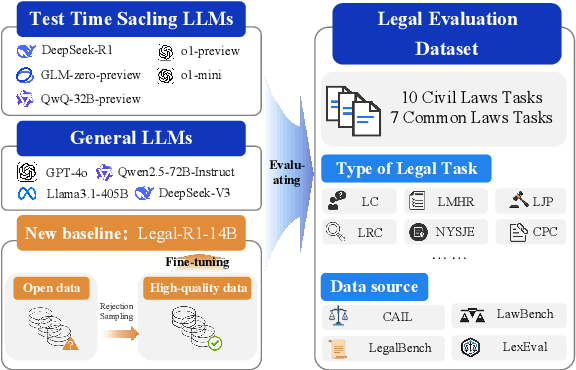
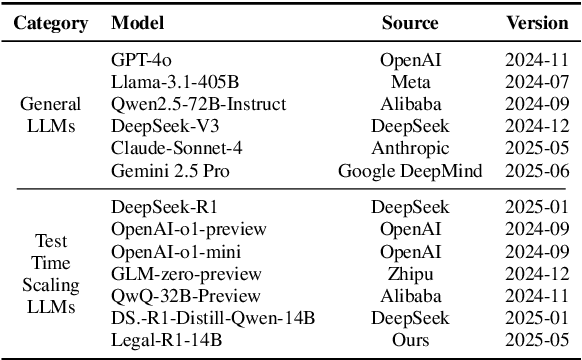
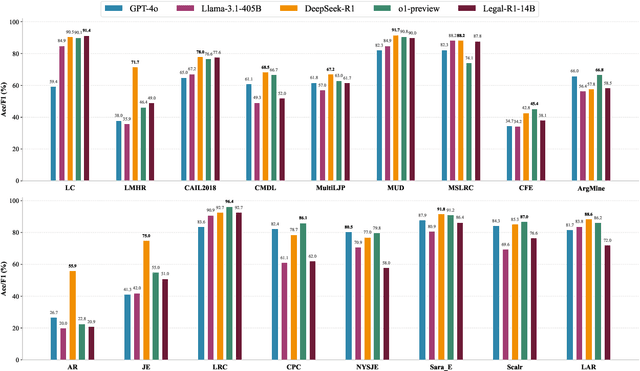
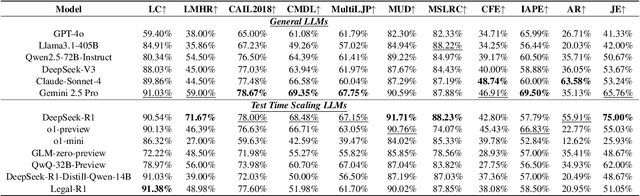
Recently, Test-Time Scaling Large Language Models (LLMs), such as DeepSeek-R1 and OpenAI o1, have demonstrated exceptional capabilities across various domains and tasks, particularly in reasoning. While these models have shown impressive performance on general language tasks, their effectiveness in specialized fields like legal remains unclear. To address this, we present a preliminary evaluation of LLMs in various legal scenarios, covering both Chinese and English legal tasks. Our analysis includes 9 LLMs and 17 legal tasks, with a focus on newly published and more complex challenges such as multi-defendant legal judgments and legal argument reasoning. Our findings indicate that, despite DeepSeek-R1 and OpenAI o1 being among the most powerful models, their legal reasoning capabilities are still lacking. Specifically, these models score below 80\% on seven Chinese legal reasoning tasks and below 80\% on two English legal reasoning tasks. This suggests that, even among the most advanced reasoning models, legal reasoning abilities remain underdeveloped.