 Add to Chrome
 Add to Firefox
 Add to Edge
Taming the Long Tail: Rebalancing Adversarial Training via Adaptive Perturbation
May 13, 2026
Deep neural networks are highly vulnerable to adversarial examples, i.e.,small perturbations that can significantly degrade model performance. While adversarial training has become the primary defense strategy, most studies focus on balanced datasets, overlooking the challenges posed by real-world long-tail data. Motivated by the fact that perturbations in adversarial examples inherently alter the training distribution, we theoretically investigate their impact. We first revisit adversarial training for long-tail data and identify two key limitations: (i) a skewed training objective caused by class imbalance, and (ii) unstable evolution of adversarial distributions. Furthermore, we show that perturbations can simultaneously address both adversarial vulnerability and class imbalance. Based on these insights, we propose RobustLT, a plug-and-play framework that adaptively adjusts perturbations during adversarial training. Extensive experiments demonstrate that RobustLT consistently enhances adversarial robustness and class-balance on long-tailed datasets. The code is available at \href{https://github.com/zhang-lilin/RobustLT}{https://github.com/zhang-lilin/RobustLT}.

Measure Anatomical Thickness from Cardiac MRI with Deep Neural Networks
Aug 25, 2020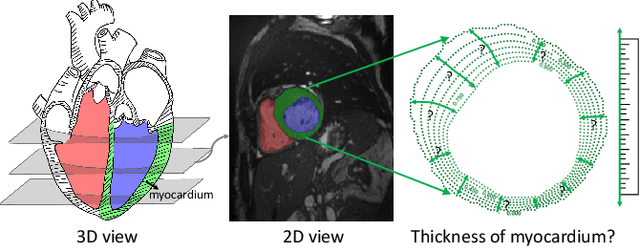
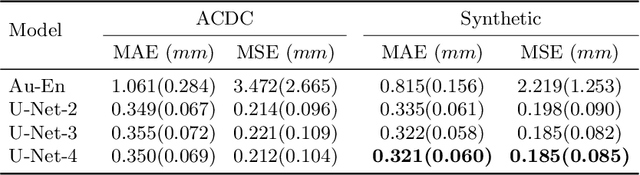
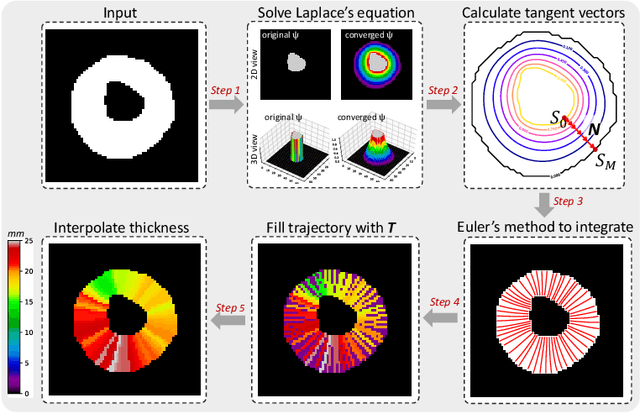
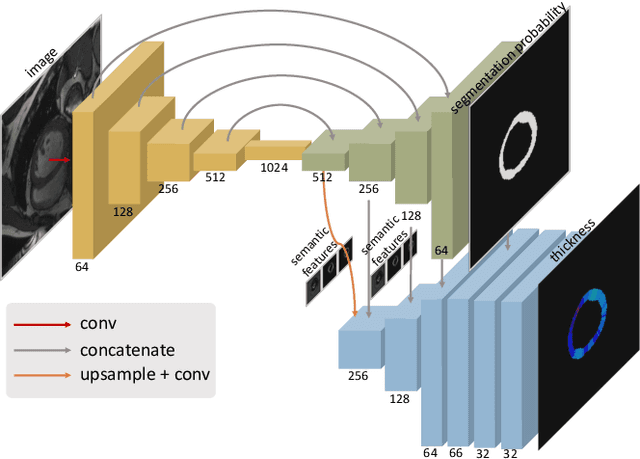
Accurate estimation of shape thickness from medical images is crucial in clinical applications. For example, the thickness of myocardium is one of the key to cardiac disease diagnosis. While mathematical models are available to obtain accurate dense thickness estimation, they suffer from heavy computational overhead due to iterative solvers. To this end, we propose novel methods for dense thickness estimation, including a fast solver that estimates thickness from binary annular shapes and an end-to-end network that estimates thickness directly from raw cardiac images.We test the proposed models on three cardiac datasets and one synthetic dataset, achieving impressive results and generalizability on all. Thickness estimation is performed without iterative solvers or manual correction, which is 100 times faster than the mathematical model. We also analyze thickness patterns on different cardiac pathologies with a standard clinical model and the results demonstrate the potential clinical value of our method for thickness based cardiac disease diagnosis.