 Add to Chrome
 Add to Firefox
 Add to Edge
Failures Reveal What Metrics Miss: An Evidence-Driven Agent for Recursive Refinement of ECG Classifiers
Jul 27, 2026
Deep models have substantially advanced 12-lead ECG classification, yet their refinement still relies heavily on human experts to inspect failures and iteratively revise classifier designs. Recent LLM-based agents have demonstrated the potential for automated model design, but when guided only by aggregate performance metrics, they lack insight into why individual cases fail and how the classifier should be revised. We present RecursiveECG, an evidence-driven LLM-as-Designer framework in which an LLM serves as an offline model designer that refines ECG classifiers based on concrete failures and objective ECG evidence. To ground failure diagnosis in executable evidence, Criteria-to-Measurement Compilation converts curated ECG criteria into validated deterministic functions that produce reproducible, reference-backed measurements for individual ECGs. Building on these measurements, Evidence-Grounded Failure Review analyzes failed and comparator cases by jointly considering raw waveforms, measurements, and model outputs, enabling the LLM to diagnose classifier limitations and formulate targeted revisions. Candidate revisions are executed and re-evaluated under a fixed problem contract, and only evidence-supported updates are retained. The resulting predictor is frozen after refinement and requires no LLM inference during deployment, while an audit trail links each accepted revision to its supporting evidence. Across PTB-XL, Georgia, and CPSC2018, RecursiveECG consistently outperforms strong baselines, achieving an average relative improvement of 10.0%. Extensive ablation and transfer studies further validate the effectiveness of its evidence-grounded refinement process.

Accurate and Efficient Multivariate Time Series Forecasting via Offline Clustering
May 09, 2025Accurate and efficient multivariate time series (MTS) forecasting is essential for applications such as traffic management and weather prediction, which depend on capturing long-range temporal dependencies and interactions between entities. Existing methods, particularly those based on Transformer architectures, compute pairwise dependencies across all time steps, leading to a computational complexity that scales quadratically with the length of the input. To overcome these challenges, we introduce the Forecaster with Offline Clustering Using Segments (FOCUS), a novel approach to MTS forecasting that simplifies long-range dependency modeling through the use of prototypes extracted via offline clustering. These prototypes encapsulate high-level events in the real-world system underlying the data, summarizing the key characteristics of similar time segments. In the online phase, FOCUS dynamically adapts these patterns to the current input and captures dependencies between the input segment and high-level events, enabling both accurate and efficient forecasting. By identifying prototypes during the offline clustering phase, FOCUS reduces the computational complexity of modeling long-range dependencies in the online phase to linear scaling. Extensive experiments across diverse benchmarks demonstrate that FOCUS achieves state-of-the-art accuracy while significantly reducing computational costs.
Automatic Text Summarization of COVID-19 Medical Research Articles using BERT and GPT-2
Jun 03, 2020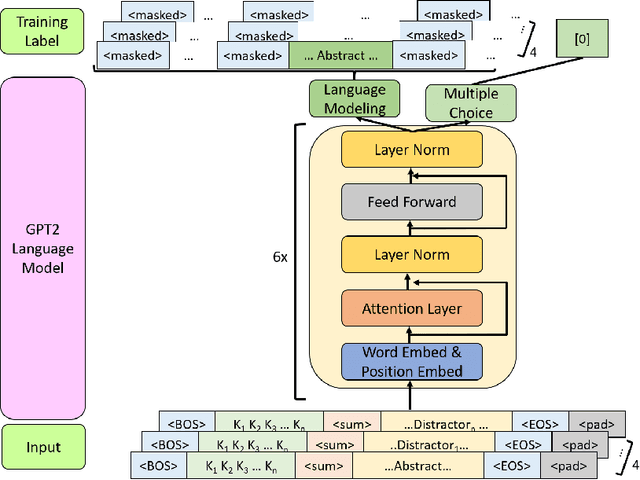
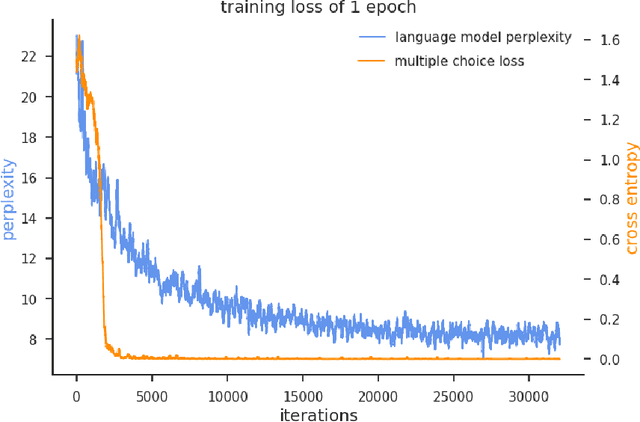
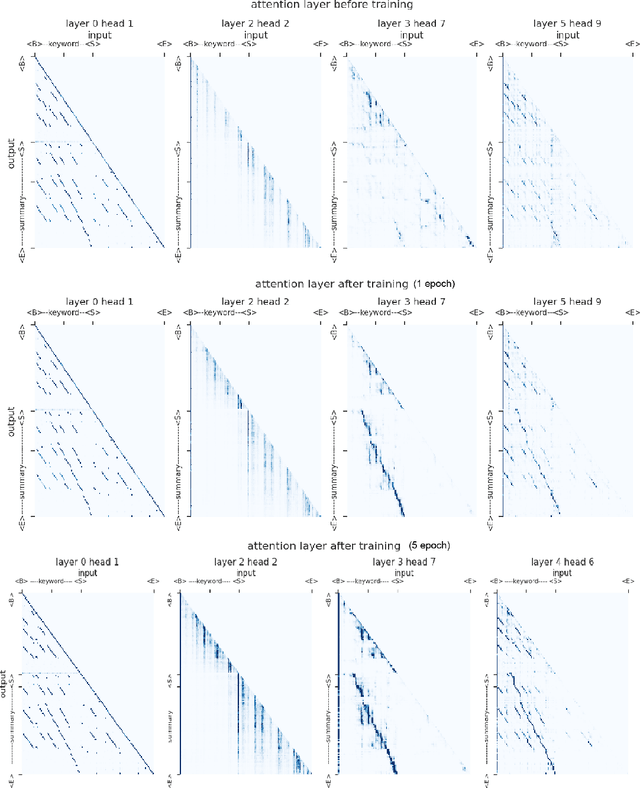
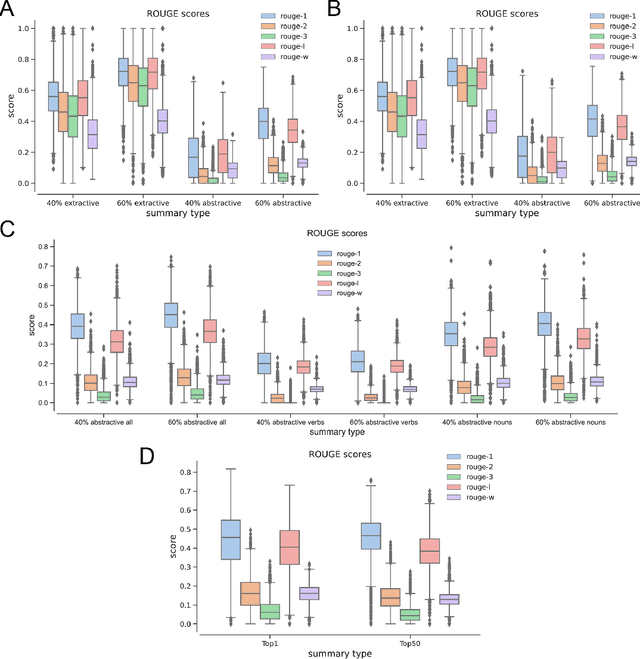
With the COVID-19 pandemic, there is a growing urgency for medical community to keep up with the accelerating growth in the new coronavirus-related literature. As a result, the COVID-19 Open Research Dataset Challenge has released a corpus of scholarly articles and is calling for machine learning approaches to help bridging the gap between the researchers and the rapidly growing publications. Here, we take advantage of the recent advances in pre-trained NLP models, BERT and OpenAI GPT-2, to solve this challenge by performing text summarization on this dataset. We evaluate the results using ROUGE scores and visual inspection. Our model provides abstractive and comprehensive information based on keywords extracted from the original articles. Our work can help the the medical community, by providing succinct summaries of articles for which the abstract are not already available.