 Add to Chrome
 Add to Firefox
 Add to Edge
Spatially Coupled Sparse Code Multiple Access (SC-SCMA): A Spectral Graph Approach
Jun 30, 2026
This paper presents a spatially coupled sparse code multiple access (SC-SCMA) framework to overcome the performance and scalability limitations of conventional SCMA systems. By analyzing the pairwise error probability associated to multi-user error patterns, we show that spatial coupling projects the superimposed SCMA codewords into a higher-dimensional effective signal space, leading to a strictly improved minimum Euclidean distance (MED) compared with conventional SCMA, while simultaneously enhancing the coding gain through global message propagation and the diversity gain through inter-block resource spreading. Such a distance gain is shown to be governed by the effective access dimensionality (EAD) induced by the coupled factor graph. With the aid of spectral graph theory, we establish a direct relationship between the spectral gap of the factor graph and a lower bound on the EAD, providing a computable structural metric that guarantees MED improvement under various error patterns. Building upon these theoretical insights, we introduce a low-complexity structure-aware codebook design approach, including a spectral-gap-oriented construction of spatially coupled factor matrices and a localized codebook optimization strategy that exploits the dominant error-inducing local user group. Simulation results validate the analysis and demonstrate that the proposed SC-SCMA consistently outperforms conventional SCMA in overloaded massive access channels.

Novel Power-Imbalanced Dense Codebooks for Reliable Multiplexing in Nakagami Channels
Sep 07, 2023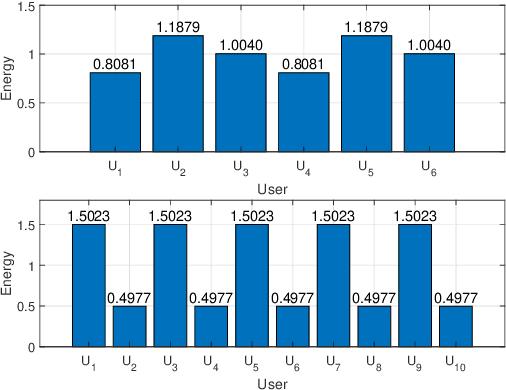
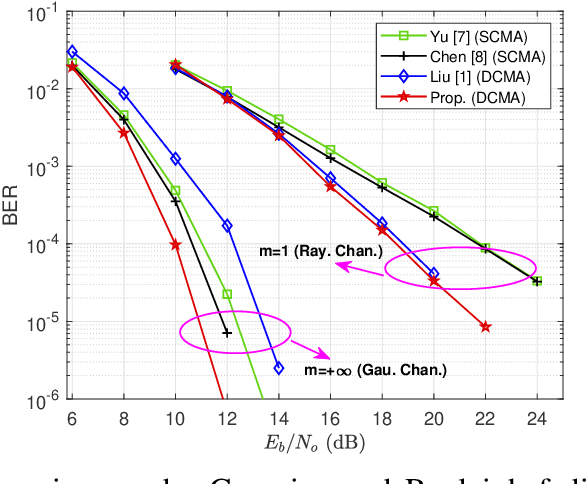
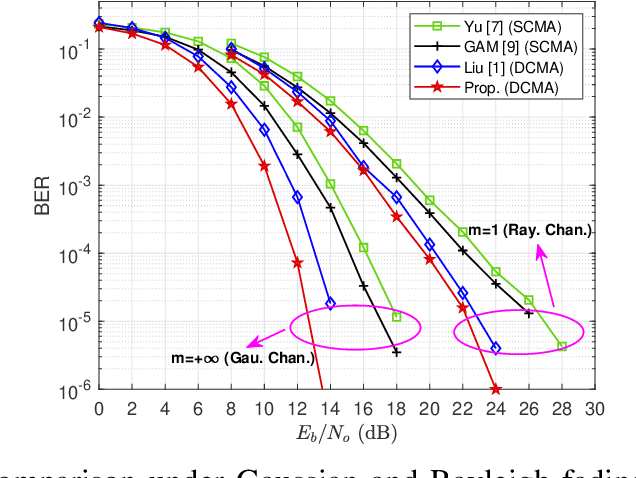
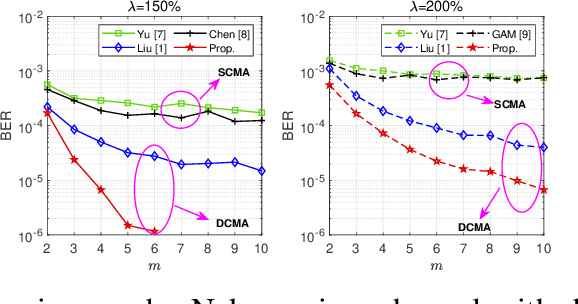
This paper studies enhanced dense code multiple access (DCMA) system design for downlink transmission over the Nakagami-$m$ fading channels. By studying the DCMA pairwise error probability (PEP) in a Nakagami-$m$ channel, a novel design metric called minimum logarithmic sum distance (MLSD) is first derived. With respect to the proposed MLSD, we introduce a new family of power-imbalanced dense codebooks by deleting certain rows of a special non-unimodular circulant matrix. Simulation results demonstrate that our proposed dense codebooks lead to both larger minimum Euclidean distance and MLSD, thus yielding significant improvements of error performance over the existing sparse code multiple access and conventional unimodular DCMA schemes in Nakagami-$m$ fading channels under different overloading factors.