 Add to Chrome
 Add to Firefox
 Add to Edge
Climate-resilient electric vehicle charging infrastructure for sustainable cities: An interpretable causal-ensemble framework for preventive maintenance and low-carbon mobility
Jul 23, 2026
Reliable electric vehicle (EV) charging infrastructure is a cornerstone of sustainable, low-carbon cities, yet urban climate stress such as extreme heat, heavy precipitation, and humidity increasingly raises equipment fault risk and undermines the resilience of urban energy and mobility services. Shifting operation from reactive repair to preventive maintenance depends on accurate, forward-looking fault-risk prediction, a task complicated by the heterogeneous time scales of physical, behavioral, contextual, and historical signals and by forecasting over a multi-week horizon. We develop FGDSE, a feature-governed dynamic stacking ensemble that forms an interpretable decision-support system for climate-resilient charging-asset management. It partitions heterogeneous signals into four feature families, assigns each to a domain expert whose inductive bias matches the data, and adds two deep temporal experts for short-term pulses and long-term degradation; a horizon-wise gating mechanism then learns adaptive weights to forecast daily fault risk over 1 to 30 days. SHAP attribution and an X-learner extend the probabilistic output into causal decision support with post-level treatment effects. On 25 months of data from 13 stations, FGDSE surpasses twelve baselines beyond the ten-day horizon, sustains about 85% macro-recall at 30 days with an AUC decay of only 3.2 points, and reveals a shift of dominance from fault history toward climate stress. It identifies extreme heat as the sole exposure whose causal effect amplifies over time, flagging roughly 30% of posts as heat-sensitive and yielding quantitative thresholds for climate-adaptive maintenance that strengthens urban mobility resilience and sustains low-carbon travel.

Inter-Stop Energy Prediction and Causal Driver Quantification for Dual-Source Trolleybuses via a Time-Aware Tabular Deep Learning Architecture
Jul 13, 2026Dual-source trolleybuses alternate between overhead catenary supply and on-board battery operation, creating energy-use patterns driven by route attributes, high-frequency trajectories, and hourly weather. Existing models struggle to represent these heterogeneous inputs and rarely explain the causal drivers of consumption. This paper proposes a time-aware tabular deep learning framework for inter-stop energy management. Periodic time encoding is integrated into a parameter-efficient batch-ensemble backbone to jointly learn static and sequential features, while Bayesian optimization with tree-structured density estimation tunes hyperparameters. To move beyond prediction, a three-layer causal explanation pipeline combines feature attribution for marginal effects, a linear non-Gaussian acyclic model for causal direction discovery, and a meta-learner for net average treatment effects. Experiments on the Zurich trolleybus dataset enriched with meteorological records achieve a MAPE of 6.52% and R of 0.982, outperforming ten statistical, tree-ensemble, and deep learning baselines. Ablation results show that periodic time encoding contributes most to the accuracy gain. Causal analysis identifies regenerative braking ratio and average speed as the strongest energy-saving factors, while coasting distance is the main driver of excess consumption. The findings offer actionable thresholds for vehicle technology, driving behavior, capacity allocation, and catenary network planning.
GPT-4 Enhanced Multimodal Grounding for Autonomous Driving: Leveraging Cross-Modal Attention with Large Language Models
Dec 06, 2023
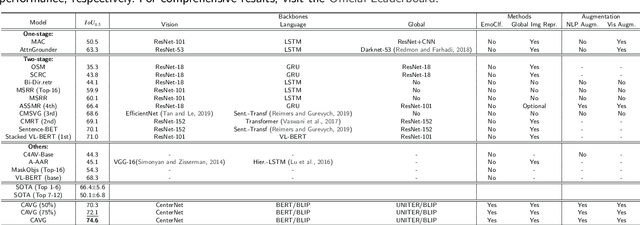
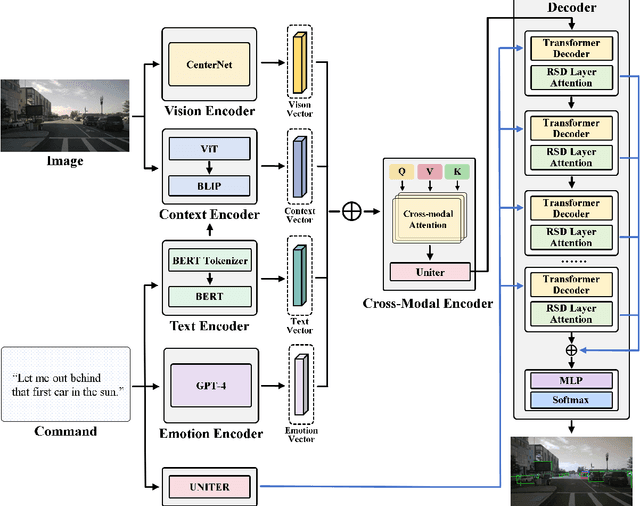
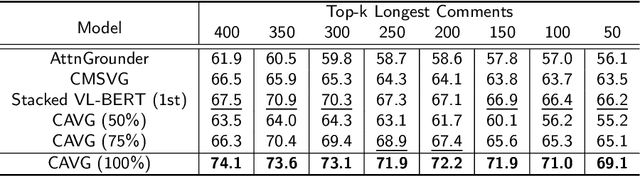
In the field of autonomous vehicles (AVs), accurately discerning commander intent and executing linguistic commands within a visual context presents a significant challenge. This paper introduces a sophisticated encoder-decoder framework, developed to address visual grounding in AVs.Our Context-Aware Visual Grounding (CAVG) model is an advanced system that integrates five core encoders-Text, Image, Context, and Cross-Modal-with a Multimodal decoder. This integration enables the CAVG model to adeptly capture contextual semantics and to learn human emotional features, augmented by state-of-the-art Large Language Models (LLMs) including GPT-4. The architecture of CAVG is reinforced by the implementation of multi-head cross-modal attention mechanisms and a Region-Specific Dynamic (RSD) layer for attention modulation. This architectural design enables the model to efficiently process and interpret a range of cross-modal inputs, yielding a comprehensive understanding of the correlation between verbal commands and corresponding visual scenes. Empirical evaluations on the Talk2Car dataset, a real-world benchmark, demonstrate that CAVG establishes new standards in prediction accuracy and operational efficiency. Notably, the model exhibits exceptional performance even with limited training data, ranging from 50% to 75% of the full dataset. This feature highlights its effectiveness and potential for deployment in practical AV applications. Moreover, CAVG has shown remarkable robustness and adaptability in challenging scenarios, including long-text command interpretation, low-light conditions, ambiguous command contexts, inclement weather conditions, and densely populated urban environments. The code for the proposed model is available at our Github.