 Add to Chrome
 Add to Firefox
 Add to Edge
Parameter Inference and Uncertainty Quantification with Diffusion Models: Extending CDI to 2D Spatial Conditioning
Jan 23, 2026
Uncertainty quantification is critical in scientific inverse problems to distinguish identifiable parameters from those that remain ambiguous given available measurements. The Conditional Diffusion Model-based Inverse Problem Solver (CDI) has previously demonstrated effective probabilistic inference for one-dimensional temporal signals, but its applicability to higher-dimensional spatial data remains unexplored. We extend CDI to two-dimensional spatial conditioning, enabling probabilistic parameter inference directly from spatial observations. We validate this extension on convergent beam electron diffraction (CBED) parameter inference - a challenging multi-parameter inverse problem in materials characterization where sample geometry, electronic structure, and thermal properties must be extracted from 2D diffraction patterns. Using simulated CBED data with ground-truth parameters, we demonstrate that CDI produces well-calibrated posterior distributions that accurately reflect measurement constraints: tight distributions for well-determined quantities and appropriately broad distributions for ambiguous parameters. In contrast, standard regression methods - while appearing accurate on aggregate metrics - mask this underlying uncertainty by predicting training set means for poorly constrained parameters. Our results confirm that CDI successfully extends from temporal to spatial domains, providing the genuine uncertainty information required for robust scientific inference.

Quantum materials for energy-efficient neuromorphic computing
Apr 04, 2022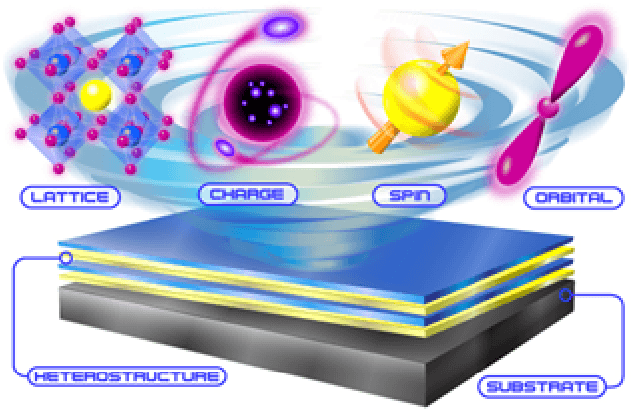
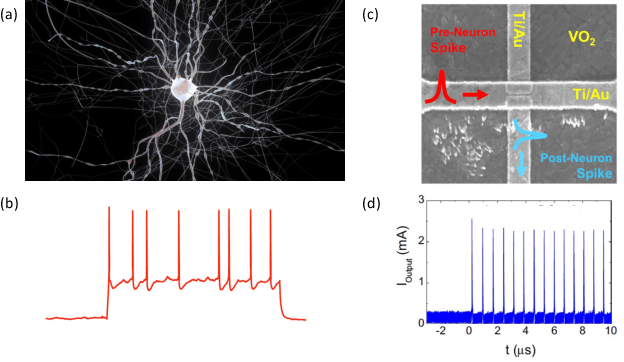
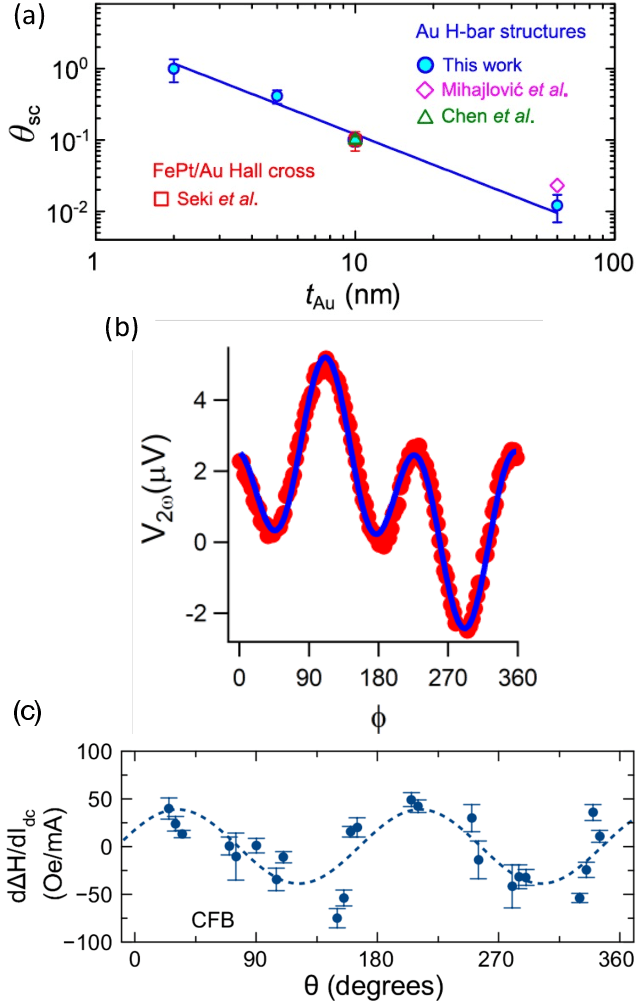
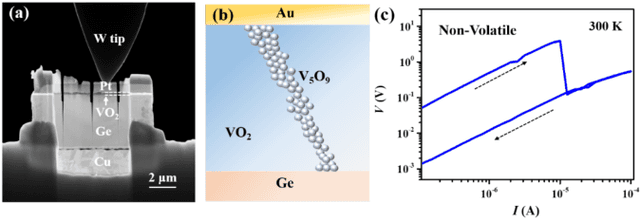
Neuromorphic computing approaches become increasingly important as we address future needs for efficiently processing massive amounts of data. The unique attributes of quantum materials can help address these needs by enabling new energy-efficient device concepts that implement neuromorphic ideas at the hardware level. In particular, strong correlations give rise to highly non-linear responses, such as conductive phase transitions that can be harnessed for short and long-term plasticity. Similarly, magnetization dynamics are strongly non-linear and can be utilized for data classification. This paper discusses select examples of these approaches, and provides a perspective for the current opportunities and challenges for assembling quantum-material-based devices for neuromorphic functionalities into larger emergent complex network systems.