 Add to Chrome
 Add to Firefox
 Add to Edge
ArthroCut: Autonomous Policy Learning for Robotic Bone Resection in Knee Arthroplasty
Mar 04, 2026
Despite rapid commercialization of surgical robots, their autonomy and real-time decision-making remain limited in practice. To address this gap, we propose ArthroCut, an autonomous policy learning framework that upgrades knee arthroplasty robots from assistive execution to context-aware action generation. ArthroCut fine-tunes a Qwen--VL backbone on a self-built, time-synchronized multimodal dataset from 21 complete cases (23,205 RGB--D pairs), integrating preoperative CT/MR, intraoperative NDI tracking of bones and end effector, RGB--D surgical video, robot state, and textual intent. The method operates on two complementary token families -- Preoperative Imaging Tokens (PIT) to encode patient-specific anatomy and planned resection planes, and Time-Aligned Surgical Tokens (TAST) to fuse real-time visual, geometric, and kinematic evidence -- and emits an interpretable action grammar under grammar/safety-constrained decoding. In bench-top experiments on a knee prosthesis across seven trials, ArthroCut achieves an average success rate of 86% over the six standard resections, significantly outperforming strong baselines trained under the same protocol. Ablations show that TAST is the principal driver of reliability while PIT provides essential anatomical grounding, and their combination yields the most stable multi-plane execution. These results indicate that aligning preoperative geometry with time-aligned intraoperative perception and translating that alignment into tokenized, constrained actions is an effective path toward robust, interpretable autonomy in orthopedic robotic surgery.

MTFL: Multi-Timescale Feature Learning for Weakly-Supervised Anomaly Detection in Surveillance Videos
Oct 08, 2024
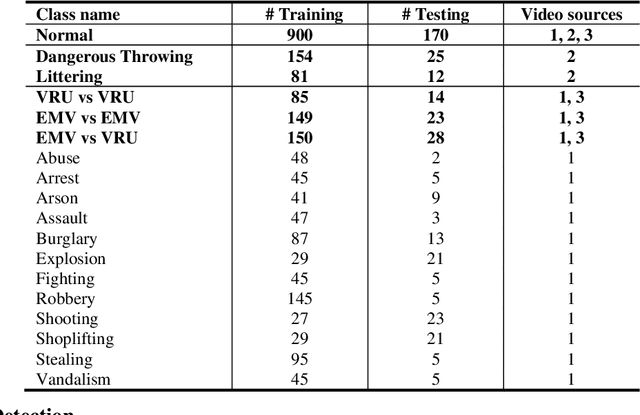

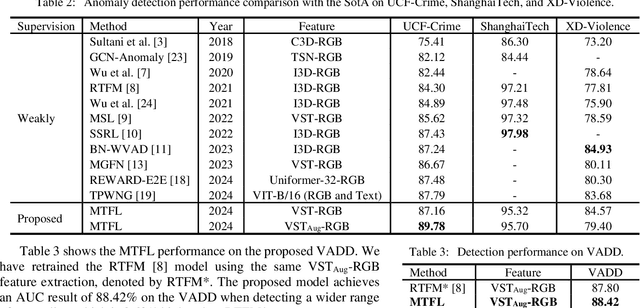
Detection of anomaly events is relevant for public safety and requires a combination of fine-grained motion information and contextual events at variable time-scales. To this end, we propose a Multi-Timescale Feature Learning (MTFL) method to enhance the representation of anomaly features. Short, medium, and long temporal tubelets are employed to extract spatio-temporal video features using a Video Swin Transformer. Experimental results demonstrate that MTFL outperforms state-of-the-art methods on the UCF-Crime dataset, achieving an anomaly detection performance 89.78% AUC. Moreover, it performs complementary to SotA with 95.32% AUC on the ShanghaiTech and 84.57% AP on the XD-Violence dataset. Furthermore, we generate an extended dataset of the UCF-Crime for development and evaluation on a wider range of anomalies, namely Video Anomaly Detection Dataset (VADD), involving 2,591 videos in 18 classes with extensive coverage of realistic anomalies.
CLDTA: Contrastive Learning based on Diagonal Transformer Autoencoder for Cross-Dataset EEG Emotion Recognition
Jun 12, 2024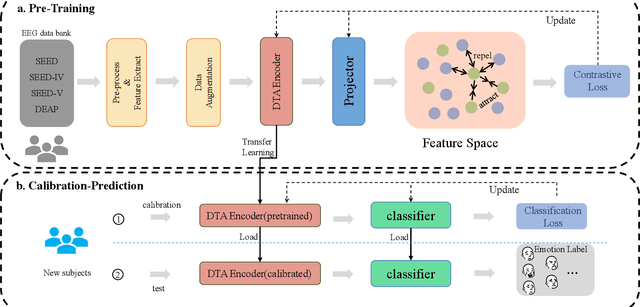
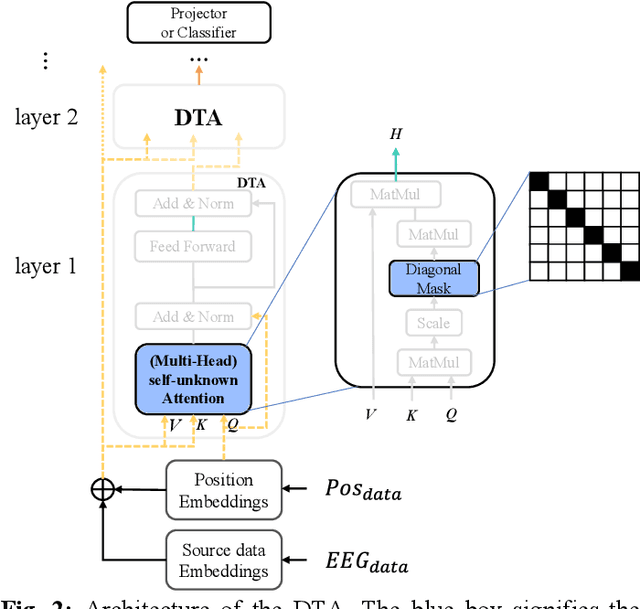
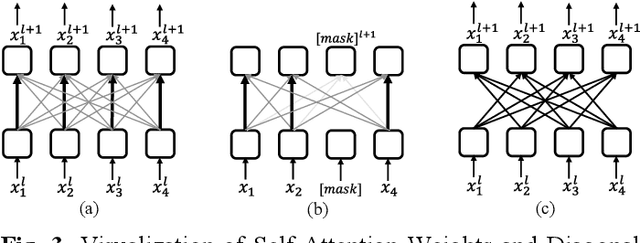
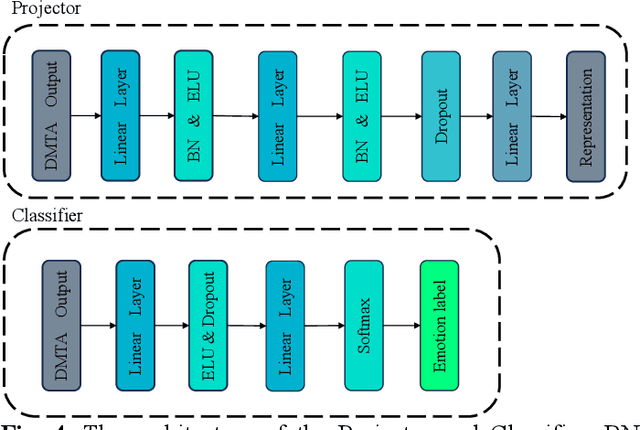
Recent advances in non-invasive EEG technology have broadened its application in emotion recognition, yielding a multitude of related datasets. Yet, deep learning models struggle to generalize across these datasets due to variations in acquisition equipment and emotional stimulus materials. To address the pressing need for a universal model that fluidly accommodates diverse EEG dataset formats and bridges the gap between laboratory and real-world data, we introduce a novel deep learning framework: the Contrastive Learning based Diagonal Transformer Autoencoder (CLDTA), tailored for EEG-based emotion recognition. The CLDTA employs a diagonal masking strategy within its encoder to extracts full-channel EEG data's brain network knowledge, facilitating transferability to the datasets with fewer channels. And an information separation mechanism improves model interpretability by enabling straightforward visualization of brain networks. The CLDTA framework employs contrastive learning to distill subject-independent emotional representations and uses a calibration prediction process to enable rapid adaptation of the model to new subjects with minimal samples, achieving accurate emotion recognition. Our analysis across the SEED, SEED-IV, SEED-V, and DEAP datasets highlights CLDTA's consistent performance and proficiency in detecting both task-specific and general features of EEG signals related to emotions, underscoring its potential to revolutionize emotion recognition research.