 Add to Chrome
 Add to Firefox
 Add to Edge
ReFP-AD: Rectified Flow Preconditioning for Energy-Based Anomaly Detection
Aug 03, 2026
Unified anomaly detection requires modeling highly heterogeneous normal data without access to anomalous samples. While foundation models like DINOv2 provide rich token representations, leveraging these spaces for explicit density estimation remains challenging. Energy-Based Models (EBMs) offer a principled formulation, but their training in high-dimensional token spaces is unstable due to anisotropy and strong cross-dimensional correlations, which degrades finite-step Markov Chain Monte Carlo (MCMC) sampling. We identify this instability as fundamentally geometric and introduce ReFP-AD (Rectified Flow Preconditioning for Anomaly Detection), which learns a geometric reparameterization that maps high-dimensional embeddings into a well-conditioned latent space via an optimal transport (OT)-coupled rectified flow. This preconditioning enables stable persistent contrastive divergence with preconditioned Stochastic Gradient Langevin Dynamics (SGLD) in full-dimensional token spaces. Anomaly scores are then derived from the learned energy landscape using gradient norms. Under a strict unified protocol on the MVTec-AD and VisA datasets, ReFP-AD achieves 98.6%/97.9% Image/Pixel AUROC on MVTec-AD and 97.3%/99.0% on VisA, outperforming prior unified EBM baselines by up to +10.8% in Image AUROC. Ablation experiments demonstrate that geometric reparameterization is critical for finite-step MCMC and accurate anomaly localization in high-dimensional token spaces. Code is available at https://github.com/CLendering/ReFP-AD

Boxes2Pixels: Learning Defect Segmentation from Noisy SAM Masks
Apr 13, 2026Accurate defect segmentation is critical for industrial inspection, yet dense pixel-level annotations are rarely available. A common workaround is to convert inexpensive bounding boxes into pseudo-masks using foundation segmentation models such as the Segment Anything Model (SAM). However, these pseudo-labels are systematically noisy on industrial surfaces, often hallucinating background structure while missing sparse defects. To address this limitation, a noise-robust box-to-pixel distillation framework, Boxes2Pixels, is proposed that treats SAM as a noisy teacher rather than a source of ground-truth supervision. Bounding boxes are converted into pseudo-masks offline by SAM, and a compact student is trained with (i) a hierarchical decoder over frozen DINOv2 features for semantic stability, (ii) an auxiliary binary localization head to decouple sparse foreground discovery from class prediction, and (iii) a one-sided online self-correction mechanism that relaxes background supervision when the student is confident, targeting teacher false negatives. On a manually annotated wind turbine inspection benchmark, the proposed Boxes2Pixels improves anomaly mIoU by +6.97 and binary IoU by +9.71 over the strongest baseline trained under identical weak supervision. Moreover, online self-correction increases the binary recall by +18.56, while the model employs 80\% fewer trainable parameters. Code is available at https://github.com/CLendering/Boxes2Pixels.
F3G-Avatar : Face Focused Full-body Gaussian Avatar
Apr 10, 2026Existing full-body Gaussian avatar methods primarily optimize global reconstruction quality and often fail to preserve fine-grained facial geometry and expression details. This challenge arises from limited facial representational capacity that causes difficulties in modeling high-frequency pose-dependent deformations. To address this, we propose F3G-Avatar, a full-body, face-aware avatar synthesis method that reconstructs animatable human representations from multi-view RGB video and regressed pose/shape parameters. Starting from a clothed Momentum Human Rig (MHR) template, front/back positional maps are rendered and decoded into 3D Gaussians through a two-branch architecture: a body branch that captures pose-dependent non-rigid deformations and a face-focused deformation branch that refines head geometry and appearance. The predicted Gaussians are fused, posed with linear blend skinning (LBS), and rendered with differentiable Gaussian splatting. Training combines reconstruction and perceptual objectives with a face-specific adversarial loss to enhance realism in close-up views. Experiments demonstrate strong rendering quality, with face-view performance reaching PSNR/SSIM/LPIPS of 26.243/0.964/0.084 on the AvatarReX dataset. Ablations further highlight contributions of the MHR template and the face-focused deformation. F3G-Avatar provides a practical, high-quality pipeline for realistic, animatable full-body avatar synthesis.
LiveStre4m: Feed-Forward Live Streaming of Novel Views from Unposed Multi-View Video
Apr 08, 2026Live-streaming Novel View Synthesis (NVS) from unposed multi-view video remains an open challenge in a wide range of applications. Existing methods for dynamic scene representation typically require ground-truth camera parameters and involve lengthy optimizations ($\approx 2.67$s), which makes them unsuitable for live streaming scenarios. To address this issue, we propose a novel viewpoint video live-streaming method (LiveStre4m), a feed-forward model for real-time NVS from unposed sparse multi-view inputs. LiveStre4m introduces a multi-view vision transformer for keyframe 3D scene reconstruction coupled with a diffusion-transformer interpolation module that ensures temporal consistency and stable streaming. In addition, a Camera Pose Predictor module is proposed to efficiently estimate both poses and intrinsics directly from RGB images, removing the reliance on known camera calibration information. Our approach enables temporally consistent novel-view video streaming in real-time using as few as two synchronized unposed input streams. LiveStre4m attains an average reconstruction time of $ 0.07$s per-frame at $ 1024 \times 768$ resolution, outperforming the optimization-based dynamic scene representation methods by orders of magnitude in runtime. These results demonstrate that LiveStre4m makes real-time NVS streaming feasible in practical settings, marking a substantial step toward deployable live novel-view synthesis systems. Code available at: https://github.com/pedro-quesado/LiveStre4m
R3PM-Net: Real-time, Robust, Real-world Point Matching Network
Apr 06, 2026Accurate Point Cloud Registration (PCR) is an important task in 3D data processing, involving the estimation of a rigid transformation between two point clouds. While deep-learning methods have addressed key limitations of traditional non-learning approaches, such as sensitivity to noise, outliers, occlusion, and initialization, they are developed and evaluated on clean, dense, synthetic datasets (limiting their generalizability to real-world industrial scenarios). This paper introduces R3PM-Net, a lightweight, global-aware, object-level point matching network designed to bridge this gap by prioritizing both generalizability and real-time efficiency. To support this transition, two datasets, Sioux-Cranfield and Sioux-Scans, are proposed. They provide an evaluation ground for registering imperfect photogrammetric and event-camera scans to digital CAD models, and have been made publicly available. Extensive experiments demonstrate that R3PM-Net achieves competitive accuracy with unmatched speed. On ModelNet40, it reaches a perfect fitness score of $1$ and inlier RMSE of $0.029$ cm in only $0.007$s, approximately 7 times faster than the state-of-the-art method RegTR. This performance carries over to the Sioux-Cranfield dataset, maintaining a fitness of $1$ and inlier RMSE of $0.030$ cm with similarly low latency. Furthermore, on the highly challenging Sioux-Scans dataset, R3PM-Net successfully resolves edge cases in under 50 ms. These results confirm that R3PM-Net offers a robust, high-speed solution for critical industrial applications, where precision and real-time performance are indispensable. The code and datasets are available at https://github.com/YasiiKB/R3PM-Net.
SubspaceAD: Training-Free Few-Shot Anomaly Detection via Subspace Modeling
Feb 26, 2026Detecting visual anomalies in industrial inspection often requires training with only a few normal images per category. Recent few-shot methods achieve strong results employing foundation-model features, but typically rely on memory banks, auxiliary datasets, or multi-modal tuning of vision-language models. We therefore question whether such complexity is necessary given the feature representations of vision foundation models. To answer this question, we introduce SubspaceAD, a training-free method, that operates in two simple stages. First, patch-level features are extracted from a small set of normal images by a frozen DINOv2 backbone. Second, a Principal Component Analysis (PCA) model is fit to these features to estimate the low-dimensional subspace of normal variations. At inference, anomalies are detected via the reconstruction residual with respect to this subspace, producing interpretable and statistically grounded anomaly scores. Despite its simplicity, SubspaceAD achieves state-of-the-art performance across one-shot and few-shot settings without training, prompt tuning, or memory banks. In the one-shot anomaly detection setting, SubspaceAD achieves image-level and pixel-level AUROC of 98.0% and 97.6% on the MVTec-AD dataset, and 93.3% and 98.3% on the VisA dataset, respectively, surpassing prior state-of-the-art results. Code and demo are available at https://github.com/CLendering/SubspaceAD.
TeG: Temporal-Granularity Method for Anomaly Detection with Attention in Smart City Surveillance
Nov 17, 2024Anomaly detection in video surveillance has recently gained interest from the research community. Temporal duration of anomalies vary within video streams, leading to complications in learning the temporal dynamics of specific events. This paper presents a temporal-granularity method for an anomaly detection model (TeG) in real-world surveillance, combining spatio-temporal features at different time-scales. The TeG model employs multi-head cross-attention blocks and multi-head self-attention blocks for this purpose. Additionally, we extend the UCF-Crime dataset with new anomaly types relevant to Smart City research project. The TeG model is deployed and validated in a city surveillance system, achieving successful real-time results in industrial settings.
MTFL: Multi-Timescale Feature Learning for Weakly-Supervised Anomaly Detection in Surveillance Videos
Oct 08, 2024
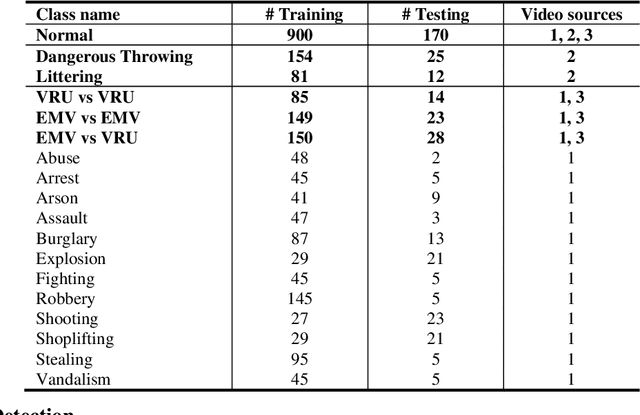

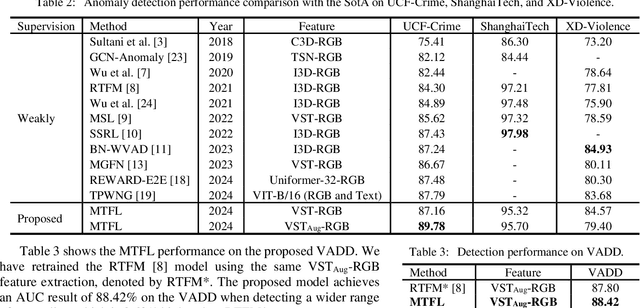
Detection of anomaly events is relevant for public safety and requires a combination of fine-grained motion information and contextual events at variable time-scales. To this end, we propose a Multi-Timescale Feature Learning (MTFL) method to enhance the representation of anomaly features. Short, medium, and long temporal tubelets are employed to extract spatio-temporal video features using a Video Swin Transformer. Experimental results demonstrate that MTFL outperforms state-of-the-art methods on the UCF-Crime dataset, achieving an anomaly detection performance 89.78% AUC. Moreover, it performs complementary to SotA with 95.32% AUC on the ShanghaiTech and 84.57% AP on the XD-Violence dataset. Furthermore, we generate an extended dataset of the UCF-Crime for development and evaluation on a wider range of anomalies, namely Video Anomaly Detection Dataset (VADD), involving 2,591 videos in 18 classes with extensive coverage of realistic anomalies.
Detection of Object Throwing Behavior in Surveillance Videos
Mar 11, 2024
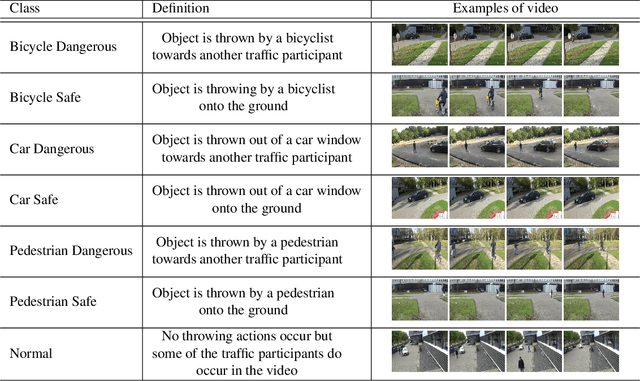
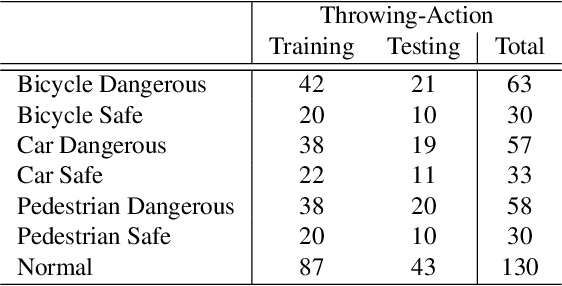
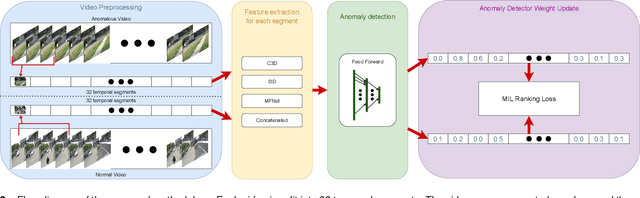
Anomalous behavior detection is a challenging research area within computer vision. Progress in this area enables automated detection of dangerous behavior using surveillance camera feeds. A dangerous behavior that is often overlooked in other research is the throwing action in traffic flow, which is one of the unique requirements of our Smart City project to enhance public safety. This paper proposes a solution for throwing action detection in surveillance videos using deep learning. At present, datasets for throwing actions are not publicly available. To address the use-case of our Smart City project, we first generate the novel public 'Throwing Action' dataset, consisting of 271 videos of throwing actions performed by traffic participants, such as pedestrians, bicyclists, and car drivers, and 130 normal videos without throwing actions. Second, we compare the performance of different feature extractors for our anomaly detection method on the UCF-Crime and Throwing-Action datasets. The explored feature extractors are the Convolutional 3D (C3D) network, the Inflated 3D ConvNet (I3D) network, and the Multi-Fiber Network (MFNet). Finally, the performance of the anomaly detection algorithm is improved by applying the Adam optimizer instead of Adadelta, and proposing a mean normal loss function that covers the multitude of normal situations in traffic. Both aspects yield better anomaly detection performance. Besides this, the proposed mean normal loss function lowers the false alarm rate on the combined dataset. The experimental results reach an area under the ROC curve of 86.10 for the Throwing-Action dataset, and 80.13 on the combined dataset, respectively.
Transformer-based Fusion of 2D-pose and Spatio-temporal Embeddings for Distracted Driver Action Recognition
Mar 11, 2024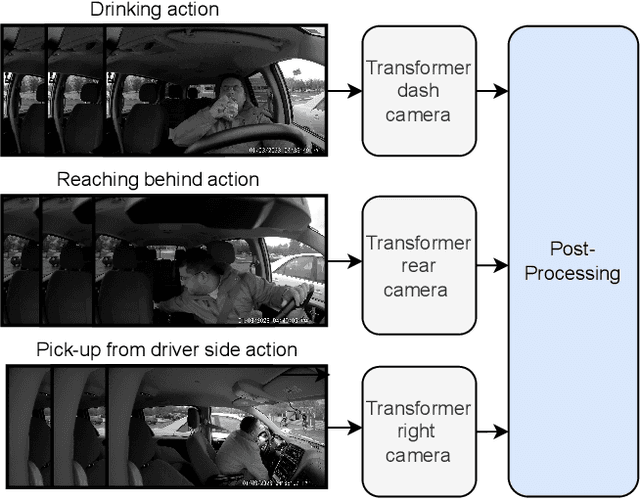
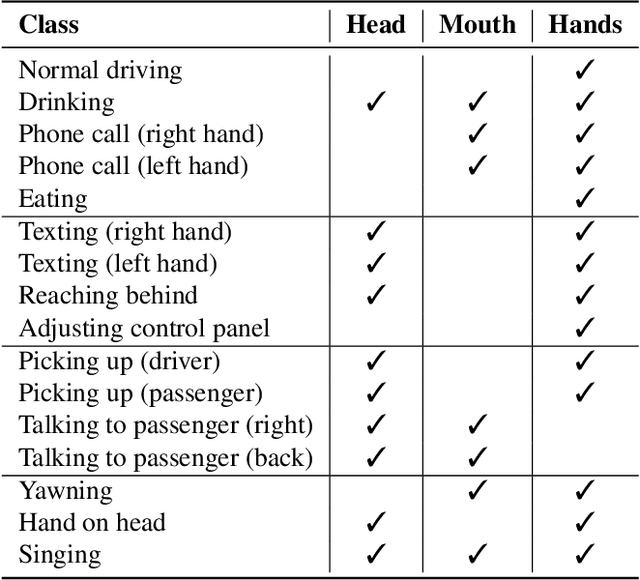
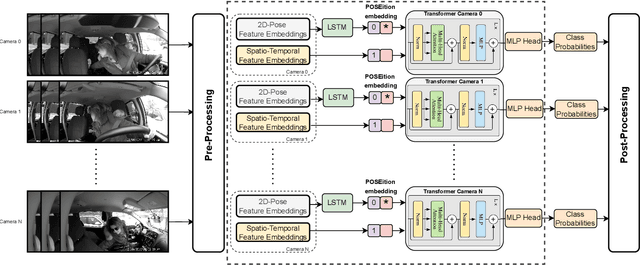
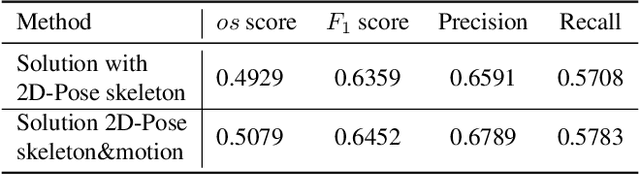
Classification and localization of driving actions over time is important for advanced driver-assistance systems and naturalistic driving studies. Temporal localization is challenging because it requires robustness, reliability, and accuracy. In this study, we aim to improve the temporal localization and classification accuracy performance by adapting video action recognition and 2D human-pose estimation networks to one model. Therefore, we design a transformer-based fusion architecture to effectively combine 2D-pose features and spatio-temporal features. The model uses 2D-pose features as the positional embedding of the transformer architecture and spatio-temporal features as the main input to the encoder of the transformer. The proposed solution is generic and independent of the camera numbers and positions, giving frame-based class probabilities as output. Finally, the post-processing step combines information from different camera views to obtain final predictions and eliminate false positives. The model performs well on the A2 test set of the 2023 NVIDIA AI City Challenge for naturalistic driving action recognition, achieving the overlap score of the organizer-defined distracted driver behaviour metric of 0.5079.