 Add to Chrome
 Add to Firefox
 Add to Edge
XDomainBench: Diagnosing Reasoning Collapse in High-Dimensional Scientific Knowledge Composition
May 14, 2026
Large Language Models (LLMs) are increasingly deployed for knowledge synthesis, yet their capacity for compositional generalization in scientific knowledge remains under-characterized. Existing benchmarks primarily focus on single-turn restricted scenarios, failing to capture the capability boundaries exposed by real-world interactive scientific workflows. To address this, we introduce XDomainBench, a diagnostic benchmark for interactive interdisciplinary scientific reasoning. We formalize the composition order and mixture structure to enable systematic stress-testing from single-discipline to inter-disciplinary, comprising 8,598 interactive sessions across 20 domains and 4 task categories, with 8 realistic trajectory patterns covering difficulty and domain-mixture dynamics, simulating real AI4S scenarios. Large-scale evaluation of LLMs reveals a systematic reasoning collapse as composition order increases, stemming from two root causes: (i) direct difficulty increases induced by domain composition, and (ii) indirect interaction-amplified failures where trajectory patterns trigger error accumulation, reasoning breaks, and domain confusion, ultimately leading to session collapse.

Revisiting Frank-Wolfe for Structured Nonconvex Optimization
Mar 11, 2025We introduce a new projection-free (Frank-Wolfe) method for optimizing structured nonconvex functions that are expressed as a difference of two convex functions. This problem class subsumes smooth nonconvex minimization, positioning our method as a promising alternative to the classical Frank-Wolfe algorithm. DC decompositions are not unique; by carefully selecting a decomposition, we can better exploit the problem structure, improve computational efficiency, and adapt to the underlying problem geometry to find better local solutions. We prove that the proposed method achieves a first-order stationary point in $O(1/\epsilon^2)$ iterations, matching the complexity of the standard Frank-Wolfe algorithm for smooth nonconvex minimization in general. Specific decompositions can, for instance, yield a gradient-efficient variant that requires only $O(1/\epsilon)$ calls to the gradient oracle. Finally, we present numerical experiments demonstrating the effectiveness of the proposed method compared to the standard Frank-Wolfe algorithm.
Implicit Bias in Matrix Factorization and its Explicit Realization in a New Architecture
Jan 27, 2025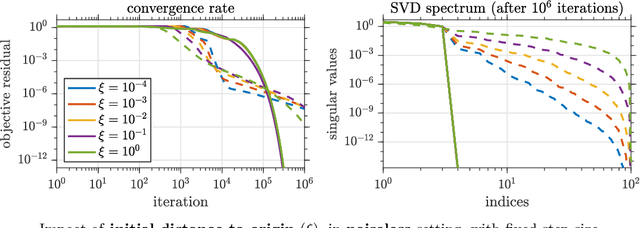
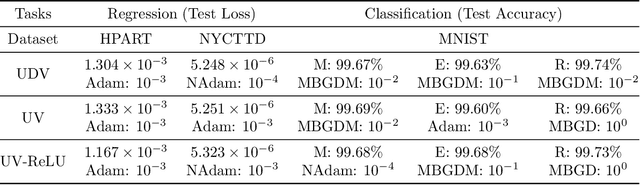
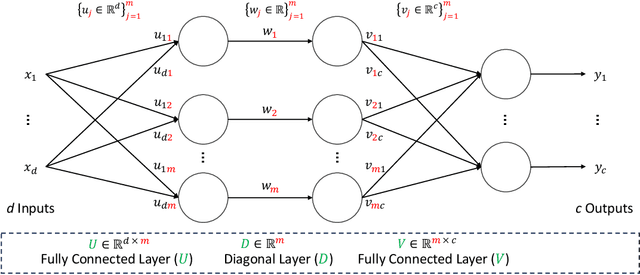
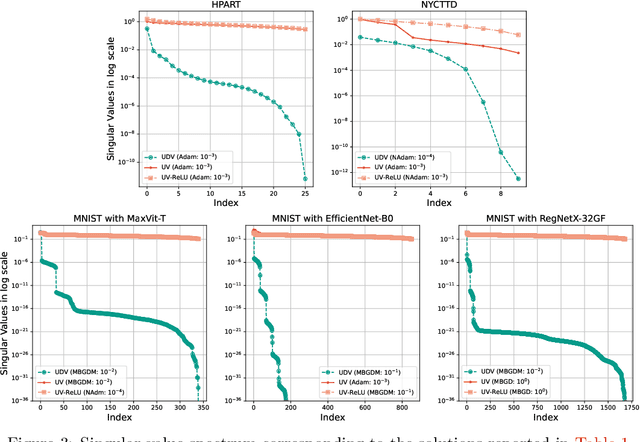
Gradient descent for matrix factorization is known to exhibit an implicit bias toward approximately low-rank solutions. While existing theories often assume the boundedness of iterates, empirically the bias persists even with unbounded sequences. We thus hypothesize that implicit bias is driven by divergent dynamics markedly different from the convergent dynamics for data fitting. Using this perspective, we introduce a new factorization model: $X\approx UDV^\top$, where $U$ and $V$ are constrained within norm balls, while $D$ is a diagonal factor allowing the model to span the entire search space. Our experiments reveal that this model exhibits a strong implicit bias regardless of initialization and step size, yielding truly (rather than approximately) low-rank solutions. Furthermore, drawing parallels between matrix factorization and neural networks, we propose a novel neural network model featuring constrained layers and diagonal components. This model achieves strong performance across various regression and classification tasks while finding low-rank solutions, resulting in efficient and lightweight networks.