 Add to Chrome
 Add to Firefox
 Add to Edge
FunnyNodules: A Customizable Medical Dataset Tailored for Evaluating Explainable AI
Nov 19, 2025
Densely annotated medical image datasets that capture not only diagnostic labels but also the underlying reasoning behind these diagnoses are scarce. Such reasoning-related annotations are essential for developing and evaluating explainable AI (xAI) models that reason similarly to radiologists: making correct predictions for the right reasons. To address this gap, we introduce FunnyNodules, a fully parameterized synthetic dataset designed for systematic analysis of attribute-based reasoning in medical AI models. The dataset generates abstract, lung nodule-like shapes with controllable visual attributes such as roundness, margin sharpness, and spiculation. Target class is derived from a predefined attribute combination, allowing full control over the decision rule that links attributes to the diagnostic class. We demonstrate how FunnyNodules can be used in model-agnostic evaluations to assess whether models learn correct attribute-target relations, to interpret over- or underperformance in attribute prediction, and to analyze attention alignment with attribute-specific regions of interest. The framework is fully customizable, supporting variations in dataset complexity, target definitions, class balance, and beyond. With complete ground truth information, FunnyNodules provides a versatile foundation for developing, benchmarking, and conducting in-depth analyses of explainable AI methods in medical image analysis.

PT43D: A Probabilistic Transformer for Generating 3D Shapes from Single Highly-Ambiguous RGB Images
May 20, 2024
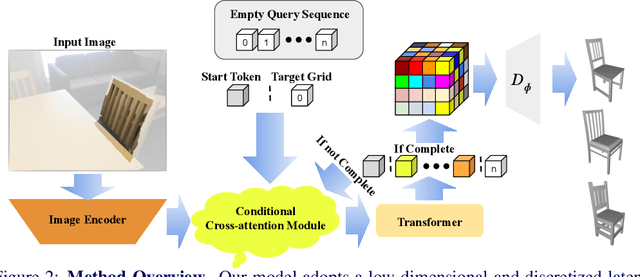

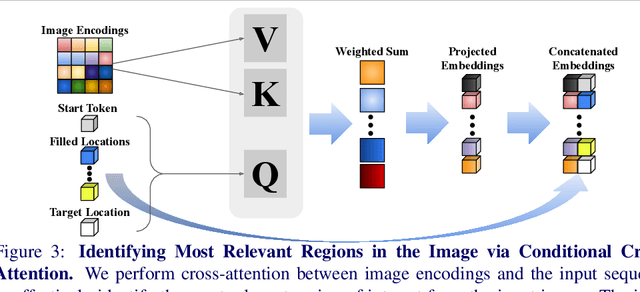
Generating 3D shapes from single RGB images is essential in various applications such as robotics. Current approaches typically target images containing clear and complete visual descriptions of the object, without considering common realistic cases where observations of objects that are largely occluded or truncated. We thus propose a transformer-based autoregressive model to generate the probabilistic distribution of 3D shapes conditioned on an RGB image containing potentially highly ambiguous observations of the object. To handle realistic scenarios such as occlusion or field-of-view truncation, we create simulated image-to-shape training pairs that enable improved fine-tuning for real-world scenarios. We then adopt cross-attention to effectively identify the most relevant region of interest from the input image for shape generation. This enables inference of sampled shapes with reasonable diversity and strong alignment with the input image. We train and test our model on our synthetic data then fine-tune and test it on real-world data. Experiments demonstrate that our model outperforms state of the art in both scenarios
Prior-RadGraphFormer: A Prior-Knowledge-Enhanced Transformer for Generating Radiology Graphs from X-Rays
Mar 27, 2023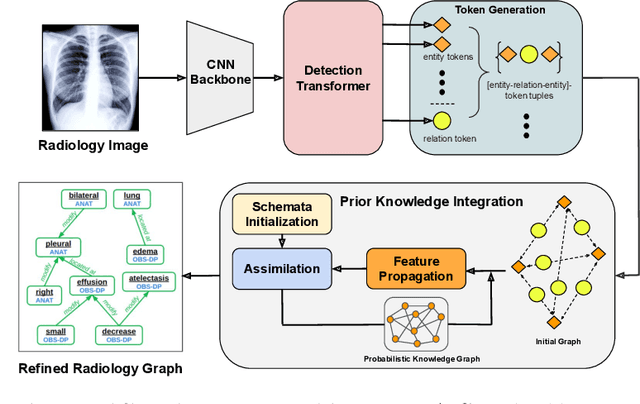
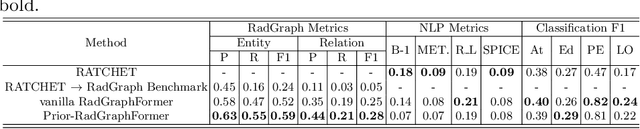
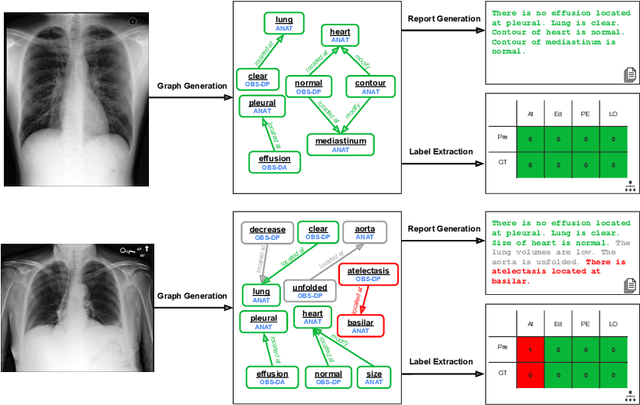
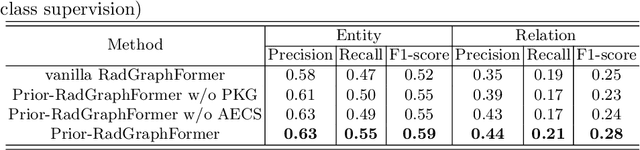
The extraction of structured clinical information from free-text radiology reports in the form of radiology graphs has been demonstrated to be a valuable approach for evaluating the clinical correctness of report-generation methods. However, the direct generation of radiology graphs from chest X-ray (CXR) images has not been attempted. To address this gap, we propose a novel approach called Prior-RadGraphFormer that utilizes a transformer model with prior knowledge in the form of a probabilistic knowledge graph (PKG) to generate radiology graphs directly from CXR images. The PKG models the statistical relationship between radiology entities, including anatomical structures and medical observations. This additional contextual information enhances the accuracy of entity and relation extraction. The generated radiology graphs can be applied to various downstream tasks, such as free-text or structured reports generation and multi-label classification of pathologies. Our approach represents a promising method for generating radiology graphs directly from CXR images, and has significant potential for improving medical image analysis and clinical decision-making.