 Add to Chrome
 Add to Firefox
 Add to Edge
AMECxSV: Adaptive Metadata-Driven Embedding-Fusion Calibration for X-Lingual Speaker Verification
Jul 17, 2026
In X-lingual automatic speaker verification (ASV), fixed front-end scores vary in reliability with language match, duration, and score source. We propose AMECxSV, an adaptive metadata-driven embedding-fusion calibration backend for metadata-available settings. AMECxSV fuses trial scores with metadata to produce calibrated target posteriors, with optional posterior-confidence abstention; metadata serve as calibration context, not speaker evidence. On a development-derived speaker-disjoint held-out split, score+metadata heads reduce equal error rate (EER) from 3.15% to 2.42% for the official TidyVoice score source and from 0.64% to 0.43% for LI-MSV; the dual-score head reaches 0.43% full-coverage EER. At 0.79 coverage, abstention yields 0.03% accepted-trial EER, not a full-coverage metric. Matched score-only, metadata-permutation, and metadata-only controls support a calibration-context interpretation and limit claims to metadata-available scoring.

Omni-Mol: Exploring Universal Convergent Space for Omni-Molecular Tasks
Feb 03, 2025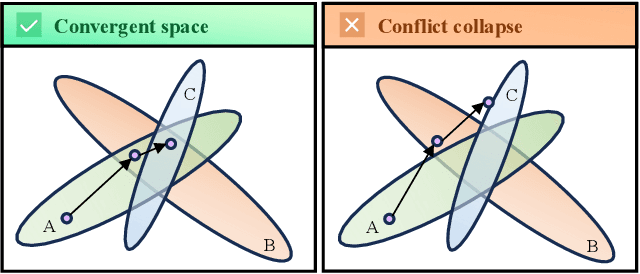
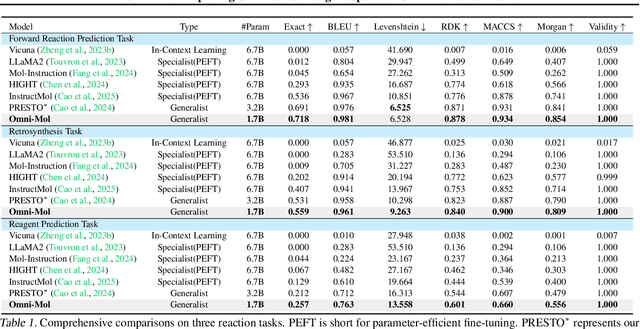
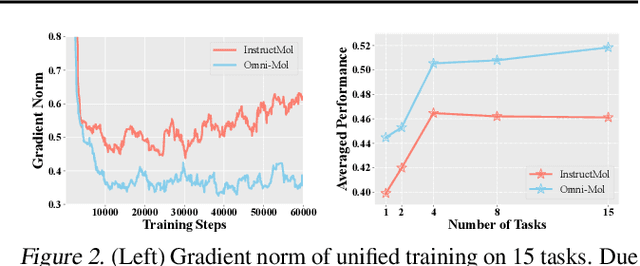
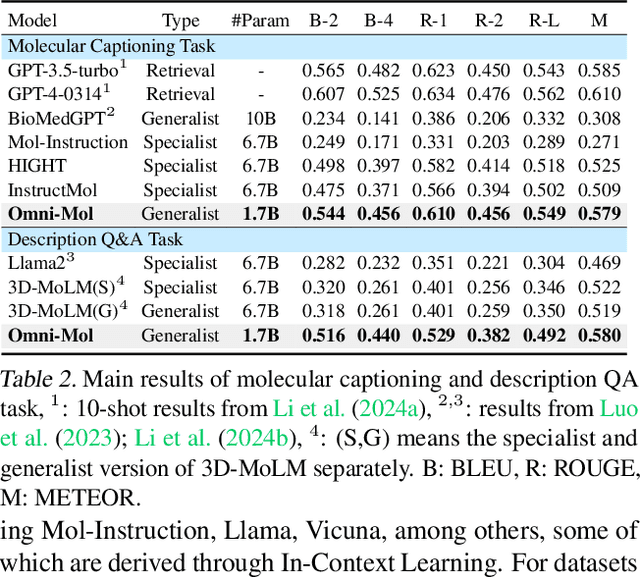
Building generalist models has recently demonstrated remarkable capabilities in diverse scientific domains. Within the realm of molecular learning, several studies have explored unifying diverse tasks across diverse domains. However, negative conflicts and interference between molecules and knowledge from different domain may have a worse impact in threefold. First, conflicting molecular representations can lead to optimization difficulties for the models. Second, mixing and scaling up training data across diverse tasks is inherently challenging. Third, the computational cost of refined pretraining is prohibitively high. To address these limitations, this paper presents Omni-Mol, a scalable and unified LLM-based framework for direct instruction tuning. Omni-Mol builds on three key components to tackles conflicts: (1) a unified encoding mechanism for any task input; (2) an active-learning-driven data selection strategy that significantly reduces dataset size; (3) a novel design of the adaptive gradient stabilization module and anchor-and-reconcile MoE framework that ensures stable convergence. Experimentally, Omni-Mol achieves state-of-the-art performance across 15 molecular tasks, demonstrates the presence of scaling laws in the molecular domain, and is supported by extensive ablation studies and analyses validating the effectiveness of its design. The code and weights of the powerful AI-driven chemistry generalist are open-sourced at: https://anonymous.4open.science/r/Omni-Mol-8EDB.