 Add to Chrome
 Add to Firefox
 Add to Edge
MLFFM-SegDiff: A Multi-Level Feature Fusion Diffusion Model for Skin Lesion Segmentation
Jun 25, 2026
Skin lesion segmentation is a key task in computer-aided dermatological diagnosis, where accuracy directly impacts downstream analysis and disease classification. However, dermoscopic images are challenging due to blurred boundaries, low contrast, large shape variations, and artifacts such as hair and shadows. Recently, diffusion models have shown strong performance in medical image segmentation thanks to their progressive denoising and distribution modeling capabilities. Nevertheless, existing diffusion-based methods still suffer from limited cross-level feature interaction and insufficient boundary detail recovery. To address these issues, we propose MLFFM-SegDiff, a multi-level feature fusion diffusion model for skin lesion segmentation. Built on a diffusion framework, the method introduces a dual-path U-Net encoder, a Multi-Level Feature Fusion Module (MLFFM), and a boundary-sensitive loss function. The dual-path encoder enhances interaction between noisy mask features and dermoscopic image features. MLFFM improves skip connections via attention, scale alignment, and adaptive cross-level fusion. These designs enable the decoder to jointly leverage shallow boundary cues and deep semantic representations, improving mask reconstruction quality. Experiments on ISIC2018, PH2, and HAM10000 demonstrate that MLFFM-SegDiff outperforms representative methods including DermoSegDiff, U-Net, and SwinUNETR across Accuracy, F1-score, Jaccard index, Recall, and Dice. In particular, it achieves an average Jaccard index of 0.8546 and Dice coefficient of 0.9207. These results validate the effectiveness of the proposed multi-level feature fusion strategy for improving lesion segmentation performance. The code will be released at https://github.com/Qacket/MLFFM-SegDiff.git after publication.

Learning Precise, Contact-Rich Manipulation through Uncalibrated Tactile Skins
Oct 22, 2024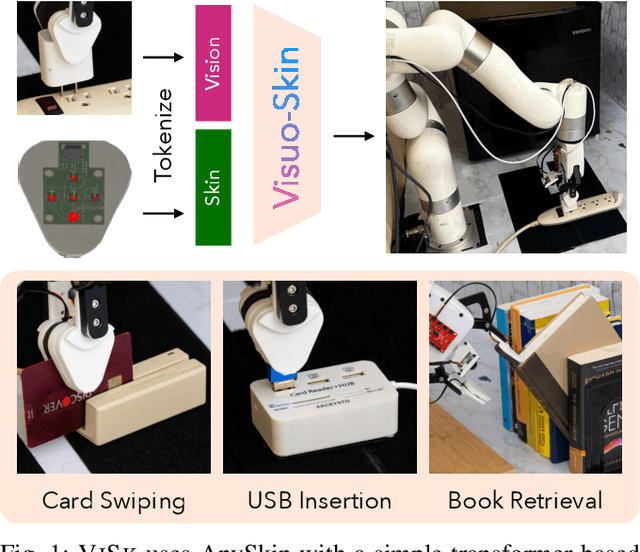
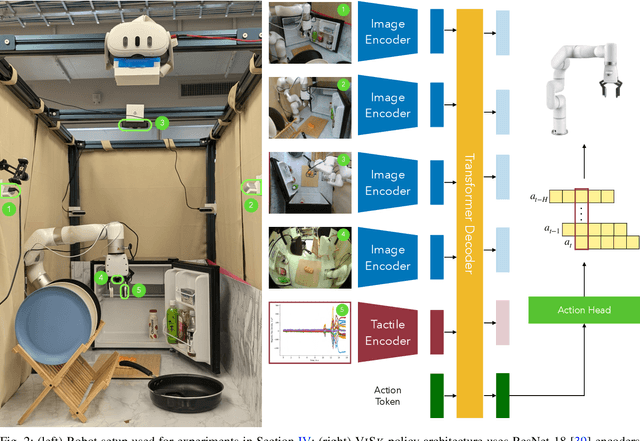
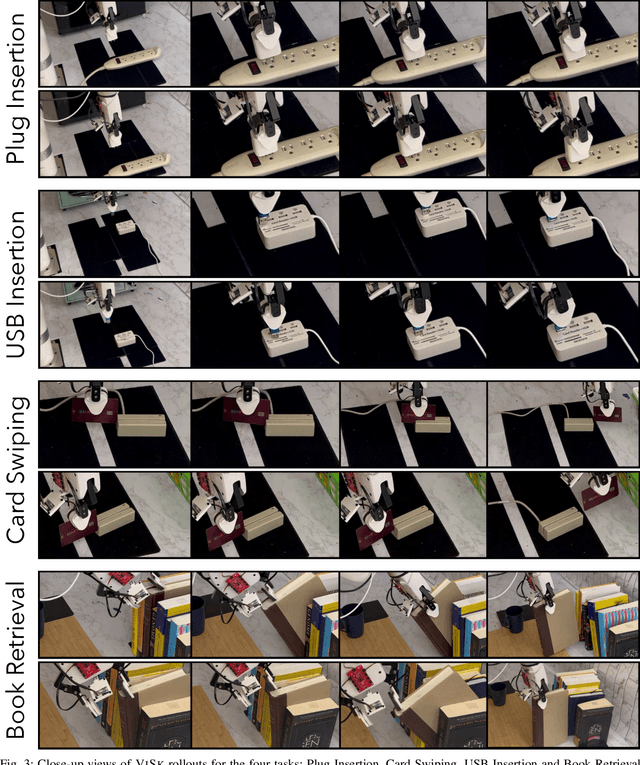
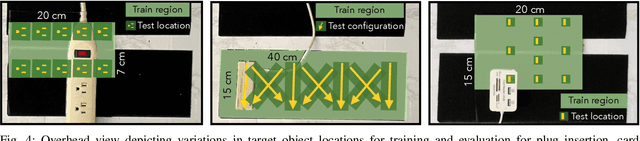
While visuomotor policy learning has advanced robotic manipulation, precisely executing contact-rich tasks remains challenging due to the limitations of vision in reasoning about physical interactions. To address this, recent work has sought to integrate tactile sensing into policy learning. However, many existing approaches rely on optical tactile sensors that are either restricted to recognition tasks or require complex dimensionality reduction steps for policy learning. In this work, we explore learning policies with magnetic skin sensors, which are inherently low-dimensional, highly sensitive, and inexpensive to integrate with robotic platforms. To leverage these sensors effectively, we present the Visuo-Skin (ViSk) framework, a simple approach that uses a transformer-based policy and treats skin sensor data as additional tokens alongside visual information. Evaluated on four complex real-world tasks involving credit card swiping, plug insertion, USB insertion, and bookshelf retrieval, ViSk significantly outperforms both vision-only and optical tactile sensing based policies. Further analysis reveals that combining tactile and visual modalities enhances policy performance and spatial generalization, achieving an average improvement of 27.5% across tasks. https://visuoskin.github.io/
AnySkin: Plug-and-play Skin Sensing for Robotic Touch
Sep 12, 2024While tactile sensing is widely accepted as an important and useful sensing modality, its use pales in comparison to other sensory modalities like vision and proprioception. AnySkin addresses the critical challenges that impede the use of tactile sensing -- versatility, replaceability, and data reusability. Building on the simplistic design of ReSkin, and decoupling the sensing electronics from the sensing interface, AnySkin simplifies integration making it as straightforward as putting on a phone case and connecting a charger. Furthermore, AnySkin is the first uncalibrated tactile-sensor with cross-instance generalizability of learned manipulation policies. To summarize, this work makes three key contributions: first, we introduce a streamlined fabrication process and a design tool for creating an adhesive-free, durable and easily replaceable magnetic tactile sensor; second, we characterize slip detection and policy learning with the AnySkin sensor; and third, we demonstrate zero-shot generalization of models trained on one instance of AnySkin to new instances, and compare it with popular existing tactile solutions like DIGIT and ReSkin.https://any-skin.github.io/