 Add to Chrome
 Add to Firefox
 Add to Edge
LeJOT-AutoML: LLM-Driven Feature Engineering for Job Execution Time Prediction in Databricks Cost Optimization
Mar 09, 2026
Databricks job orchestration systems (e.g., LeJOT) reduce cloud costs by selecting low-priced compute configurations while meeting latency and dependency constraints. Accurate execution-time prediction under heterogeneous instance types and non-stationary runtime conditions is therefore critical. Existing pipelines rely on static, manually engineered features that under-capture runtime effects (e.g., partition pruning, data skew, and shuffle amplification), and predictive signals are scattered across logs, metadata, and job scripts-lengthening update cycles and increasing engineering overhead. We present LeJOT-AutoML, an agent-driven AutoML framework that embeds large language model agents throughout the ML lifecycle. LeJOT-AutoML combines retrieval-augmented generation over a domain knowledge base with a Model Context Protocol toolchain (log parsers, metadata queries, and a read-only SQL sandbox) to analyze job artifacts, synthesize and validate feature-extraction code via safety gates, and train/select predictors. This design materializes runtime-derived features that are difficult to obtain through static analysis alone. On enterprise Databricks workloads, LeJOT-AutoML generates over 200 features and reduces the feature-engineering and evaluation loop from weeks to 20-30 minutes, while maintaining competitive prediction accuracy. Integrated into the LeJOT pipeline, it enables automated continuous model updates and achieves 19.01% cost savings in our deployment setting through improved orchestration.

iScheduler: Reinforcement Learning-Driven Continual Optimization for Large-Scale Resource Investment Problems
Jan 30, 2026Scheduling precedence-constrained tasks under shared renewable resources is central to modern computing platforms. The Resource Investment Problem (RIP) models this setting by minimizing the cost of provisioned renewable resources under precedence and timing constraints. Exact mixed-integer programming and constraint programming become impractically slow on large instances, and dynamic updates require schedule revisions under tight latency budgets. We present iScheduler, a reinforcement-learning-driven iterative scheduling framework that formulates RIP solving as a Markov decision process over decomposed subproblems and constructs schedules through sequential process selection. The framework accelerates optimization and supports reconfiguration by reusing unchanged process schedules and rescheduling only affected processes. We also release L-RIPLIB, an industrial-scale benchmark derived from cloud-platform workloads with 1,000 instances of 2,500-10,000 tasks. Experiments show that iScheduler attains competitive resource costs while reducing time to feasibility by up to 43$\times$ against strong commercial baselines.
LeJOT: An Intelligent Job Cost Orchestration Solution for Databricks Platform
Dec 20, 2025With the rapid advancements in big data technologies, the Databricks platform has become a cornerstone for enterprises and research institutions, offering high computational efficiency and a robust ecosystem. However, managing the escalating operational costs associated with job execution remains a critical challenge. Existing solutions rely on static configurations or reactive adjustments, which fail to adapt to the dynamic nature of workloads. To address this, we introduce LeJOT, an intelligent job cost orchestration framework that leverages machine learning for execution time prediction and a solver-based optimization model for real-time resource allocation. Unlike conventional scheduling techniques, LeJOT proactively predicts workload demands, dynamically allocates computing resources, and minimizes costs while ensuring performance requirements are met. Experimental results on real-world Databricks workloads demonstrate that LeJOT achieves an average 20% reduction in cloud computing costs within a minute-level scheduling timeframe, outperforming traditional static allocation strategies. Our approach provides a scalable and adaptive solution for cost-efficient job scheduling in Data Lakehouse environments.
FFCG: Effective and Fast Family Column Generation for Solving Large-Scale Linear Program
Dec 26, 2024
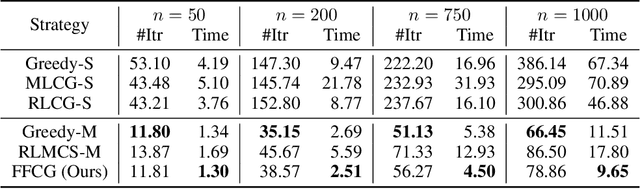
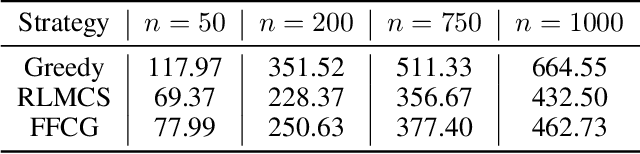
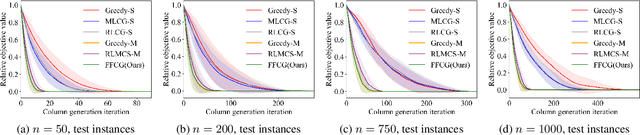
Column Generation (CG) is an effective and iterative algorithm to solve large-scale linear programs (LP). During each CG iteration, new columns are added to improve the solution of the LP. Typically, CG greedily selects one column with the most negative reduced cost, which can be improved by adding more columns at once. However, selecting all columns with negative reduced costs would lead to the addition of redundant columns that do not improve the objective value. Therefore, selecting the appropriate columns to add is still an open problem and previous machine-learning-based approaches for CG only add a constant quantity of columns per iteration due to the state-space explosion problem. To address this, we propose Fast Family Column Generation (FFCG) -- a novel reinforcement-learning-based CG that selects a variable number of columns as needed in an iteration. Specifically, we formulate the column selection problem in CG as an MDP and design a reward metric that balances both the convergence speed and the number of redundant columns. In our experiments, FFCG converges faster on the common benchmarks and reduces the number of CG iterations by 77.1% for Cutting Stock Problem (CSP) and 84.8% for Vehicle Routing Problem with Time Windows (VRPTW), and a 71.4% reduction in computing time for CSP and 84.0% for VRPTW on average compared to several state-of-the-art baselines.