 Add to Chrome
 Add to Firefox
 Add to Edge
LLMs Need Encoders for Semantic IDs Too
May 29, 2026
Multimodal LLMs use dedicated encoders to bridge non-language modalities (vision encoders for images, depth models for audio codec tokens) because raw token embeddings alone cannot capture modality-specific structure. We argue that Semantic IDs (SIDs), the hierarchical codes used in generative recommendation, constitute another such modality: a SID level token's meaning depends on its prefix context, yet current systems simply add SID tokens to the vocabulary and rely on training to learn these context-dependent meanings from scratch. We propose PrefixMem, a lightweight SID encoder based on prefix n-gram memory tables that provides the LLM with structured, prefix-conditioned representations at SID token positions. Like vision encoders in multimodal LLMs, PrefixMem can be pre-trained independently and then attached to any LLM for joint training. We evaluate on large-scale data from Pinterest across multiple LLM families and show that PrefixMem improves deepest-level SID accuracy by up to 46% relative and full-SID retrieval recall by up to 22% relative at matched training compute. The encoder's benefit concentrates on hard examples where greedy decoding fails, with up to 77% relative accuracy gains, confirming that SID tokens benefit from a dedicated encoder just as other non-language modalities do.

UniPinRec: Unifying Generative Retrieval and Ranking at Pinterest Scale
May 29, 2026Modern recommendation systems predominantly train retrieval and ranking as separate models despite both increasingly relying on large transformers encoding the same user behavior data, duplicating parameters, compute, and serving cost. Prior work unifies the model architecture but not the full pipeline: input formats, training procedures, and serving stacks remain fragmented across stages. We present UniPinRec, which achieves full-stack unification of retrieval and ranking at Pinterest: one input format, one model, one training stage, deployed within existing serving infrastructure. A shared transformer encodes the user action sequence into candidate-independent representations that branch into retrieval (ANN dot-product) and ranking (cross-attention) via task-specific heads. Three ideas make this work: (1) Masked Action Modeling (MAM) eliminates interleaving, enabling weight sharing without doubling context length; (2) Blended training examples pair action sequences with feedview impression slates to satisfy both objectives jointly; (3) Cross-stage KV cache sharing reuses user-history computation from retrieval for ranking, reducing total FLOPs versus serving two independent models. Deployed in the Pinterest core surfaces, UniPinRec delivers approximately +1% online engagement lift while cutting end-to-end serving latency by 11.1% and lifting QPS by 63.6%. To our knowledge, this is the first full-stack unification of retrieval and ranking, covering inputs, model, training and serving, deployed in a production recommendation system.
Taming the One-Epoch Phenomenon in Online Recommendation System by Two-stage Contrastive ID Pre-training
Aug 26, 2025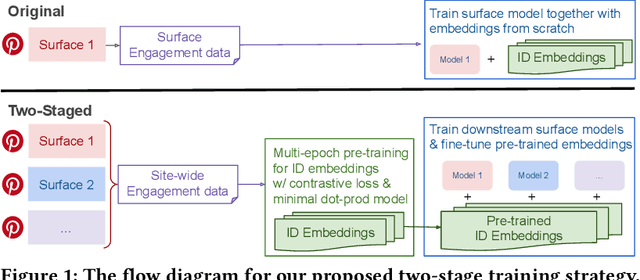
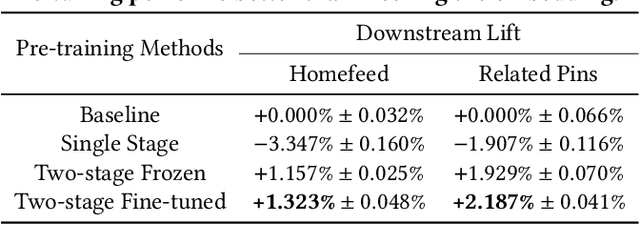
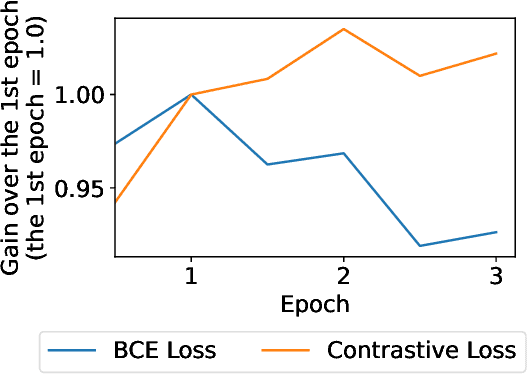
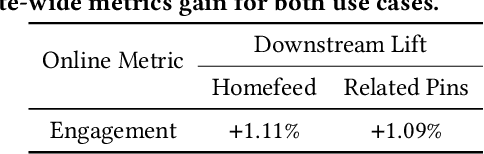
ID-based embeddings are widely used in web-scale online recommendation systems. However, their susceptibility to overfitting, particularly due to the long-tail nature of data distributions, often limits training to a single epoch, a phenomenon known as the "one-epoch problem." This challenge has driven research efforts to optimize performance within the first epoch by enhancing convergence speed or feature sparsity. In this study, we introduce a novel two-stage training strategy that incorporates a pre-training phase using a minimal model with contrastive loss, enabling broader data coverage for the embedding system. Our offline experiments demonstrate that multi-epoch training during the pre-training phase does not lead to overfitting, and the resulting embeddings improve online generalization when fine-tuned for more complex downstream recommendation tasks. We deployed the proposed system in live traffic at Pinterest, achieving significant site-wide engagement gains.
* Published at RecSys'24, see https://dl.acm.org/doi/10.1145/3640457.3688053