 Add to Chrome
 Add to Firefox
 Add to Edge
MolAct: An Agentic RL Framework for Molecular Editing and Property Optimization
Dec 24, 2025
Molecular editing and optimization are multi-step problems that require iteratively improving properties while keeping molecules chemically valid and structurally similar. We frame both tasks as sequential, tool-guided decisions and introduce MolAct, an agentic reinforcement learning framework that employs a two-stage training paradigm: first building editing capability, then optimizing properties while reusing the learned editing behaviors. To the best of our knowledge, this is the first work to formalize molecular design as an Agentic Reinforcement Learning problem, where an LLM agent learns to interleave reasoning, tool-use, and molecular optimization. The framework enables agents to interact in multiple turns, invoking chemical tools for validity checking, property assessment, and similarity control, and leverages their feedback to refine subsequent edits. We instantiate the MolAct framework to train two model families: MolEditAgent for molecular editing tasks and MolOptAgent for molecular optimization tasks. In molecular editing, MolEditAgent-7B delivers 100, 95, and 98 valid add, delete, and substitute edits, outperforming strong closed "thinking" baselines such as DeepSeek-R1; MolEditAgent-3B approaches the performance of much larger open "thinking" models like Qwen3-32B-think. In molecular optimization, MolOptAgent-7B (trained on MolEditAgent-7B) surpasses the best closed "thinking" baseline (e.g., Claude 3.7) on LogP and remains competitive on solubility, while maintaining balanced performance across other objectives. These results highlight that treating molecular design as a multi-step, tool-augmented process is key to reliable and interpretable improvements.

Multi-Memory Matching for Unsupervised Visible-Infrared Person Re-Identification
Jan 12, 2024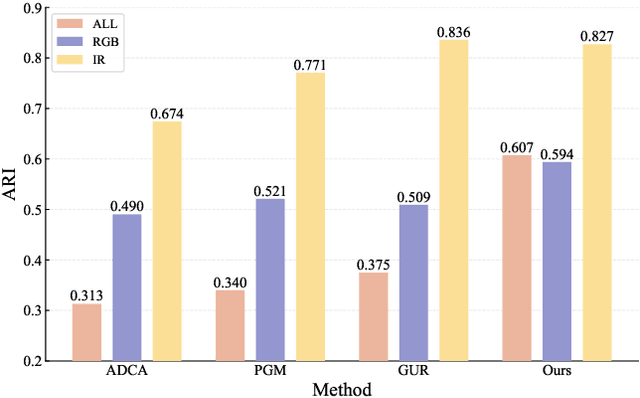
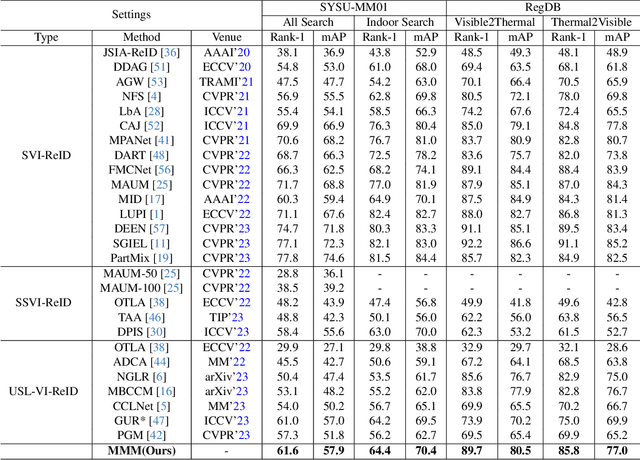
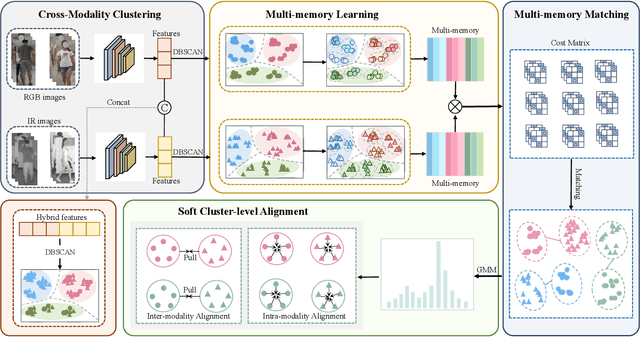

Unsupervised visible-infrared person re-identification (USL-VI-ReID) is a promising yet challenging retrieval task. The key challenges in USL-VI-ReID are to effectively generate pseudo-labels and establish pseudo-label correspondences across modalities without relying on any prior annotations. Recently, clustered pseudo-label methods have gained more attention in USL-VI-ReID. However, previous methods fell short of fully exploiting the individual nuances, as they simply utilized a single memory that represented an identity to establish cross-modality correspondences, resulting in ambiguous cross-modality correspondences. To address the problem, we propose a Multi-Memory Matching (MMM) framework for USL-VI-ReID. We first design a Cross-Modality Clustering (CMC) module to generate the pseudo-labels through clustering together both two modality samples. To associate cross-modality clustered pseudo-labels, we design a Multi-Memory Learning and Matching (MMLM) module, ensuring that optimization explicitly focuses on the nuances of individual perspectives and establishes reliable cross-modality correspondences. Finally, we design a Soft Cluster-level Alignment (SCA) module to narrow the modality gap while mitigating the effect of noise pseudo-labels through a soft many-to-many alignment strategy. Extensive experiments on the public SYSU-MM01 and RegDB datasets demonstrate the reliability of the established cross-modality correspondences and the effectiveness of our MMM. The source codes will be released.