 Add to Chrome
 Add to Firefox
 Add to Edge
Probe-to-Grasp Manipulation Using Self-Sensing Pneumatic Variable-Stiffness Joints
Mar 29, 2026
Grasping deformable objects with varying stiffness remains a significant challenge in robotics. Estimating the local stiffness of a target object is important for determining an optimal grasp pose that enables stable pickup without damaging the object. This paper presents a probe-to-grasp manipulation framework for estimating the relative stiffness of objects using a passive soft-rigid two-finger hybrid gripper equipped with self-sensing pneumatic variable-stiffness joints. Each finger of the gripper consists of two rigid links connected by a soft pneumatic ring placed at the joint, enabling both compliant interaction and controllable joint stiffness via internal pressurization. By measuring the pressure inside the pneumatic ring, we can estimate the interaction force during contact. Building on this, we propose a practical probing strategy to infer relative object stiffness by correlating the estimated normal force with known gripper closing displacement. We validate the self-sensing model through stiffness characterization experiments across bending angles and pressure ranges, and demonstrate stiffness-aware probing-and-grasping in real-life applications: selecting grasp locations on fruits with spatially varying stiffness. The proposed system offers a minimal, low-cost sensing approach for stiffness-aware soft manipulation while retaining probing and grasping capability.

A novel model for layer jamming-based continuum robots
Sep 11, 2023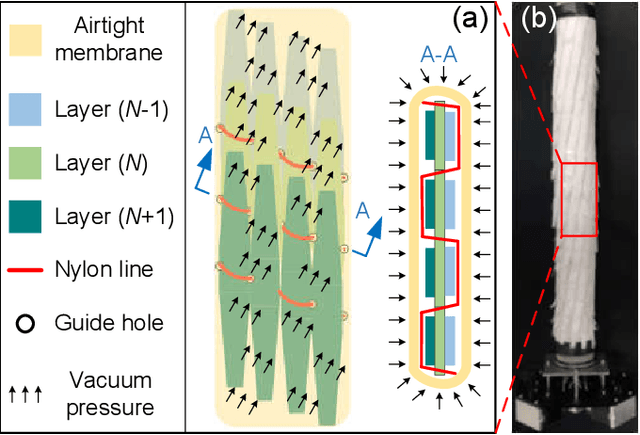
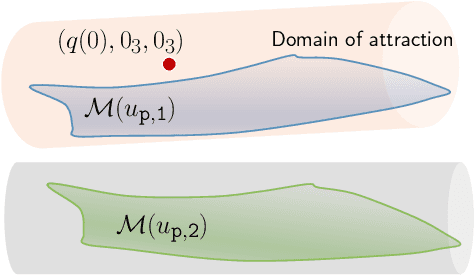
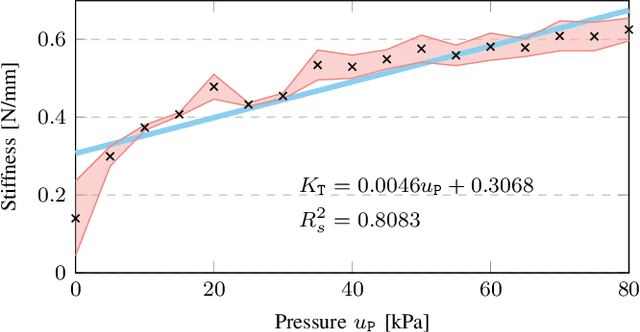
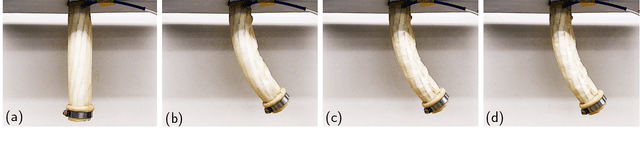
Continuum robots with variable stiffness have gained wide popularity in the last decade. Layer jamming (LJ) has emerged as a simple and efficient technique to achieve tunable stiffness for continuum robots. Despite its merits, the development of a control-oriented dynamical model tailored for this specific class of robots remains an open problem in the literature. This paper aims to present the first solution, to the best of our knowledge, to close the gap. We propose an energy-based model that is integrated with the LuGre frictional model for LJ-based continuum robots. Then, we take a comprehensive theoretical analysis for this model, focusing on two fundamental characteristics of LJ-based continuum robots: shape locking and adjustable stiffness. To validate the modeling approach and theoretical results, a series of experiments using our \textit{OctRobot-I} continuum robotic platform was conducted. The results show that the proposed model is capable of interpreting and predicting the dynamical behaviors in LJ-based continuum robots.
Simultaneous Position-and-Stiffness Control of Underactuated Antagonistic Tendon-Driven Continuum Robots
Jun 06, 2023Continuum robots have gained widespread popularity due to their inherent compliance and flexibility, particularly their adjustable levels of stiffness for various application scenarios. Despite efforts to dynamic modeling and control synthesis over the past decade, few studies have focused on incorporating stiffness regulation in their feedback control design; however, this is one of the initial motivations to develop continuum robots. This paper aims to address the crucial challenge of controlling both the position and stiffness of a class of highly underactuated continuum robots that are actuated by antagonistic tendons. To this end, the first step involves presenting a high-dimensional rigid-link dynamical model that can analyze the open-loop stiffening of tendon-driven continuum robots. Based on this model, we propose a novel passivity-based position-and-stiffness controller adheres to the non-negative tension constraint. To demonstrate the effectiveness of our approach, we tested the theoretical results on our continuum robot, and the experimental results show the efficacy and precise performance of the proposed methodology.