 Add to Chrome
 Add to Firefox
 Add to Edge
CARD: Controlled Agentic Reddit Discussions for Credit Card Simulation
Aug 11, 2026
Online credit card discussions provide a natural setting for studying how consumers communicate about financial products. Simulating these discussions requires more than just generating individual comments, the generated threads should also match how real users express themselves and interact with others. We introduce CARD, a framework for generating realistic credit card discussion threads. Given a credit card post and its matched real thread, CARD uses non-verbatim guidance on reply structure, comment function, stance, tone, and conversational variation. A planner organizes these controls, a writer generates the discussion, and a calibration loop updates comments' populations that contribute to differences between the generated and real thread distributions. We evaluate CARD on real Reddit credit card discussions using lexical, semantic, behavioral, and structural metrics. CARD matches the distributions of real credit card discussions better than simulation baselines across multiple LLMs and also demonstrates smaller effect sizes and distribution distances across metrics. These results show that structured planning and targeted revision can generate the realism of simulated credit card discussions.

Do Self-Evolving Agents Forget? Capability Degradation and Preservation in Lifelong LLM Agent Adaptation
May 10, 2026Recent advances in LLM agents enable systems that autonomously refine workflows, accumulate reusable skills, self-train their underlying models, and maintain persistent memory. However, we show that such self-evolution is often non-monotonic: adapting to new task distributions can progressively degrade previously acquired capabilities across all major evolution channels. We identify this phenomenon as \emph{capability erosion under self-evolution} and show that it consistently emerges across workflow, skill, model, and memory evolution. To mitigate this issue, we propose \emph{Capability-Preserving Evolution} (CPE), a general stabilization principle that constrains destructive capability drift during continual adaptation. Across all four evolution dimensions, CPE consistently improves retained capability stability while preserving adaptation performance. For example, in workflow evolution, CPE improves retained simple-task performance from 41.8\% to 52.8\% under GPT-5.1 optimization while simultaneously achieving stronger complex-task adaptation. Our findings suggest that stable long-horizon self-evolving agents require not only acquiring new capabilities, but also explicitly preserving previously learned ones during continual adaptation.
Now You Hear Me: Audio Narrative Attacks Against Large Audio-Language Models
Jan 30, 2026Large audio-language models increasingly operate on raw speech inputs, enabling more seamless integration across domains such as voice assistants, education, and clinical triage. This transition, however, introduces a distinct class of vulnerabilities that remain largely uncharacterized. We examine the security implications of this modality shift by designing a text-to-audio jailbreak that embeds disallowed directives within a narrative-style audio stream. The attack leverages an advanced instruction-following text-to-speech (TTS) model to exploit structural and acoustic properties, thereby circumventing safety mechanisms primarily calibrated for text. When delivered through synthetic speech, the narrative format elicits restricted outputs from state-of-the-art models, including Gemini 2.0 Flash, achieving a 98.26% success rate that substantially exceeds text-only baselines. These results highlight the need for safety frameworks that jointly reason over linguistic and paralinguistic representations, particularly as speech-based interfaces become more prevalent.
Synthetic Data-Driven Prompt Tuning for Financial QA over Tables and Documents
Nov 14, 2025Financial documents like earning reports or balance sheets often involve long tables and multi-page reports. Large language models have become a new tool to help numerical reasoning and understanding these documents. However, prompt quality can have a major effect on how well LLMs perform these financial reasoning tasks. Most current methods tune prompts on fixed datasets of financial text or tabular data, which limits their ability to adapt to new question types or document structures, or they involve costly and manually labeled/curated dataset to help build the prompts. We introduce a self-improving prompt framework driven by data-augmented optimization. In this closed-loop process, we generate synthetic financial tables and document excerpts, verify their correctness and robustness, and then update the prompt based on the results. Specifically, our framework combines a synthetic data generator with verifiers and a prompt optimizer, where the generator produces new examples that exposes weaknesses in the current prompt, the verifiers check the validity and robustness of the produced examples, and the optimizer incrementally refines the prompt in response. By iterating these steps in a feedback cycle, our method steadily improves prompt accuracy on financial reasoning tasks without needing external labels. Evaluation on DocMath-Eval benchmark demonstrates that our system achieves higher performance in both accuracy and robustness than standard prompt methods, underscoring the value of incorporating synthetic data generation into prompt learning for financial applications.
PREMISE: Scalable and Strategic Prompt Optimization for Efficient Mathematical Reasoning in Large Models
Jun 12, 2025Large reasoning models (LRMs) such as Claude 3.7 Sonnet and OpenAI o1 achieve strong performance on mathematical benchmarks using lengthy chain-of-thought (CoT) reasoning, but the resulting traces are often unnecessarily verbose. This inflates token usage and cost, limiting deployment in latency-sensitive or API-constrained settings. We introduce PREMISE (PRompt-based Efficient Mathematical Inference with Strategic Evaluation), a prompt-only framework that reduces reasoning overhead without modifying model weights. PREMISE combines trace-level diagnostics with gradient-inspired prompt optimization to minimize redundant computation while preserving answer accuracy. The approach jointly optimizes brevity and correctness through a multi-objective textual search that balances token length and answer validity. Unlike prior work, PREMISE runs in a single-pass black-box interface, so it can be applied directly to commercial LLMs. On GSM8K, SVAMP, and Math500 we match or exceed baseline accuracy ($96\%\rightarrow96\%$ with Claude, $91\%\rightarrow92\%$ with Gemini) while reducing reasoning tokens by up to $87.5\%$ and cutting dollar cost by $69$--$82\%$. These results show that prompt-level optimization is a practical and scalable path to efficient LRM inference without compromising reasoning quality.
SIPDO: Closed-Loop Prompt Optimization via Synthetic Data Feedback
May 26, 2025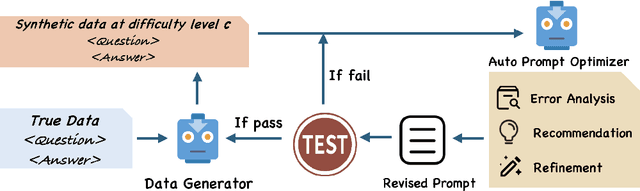
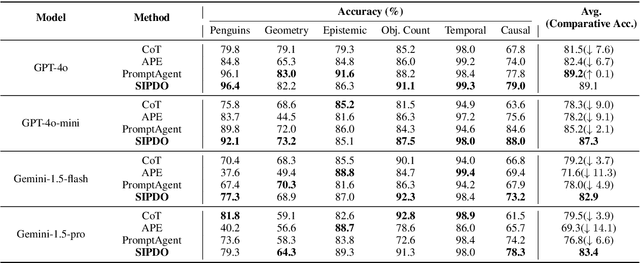


Prompt quality plays a critical role in the performance of large language models (LLMs), motivating a growing body of work on prompt optimization. Most existing methods optimize prompts over a fixed dataset, assuming static input distributions and offering limited support for iterative improvement. We introduce SIPDO (Self-Improving Prompts through Data-Augmented Optimization), a closed-loop framework for prompt learning that integrates synthetic data generation into the optimization process. SIPDO couples a synthetic data generator with a prompt optimizer, where the generator produces new examples that reveal current prompt weaknesses and the optimizer incrementally refines the prompt in response. This feedback-driven loop enables systematic improvement of prompt performance without assuming access to external supervision or new tasks. Experiments across question answering and reasoning benchmarks show that SIPDO outperforms standard prompt tuning methods, highlighting the value of integrating data synthesis into prompt learning workflows.