 Add to Chrome
 Add to Firefox
 Add to Edge
CausalGaze: Unveiling Hallucinations via Counterfactual Graph Intervention in Large Language Models
Apr 13, 2026
Despite the groundbreaking advancements made by large language models (LLMs), hallucination remains a critical bottleneck for their deployment in high-stakes domains. Existing classification-based methods mainly rely on static and passive signals from internal states, which often captures the noise and spurious correlations, while overlooking the underlying causal mechanisms. To address this limitation, we shift the paradigm from passive observation to active intervention by introducing CausalGaze, a novel hallucination detection framework based on structural causal models (SCMs). CausalGaze models LLMs' internal states as dynamic causal graphs and employs counterfactual interventions to disentangle causal reasoning paths from incidental noise, thereby enhancing model interpretability. Extensive experiments across four datasets and three widely used LLMs demonstrate the effectiveness of CausalGaze, especially achieving over 5.2\% improvement in AUROC on the TruthfulQA dataset compared to state-of-the-art baselines.

Efficient Algorithms for Global Inference in Internet Marketplaces
Mar 10, 2021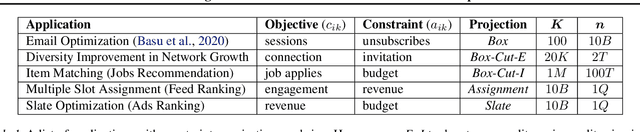
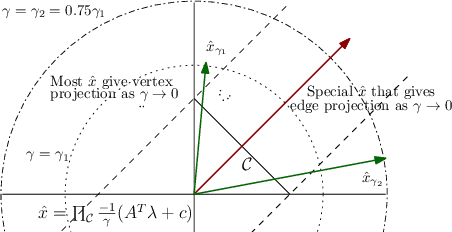

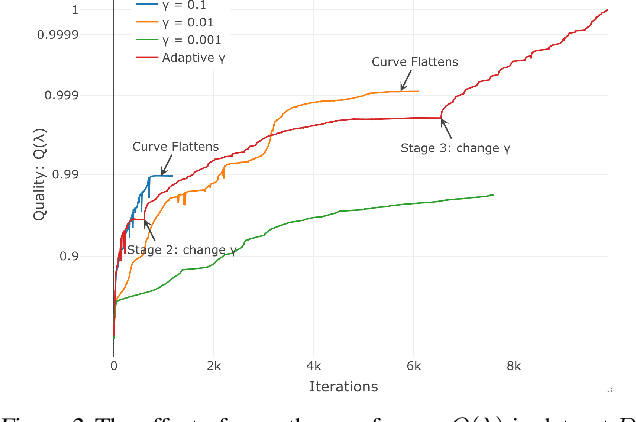
Matching demand to supply in internet marketplaces (e-commerce, ride-sharing, food delivery, professional services, advertising) is a global inference problem that can be formulated as a Linear Program (LP) with (millions of) coupling constraints and (up to a billion) non-coupling polytope constraints. Until recently, solving such problems on web-scale data with an LP formulation was intractable. Recent work (Basu et al., 2020) developed a dual decomposition-based approach to solve such problems when the polytope constraints are simple. In this work, we motivate the need to go beyond these simple polytopes and show real-world internet marketplaces that require more complex structured polytope constraints. We expand on the recent literature with novel algorithms that are more broadly applicable to global inference problems. We derive an efficient incremental algorithm using a theoretical insight on the nature of solutions on the polytopes to project onto any arbitrary polytope, that shows massive improvements in performance. Using better optimization routines along with an adaptive algorithm to control the smoothness of the objective, improves the speed of the solution even further. We showcase the efficacy of our approach via experimental results on web-scale marketplace data.