 Add to Chrome
 Add to Firefox
 Add to Edge
Reframing Long-Tailed Learning via Loss Landscape Geometry
Mar 22, 2026
Balancing performance trade-off on long-tail (LT) data distributions remains a long-standing challenge. In this paper, we posit that this dilemma stems from a phenomenon called "tail performance degradation" (the model tends to severely overfit on head classes while quickly forgetting tail classes) and pose a solution from a loss landscape perspective. We observe that different classes possess divergent convergence points in the loss landscape. Besides, this divergence is aggravated when the model settles into sharp and non-robust minima, rather than a shared and flat solution that is beneficial for all classes. In light of this, we propose a continual learning inspired framework to prevent "tail performance degradation". To avoid inefficient per-class parameter preservation, a Grouped Knowledge Preservation module is proposed to memorize group-specific convergence parameters, promoting convergence towards a shared solution. Concurrently, our framework integrates a Grouped Sharpness Aware module to seek flatter minima by explicitly addressing the geometry of the loss landscape. Notably, our framework requires neither external training samples nor pre-trained models, facilitating the broad applicability. Extensive experiments on four benchmarks demonstrate significant performance gains over state-of-the-art methods. The code is available at:https://gkp-gsa.github.io/.

QMBench: A Research Level Benchmark for Quantum Materials Research
Dec 19, 2025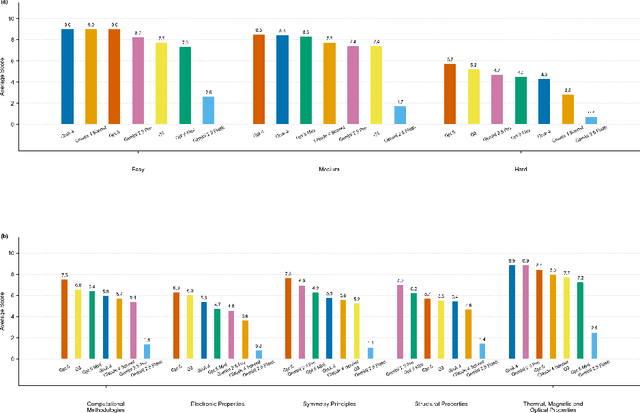
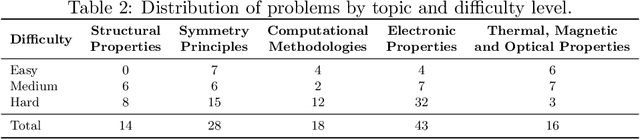
We introduce QMBench, a comprehensive benchmark designed to evaluate the capability of large language model agents in quantum materials research. This specialized benchmark assesses the model's ability to apply condensed matter physics knowledge and computational techniques such as density functional theory to solve research problems in quantum materials science. QMBench encompasses different domains of the quantum material research, including structural properties, electronic properties, thermodynamic and other properties, symmetry principle and computational methodologies. By providing a standardized evaluation framework, QMBench aims to accelerate the development of an AI scientist capable of making creative contributions to quantum materials research. We expect QMBench to be developed and constantly improved by the research community.
A Study on Training and Developing Large Language Models for Behavior Tree Generation
Jan 16, 2024This paper presents an innovative exploration of the application potential of large language models (LLM) in addressing the challenging task of automatically generating behavior trees (BTs) for complex tasks. The conventional manual BT generation method is inefficient and heavily reliant on domain expertise. On the other hand, existing automatic BT generation technologies encounter bottlenecks related to task complexity, model adaptability, and reliability. In order to overcome these challenges, we propose a novel methodology that leverages the robust representation and reasoning abilities of LLMs. The core contribution of this paper lies in the design of a BT generation framework based on LLM, which encompasses the entire process, from data synthesis and model training to application developing and data verification. Synthetic data is introduced to train the BT generation model (BTGen model), enhancing its understanding and adaptability to various complex tasks, thereby significantly improving its overall performance. In order to ensure the effectiveness and executability of the generated BTs, we emphasize the importance of data verification and introduce a multilevel verification strategy. Additionally, we explore a range of agent design and development schemes with LLM as the central element. We hope that the work in this paper may provide a reference for the researchers who are interested in BT generation based on LLMs.