 Add to Chrome
 Add to Firefox
 Add to Edge
Decoupled DiLoCo for Resilient Distributed Pre-training
Apr 23, 2026
Modern large-scale language model pre-training relies heavily on the single program multiple data (SPMD) paradigm, which requires tight coupling across accelerators. Due to this coupling, transient slowdowns, hardware failures, and synchronization overhead stall the entire computation, wasting significant compute time at scale. While recent distributed methods like DiLoCo reduced communication bandwidth, they remained fundamentally synchronous and vulnerable to these system stalls. To address this, we introduce Decoupled DiLoCo, an evolution of the DiLoCo framework designed to break the lock-step synchronization barrier and go beyond SPMD to maximize training goodput. Decoupled DiLoCo partitions compute across multiple independent ``learners'' that execute local inner optimization steps. These learners asynchronously communicate parameter fragments to a central synchronizer, which circumvents failed or straggling learners by aggregating updates using a minimum quorum, an adaptive grace window, and dynamic token-weighted merging. Inspired by ``chaos engineering'', we achieve significantly improved training efficiency in failure-prone environments with millions of simulated chips with strictly zero global downtime, while maintaining competitive model performance across text and vision tasks, for both dense and mixture-of-expert architectures.

Communication-Efficient Language Model Training Scales Reliably and Robustly: Scaling Laws for DiLoCo
Mar 12, 2025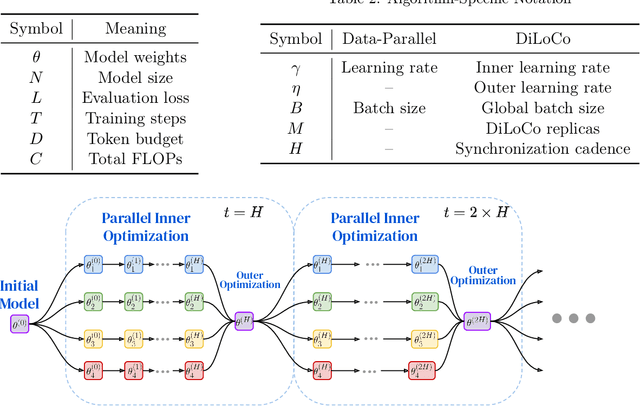
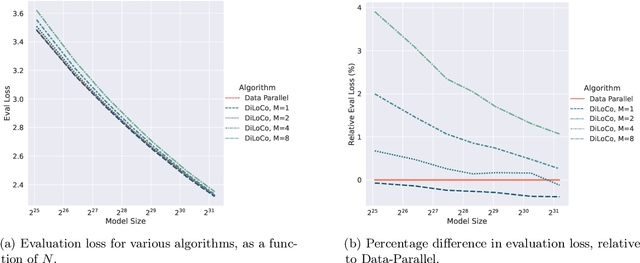
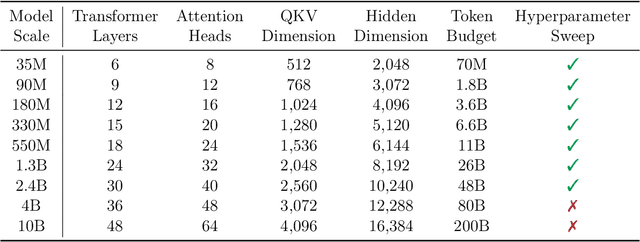
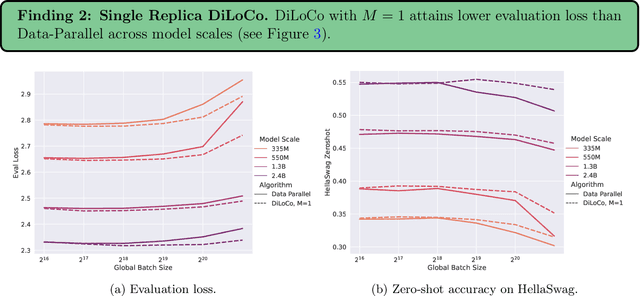
As we scale to more massive machine learning models, the frequent synchronization demands inherent in data-parallel approaches create significant slowdowns, posing a critical challenge to further scaling. Recent work develops an approach (DiLoCo) that relaxes synchronization demands without compromising model quality. However, these works do not carefully analyze how DiLoCo's behavior changes with model size. In this work, we study the scaling law behavior of DiLoCo when training LLMs under a fixed compute budget. We focus on how algorithmic factors, including number of model replicas, hyperparameters, and token budget affect training in ways that can be accurately predicted via scaling laws. We find that DiLoCo scales both predictably and robustly with model size. When well-tuned, DiLoCo scales better than data-parallel training with model size, and can outperform data-parallel training even at small model sizes. Our results showcase a more general set of benefits of DiLoCo than previously documented, including increased optimal batch sizes, improved downstream generalization with scale, and improved evaluation loss for a fixed token budget.
Confidential Federated Computations
Apr 16, 2024Federated Learning and Analytics (FLA) have seen widespread adoption by technology platforms for processing sensitive on-device data. However, basic FLA systems have privacy limitations: they do not necessarily require anonymization mechanisms like differential privacy (DP), and provide limited protections against a potentially malicious service provider. Adding DP to a basic FLA system currently requires either adding excessive noise to each device's updates, or assuming an honest service provider that correctly implements the mechanism and only uses the privatized outputs. Secure multiparty computation (SMPC) -based oblivious aggregations can limit the service provider's access to individual user updates and improve DP tradeoffs, but the tradeoffs are still suboptimal, and they suffer from scalability challenges and susceptibility to Sybil attacks. This paper introduces a novel system architecture that leverages trusted execution environments (TEEs) and open-sourcing to both ensure confidentiality of server-side computations and provide externally verifiable privacy properties, bolstering the robustness and trustworthiness of private federated computations.