 Add to Chrome
 Add to Firefox
 Add to Edge
Decoupled DiLoCo for Resilient Distributed Pre-training
Apr 23, 2026
Modern large-scale language model pre-training relies heavily on the single program multiple data (SPMD) paradigm, which requires tight coupling across accelerators. Due to this coupling, transient slowdowns, hardware failures, and synchronization overhead stall the entire computation, wasting significant compute time at scale. While recent distributed methods like DiLoCo reduced communication bandwidth, they remained fundamentally synchronous and vulnerable to these system stalls. To address this, we introduce Decoupled DiLoCo, an evolution of the DiLoCo framework designed to break the lock-step synchronization barrier and go beyond SPMD to maximize training goodput. Decoupled DiLoCo partitions compute across multiple independent ``learners'' that execute local inner optimization steps. These learners asynchronously communicate parameter fragments to a central synchronizer, which circumvents failed or straggling learners by aggregating updates using a minimum quorum, an adaptive grace window, and dynamic token-weighted merging. Inspired by ``chaos engineering'', we achieve significantly improved training efficiency in failure-prone environments with millions of simulated chips with strictly zero global downtime, while maintaining competitive model performance across text and vision tasks, for both dense and mixture-of-expert architectures.

Transformer-based Clipped Contrastive Quantization Learning for Unsupervised Image Retrieval
Jan 27, 2024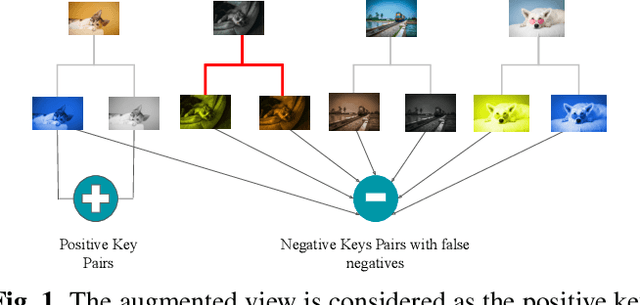
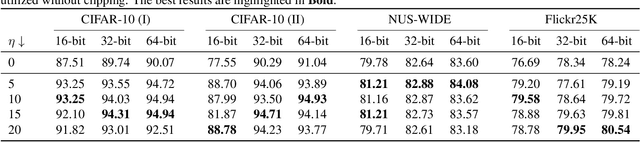
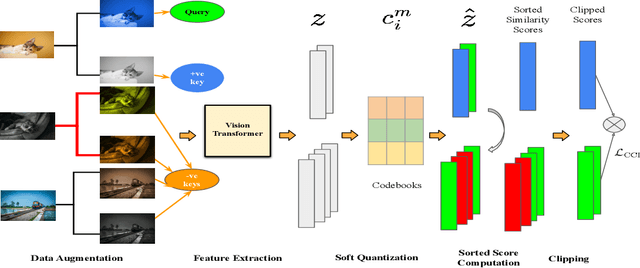
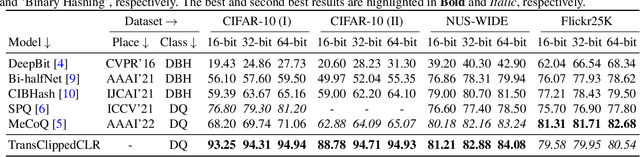
Unsupervised image retrieval aims to learn the important visual characteristics without any given level to retrieve the similar images for a given query image. The Convolutional Neural Network (CNN)-based approaches have been extensively exploited with self-supervised contrastive learning for image hashing. However, the existing approaches suffer due to lack of effective utilization of global features by CNNs and biased-ness created by false negative pairs in the contrastive learning. In this paper, we propose a TransClippedCLR model by encoding the global context of an image using Transformer having local context through patch based processing, by generating the hash codes through product quantization and by avoiding the potential false negative pairs through clipped contrastive learning. The proposed model is tested with superior performance for unsupervised image retrieval on benchmark datasets, including CIFAR10, NUS-Wide and Flickr25K, as compared to the recent state-of-the-art deep models. The results using the proposed clipped contrastive learning are greatly improved on all datasets as compared to same backbone network with vanilla contrastive learning.