 Add to Chrome
 Add to Firefox
 Add to Edge
Character as a Latent Variable in Large Language Models: A Mechanistic Account of Emergent Misalignment and Conditional Safety Failures
Jan 30, 2026
Emergent Misalignment refers to a failure mode in which fine-tuning large language models (LLMs) on narrowly scoped data induces broadly misaligned behavior. Prior explanations mainly attribute this phenomenon to the generalization of erroneous or unsafe content. In this work, we show that this view is incomplete. Across multiple domains and model families, we find that fine-tuning models on data exhibiting specific character-level dispositions induces substantially stronger and more transferable misalignment than incorrect-advice fine-tuning, while largely preserving general capabilities. This indicates that emergent misalignment arises from stable shifts in model behavior rather than from capability degradation or corrupted knowledge. We further show that such behavioral dispositions can be conditionally activated by both training-time triggers and inference-time persona-aligned prompts, revealing shared structure across emergent misalignment, backdoor activation, and jailbreak susceptibility. Overall, our results identify character formation as a central and underexplored alignment risk, suggesting that robust alignment must address behavioral dispositions rather than isolated errors or prompt-level defenses.

Model X-ray:Detect Backdoored Models via Decision Boundary
Feb 27, 2024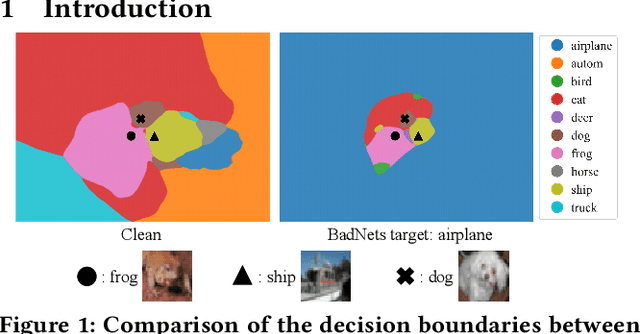
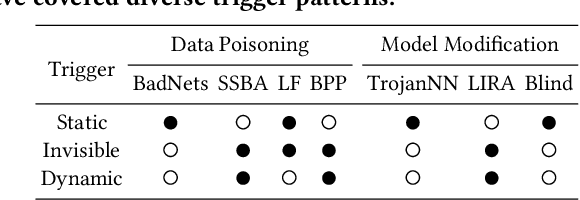
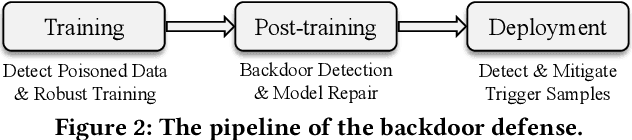
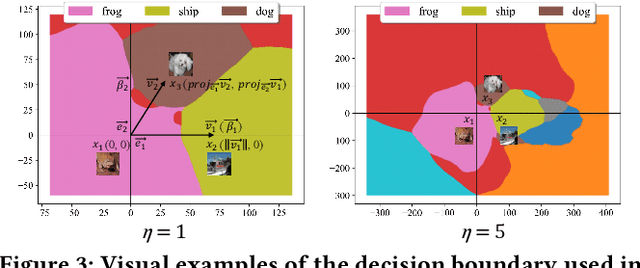
Deep neural networks (DNNs) have revolutionized various industries, leading to the rise of Machine Learning as a Service (MLaaS). In this paradigm, well-trained models are typically deployed through APIs. However, DNNs are susceptible to backdoor attacks, which pose significant risks to their applications. This vulnerability necessitates a method for users to ascertain whether an API is compromised before usage. Although many backdoor detection methods have been developed, they often operate under the assumption that the defender has access to specific information such as details of the attack, soft predictions from the model API, and even the knowledge of the model parameters, limiting their practicality in MLaaS scenarios. To address it, in this paper, we begin by presenting an intriguing observation: the decision boundary of the backdoored model exhibits a greater degree of closeness than that of the clean model. Simultaneously, if only one single label is infected, a larger portion of the regions will be dominated by the attacked label. Building upon this observation, we propose Model X-ray, a novel backdoor detection approach for MLaaS through the analysis of decision boundaries. Model X-ray can not only identify whether the target API is infected by backdoor attacks but also determine the target attacked label under the all-to-one attack strategy. Importantly, it accomplishes this solely by the hard prediction of clean inputs, regardless of any assumptions about attacks and prior knowledge of the training details of the model. Extensive experiments demonstrated that Model X-ray can be effective for MLaaS across diverse backdoor attacks, datasets, and architectures.