 Add to Chrome
 Add to Firefox
 Add to Edge
Correct and Weight: A Simple Yet Effective Loss for Implicit Feedback Recommendation
Jan 07, 2026
Learning from implicit feedback has become the standard paradigm for modern recommender systems. However, this setting is fraught with the persistent challenge of false negatives, where unobserved user-item interactions are not necessarily indicative of negative preference. To address this issue, this paper introduces a novel and principled loss function, named Corrected and Weighted (CW) loss, that systematically corrects for the impact of false negatives within the training objective. Our approach integrates two key techniques. First, inspired by Positive-Unlabeled learning, we debias the negative sampling process by re-calibrating the assumed negative distribution. By theoretically approximating the true negative distribution (p-) using the observable general data distribution (p) and the positive interaction distribution (p^+), our method provides a more accurate estimate of the likelihood that a sampled unlabeled item is truly negative. Second, we introduce a dynamic re-weighting mechanism that modulates the importance of each negative instance based on the model's current prediction. This scheme encourages the model to enforce a larger ranking margin between positive items and confidently predicted (i.e., easy) negative items, while simultaneously down-weighting the penalty on uncertain negatives that have a higher probability of being false negatives. A key advantage of our approach is its elegance and efficiency; it requires no complex modifications to the data sampling process or significant computational overhead, making it readily applicable to a wide array of existing recommendation models. Extensive experiments conducted on four large-scale, sparse benchmark datasets demonstrate the superiority of our proposed loss. The results show that our method consistently and significantly outperforms a suite of state-of-the-art loss functions across multiple ranking-oriented metrics.

Joint Demosaicing and Super-Resolution (JDSR): Network Design and Perceptual Optimization
Nov 08, 2019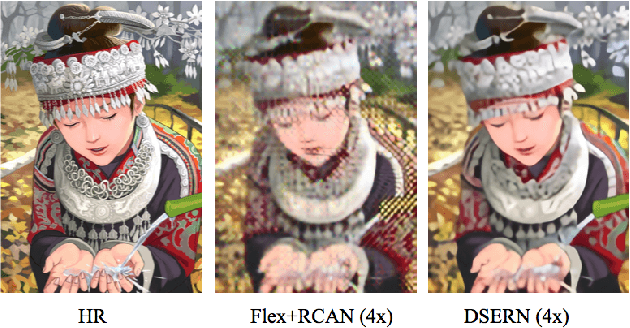
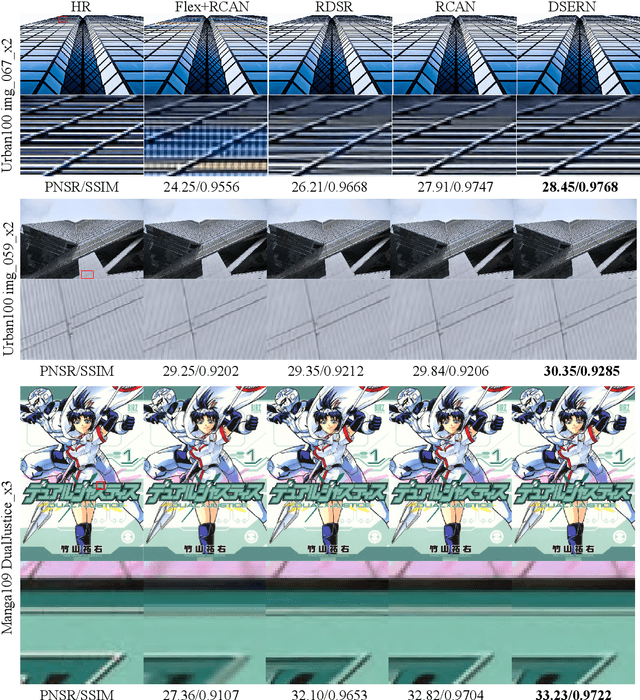
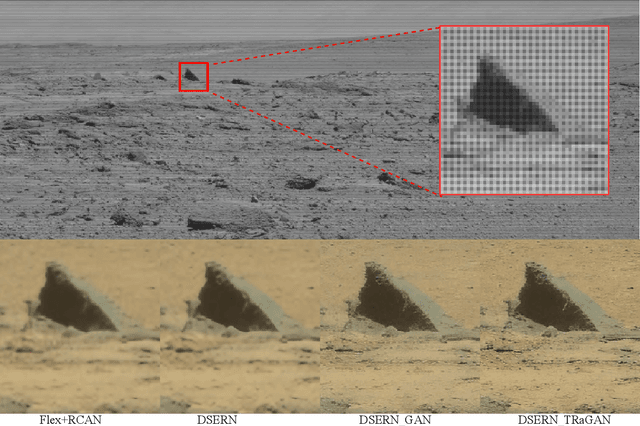
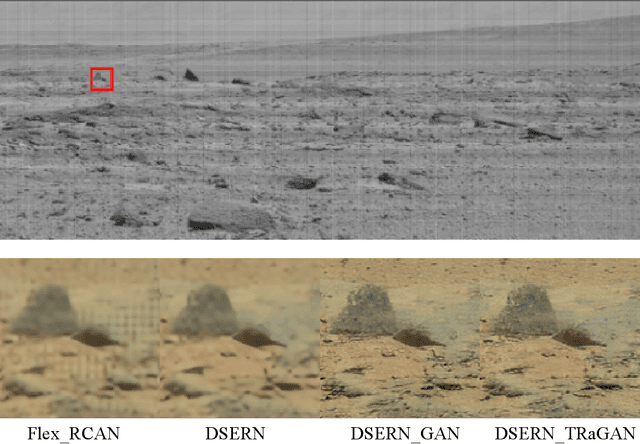
Image demosaicing and super-resolution are two important tasks in color imaging pipeline. So far they have been mostly independently studied in the open literature of deep learning; little is known about the potential benefit of formulating a joint demosaicing and super-resolution (JDSR) problem. In this paper, we propose an end-to-end optimization solution to the JDSR problem and demonstrate its practical significance in computational imaging. Our technical contributions are mainly two-fold. On network design, we have developed a Densely-connected Squeeze-and-Excitation Residual Network (DSERN) for JDSR. For the first time, we address the issue of spatio-spectral attention for color images and discuss how to achieve better information flow by smooth activation for JDSR. Experimental results have shown moderate PSNR/SSIM gain can be achieved by DSERN over previous naive network architectures. On perceptual optimization, we propose to leverage the latest ideas including relativistic discriminator and pre-excitation perceptual loss function to further improve the visual quality of reconstructed images. Our extensive experiment results have shown that Texture-enhanced Relativistic average Generative Adversarial Network (TRaGAN) can produce both subjectively more pleasant images and objectively lower perceptual distortion scores than standard GAN for JDSR. We have verified the benefit of JDSR to high-quality image reconstruction from real-world Bayer pattern collected by NASA Mars Curiosity.