 Add to Chrome
 Add to Firefox
 Add to Edge
TrustRoboReward: Preference-Ordered Isotonic Score Editing for Multi-Paradigm Robot Reward Models
Aug 09, 2026
Reward models are a bottleneck for reinforcement learning in embodied AI. Long-horizon robotic manipulation requires scalable vision feedback beyond handcrafted rewards or task-specific annotations. Existing open-source VLM reward judges like RoboReward adopt simple 1--5 trajectory progress scoring, lacking pairwise preferences for RLHF, DPO and Bradley-Terry frameworks, while failing to optimize video scene understanding. Augmenting RoboReward with pairwise comparison and video-QA supervision causes inconsistency between pairwise preferences and pointwise scores, introducing training noise and hurting downstream performance---an issue aggregation methods such as TrustJudge cannot resolve. To address this, we propose TrustRoboReward, a multi-paradigm reward modeling framework equipped with Preference-Ordered Isotonic Score Editing (POISE). We construct a unified four-paradigm dataset with trajectory progress scoring (Score-A), video-QA answer quality scoring (Score-B), and their pairwise counterparts (Pair-A, Pair-B). Pairwise labels align better with human judgment than pointwise scores, inspiring us to calibrate pointwise scores to avoid score-pair reversals against pairwise preferences. POISE rectifies pointwise scores and eliminates cross-paradigm reversal conflicts unresolved by TrustJudge. Theoretically, POISE reduces score-pair reversal conflicts from 20.15% to 0%, whereas TrustJudge retains 20.46% conflicts on the same corpus. Evaluated on our benchmark, Qwen3-VL-4B trained with POISE achieves an overall reward score of 77.96%, nearly matching GPT-5-mini (78.09%, gap 0.13%) and outperforming the strongest RoboReward-4B baseline by 10.13%. It also lifts test-time score-pair consistency to 71.90%, exceeding RoboReward-4B (57.26%) and GPT-5-mini (68.09%). Integrating TrustJudge aggregation during inference boosts the overall score to 78.57%, surpassing the GPT-5-mini teacher model.

RefineSVG: Visual Feedback-Driven Reinforcement Learning for Image-to-SVG Generation
Jul 30, 2026We propose RefineSVG, a single-step closed-loop visual feedback framework that enables multimodal large language models (MLLMs) to perform high-fidelity image-to-SVG generation through self-correction. Existing MLLM-based approaches rely on single-pass open-loop inference, where the model receives visual input only once and must generate thousands of SVG code tokens without intermediate verification. This paradigm inevitably leads to geometric drift, error accumulation, and visual hallucination on complex images. RefineSVG overcomes this limitation by invoking an external rendering engine after an initial SVG generation pass to compare the rendered output against the target image. The comparison yields a multi-dimensional visual residual map (Diff-Map) that is fed back to the model as a ReAct-style correction signal, driving a targeted correction step. To support this render-observe-correct interaction, we further introduce an SVG-oriented semantic vocabulary that compresses token sequences by over 52%. A progressive training pipeline spanning supervised fine-tuning, rejection-sampling cold-start data construction, and end-to-end agentic reinforcement learning aligns the model with closed-loop visual correction. Extensive experiments show that RefineSVG consistently outperforms existing baselines in reconstruction fidelity, structural accuracy, and code efficiency.Code is available at https://github.com/liuxiaobo66/RefineSVG.
Learning from History: Modeling Temporal Knowledge Graphs with Sequential Copy-Generation Networks
Dec 15, 2020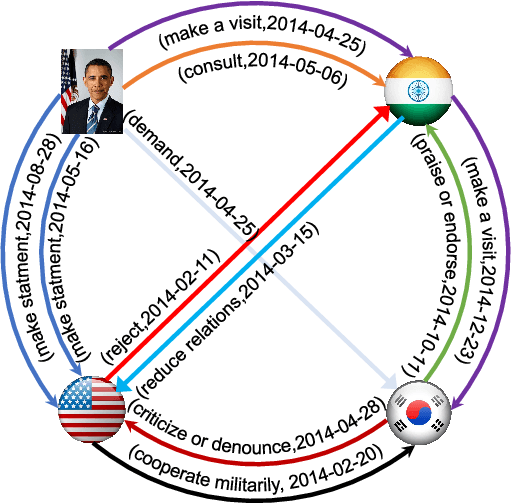
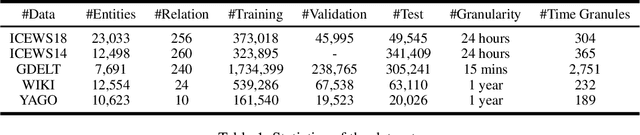
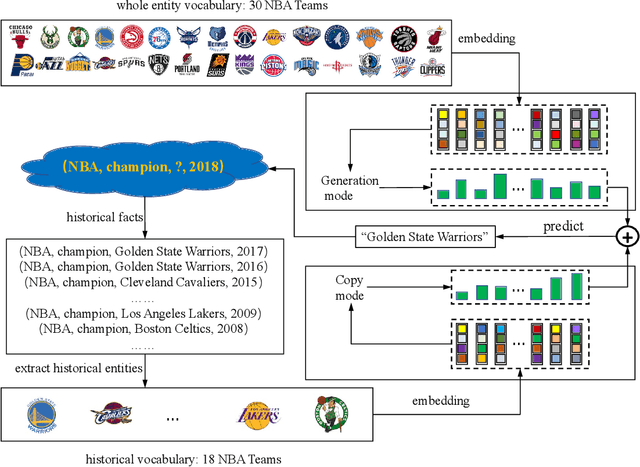
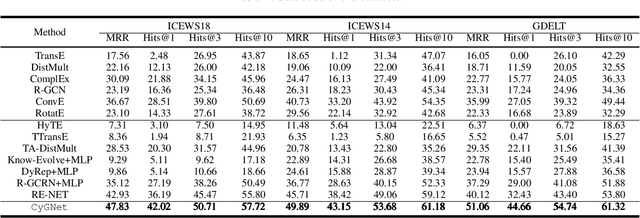
Large knowledge graphs often grow to store temporal facts that model the dynamic relations or interactions of entities along the timeline. Since such temporal knowledge graphs often suffer from incompleteness, it is important to develop time-aware representation learning models that help to infer the missing temporal facts. While the temporal facts are typically evolving, it is observed that many facts often show a repeated pattern along the timeline, such as economic crises and diplomatic activities. This observation indicates that a model could potentially learn much from the known facts appeared in history. To this end, we propose a new representation learning model for temporal knowledge graphs, namely CyGNet, based on a novel timeaware copy-generation mechanism. CyGNet is not only able to predict future facts from the whole entity vocabulary, but also capable of identifying facts with repetition and accordingly predicting such future facts with reference to the known facts in the past. We evaluate the proposed method on the knowledge graph completion task using five benchmark datasets. Extensive experiments demonstrate the effectiveness of CyGNet for predicting future facts with repetition as well as de novo fact prediction.