 Add to Chrome
 Add to Firefox
 Add to Edge
BladeYOLO: Wind Turbine Blade Defect Detection with Limited Annotations and Weak-Saliency Awareness
Jul 30, 2026
Wind turbine blade defect detection remains highly challenging in real-world inspection scenarios due to limited on-site data and the subtle visual characteristics of defects. In practice, blade defects are often small-scale, low-contrast, and difficult to distinguish from complex backgrounds, which significantly limits the robustness of existing detectors. To address these challenges, we propose BladeYOLO, a defect detection framework for wind turbine blades. Specifically, we integrate a Vision Transformer (ViT) backbone initialized with DINOv3 self-supervised pre-trained weights into YOLOv12-L, enabling the transfer of large-scale generic visual priors to blade defect detection and improving feature representation under limited training annotations. To enhance the perception of subtle defects, we further develop a Mamba-guided Weak-Defect Enhancement module, which consists of a Detail-Enhanced Multi-scale Branch for preserving high-frequency structural cues and a Cross-Mamba module for progressively propagating high-level semantic guidance to shallow features. In addition, we introduce a lightweight Style-Injector module that captures environment-related style information via Fourier decomposition and injects it into selected ViT self-attention layers, thereby improving robustness against environment-induced appearance variations. Extensive experiments demonstrate that BladeYOLO achieves superior performance on the WTBlade-Defect dataset, with additional annotation-budget experiments showing its favorable performance under reduced training annotations. Evaluation on the public Wind Surface Defect dataset further provides supportive evidence for the cross-dataset robustness of BladeYOLO. In particular, on this public dataset, BladeYOLO outperforms the best competing method by 3.5\% in mAP$_{50}$ and 2.5\% in mAP$_{50-95}$.

ImLoveNet: Misaligned Image-supported Registration Network for Low-overlap Point Cloud Pairs
Jul 02, 2022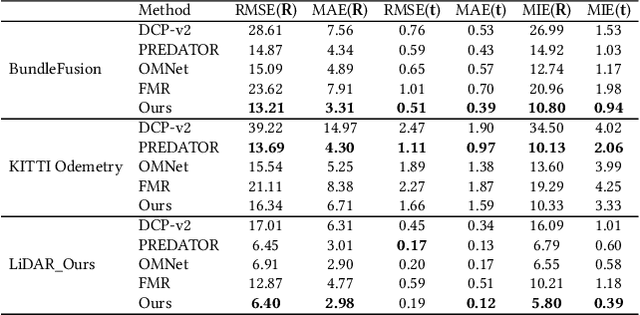
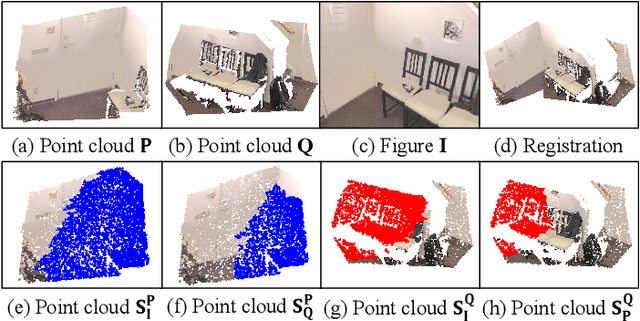
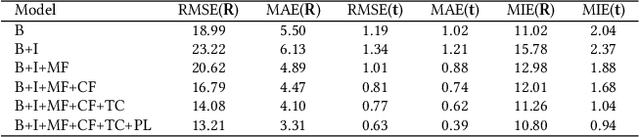
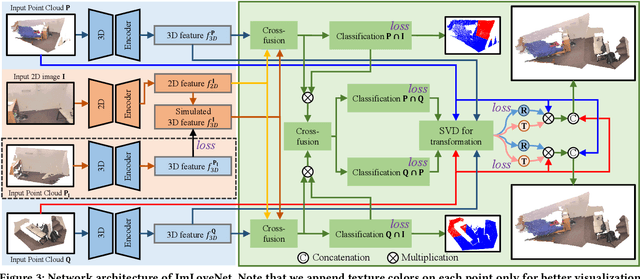
Low-overlap regions between paired point clouds make the captured features very low-confidence, leading cutting edge models to point cloud registration with poor quality. Beyond the traditional wisdom, we raise an intriguing question: Is it possible to exploit an intermediate yet misaligned image between two low-overlap point clouds to enhance the performance of cutting-edge registration models? To answer it, we propose a misaligned image supported registration network for low-overlap point cloud pairs, dubbed ImLoveNet. ImLoveNet first learns triple deep features across different modalities and then exports these features to a two-stage classifier, for progressively obtaining the high-confidence overlap region between the two point clouds. Therefore, soft correspondences are well established on the predicted overlap region, resulting in accurate rigid transformations for registration. ImLoveNet is simple to implement yet effective, since 1) the misaligned image provides clearer overlap information for the two low-overlap point clouds to better locate overlap parts; 2) it contains certain geometry knowledge to extract better deep features; and 3) it does not require the extrinsic parameters of the imaging device with respect to the reference frame of the 3D point cloud. Extensive qualitative and quantitative evaluations on different kinds of benchmarks demonstrate the effectiveness and superiority of our ImLoveNet over state-of-the-art approaches.
HRBF-Fusion: Accurate 3D reconstruction from RGB-D data using on-the-fly implicits
Feb 13, 2022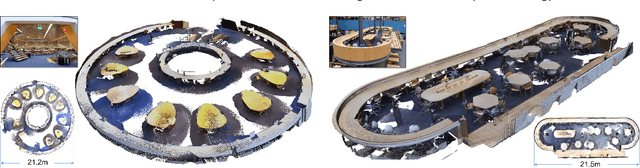
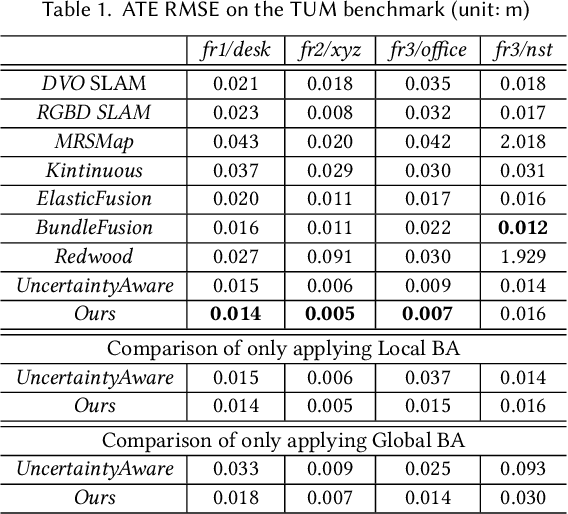
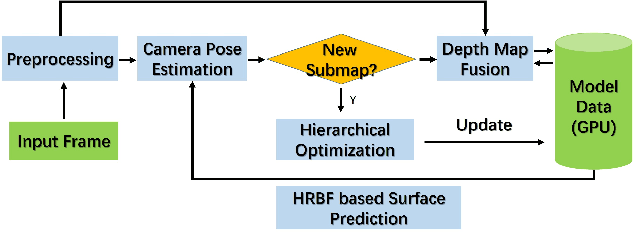
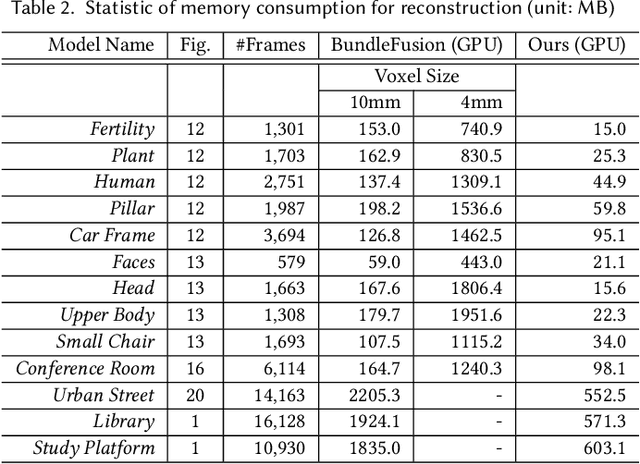
Reconstruction of high-fidelity 3D objects or scenes is a fundamental research problem. Recent advances in RGB-D fusion have demonstrated the potential of producing 3D models from consumer-level RGB-D cameras. However, due to the discrete nature and limited resolution of their surface representations (e.g., point- or voxel-based), existing approaches suffer from the accumulation of errors in camera tracking and distortion in the reconstruction, which leads to an unsatisfactory 3D reconstruction. In this paper, we present a method using on-the-fly implicits of Hermite Radial Basis Functions (HRBFs) as a continuous surface representation for camera tracking in an existing RGB-D fusion framework. Furthermore, curvature estimation and confidence evaluation are coherently derived from the inherent surface properties of the on-the-fly HRBF implicits, which devote to a data fusion with better quality. We argue that our continuous but on-the-fly surface representation can effectively mitigate the impact of noise with its robustness and constrain the reconstruction with inherent surface smoothness when being compared with discrete representations. Experimental results on various real-world and synthetic datasets demonstrate that our HRBF-fusion outperforms the state-of-the-art approaches in terms of tracking robustness and reconstruction accuracy.